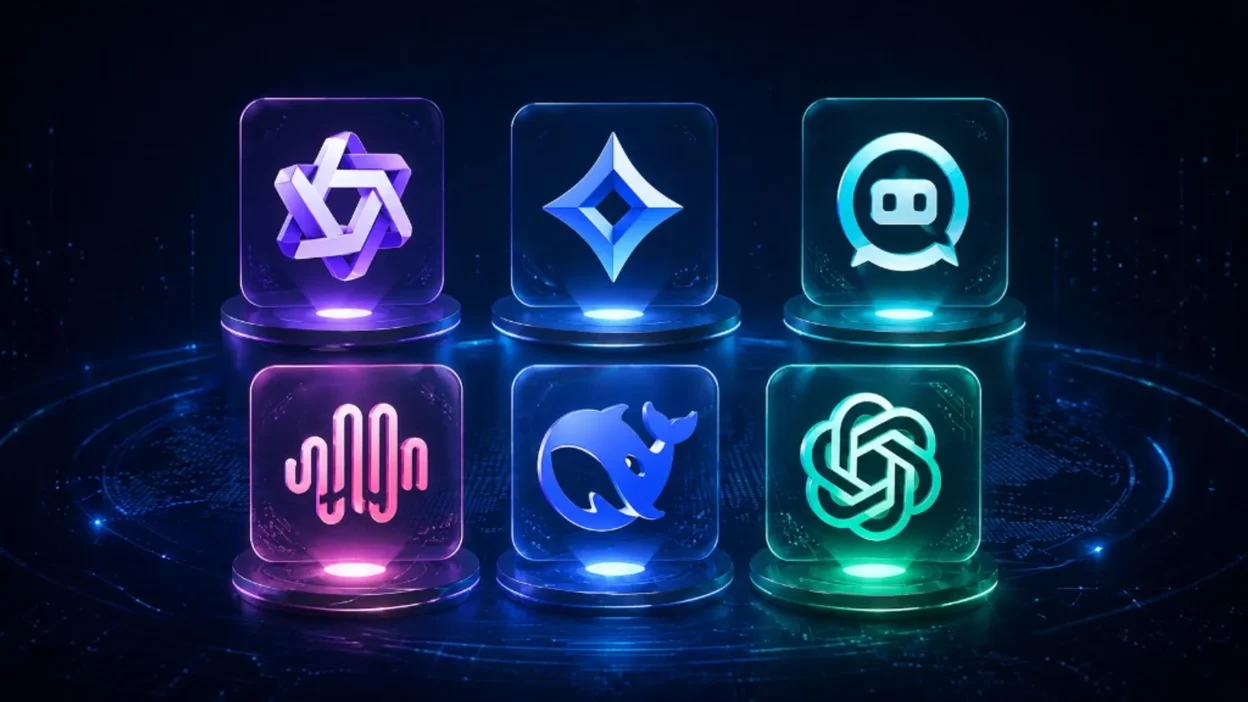
If you only read one local-model roundup this month, read this one with a budget lens, not a hype lens. In April 2026, the open-weight conversation has clearly shifted: Qwen 3.5 is still the broad recommendation baseline, Gemma 4 is one of the cleanest local deployment families, GLM-5 has pushed itself into top-tier open-weight rankings, MiniMax M2.5/M2.7 keeps surfacing for tool-heavy agent flows, DeepSeek V4 is now the current-generation anchor over V3.2 in API and open-weight discussions, and gpt-oss-20b remains a practical, low-friction local option for many teams.
How this list is ranked
This is not a synthetic one-number leaderboard. We rank by a weighted practical lens: real deployability (weights, runtimes, memory), agentic/tool behavior, coding usefulness, and ecosystem readiness (docs, integrations, model-card clarity). When a benchmark claim is vendor-owned, we label it as vendor-reported and point to first-party pages.
If you want broader context first, What Is Generative AI? and Generative AI use cases by industry frame the fundamentals. This page is explicitly about what to run locally in April 2026.
Top local models list: April 2026
1) Qwen 3.5: the broadest recommendation right now
Why it stays #1 in practical shortlists: the family breadth is unusually strong. You get multiple open-weight sizes (from small to very large), clear local runtime compatibility (Ollama, vLLM, llama.cpp, MLX), and a mature community around quantized variants. The official Qwen model cards and docs ecosystem keep this family easy to slot into both hobby and production experiments.
What changed recently: by 2026 this is no longer “one model,” but a menu. Teams can choose dense or MoE sizes based on latency and memory ceilings instead of forcing one giant checkpoint everywhere. That flexibility is exactly why Qwen 3.5 remains the “default suggestion” in many engineering circles.
Use it when: you need one model family that scales from laptop-class testing to heavier multi-GPU evaluation without rewriting your whole serving stack.
2) Gemma 4: the clean local-first family for many teams
Why it ranks high: Google positioned Gemma 4 explicitly for local and edge-friendly deployment across four practical sizes (E2B, E4B, 26B A4B, 31B), with published memory guidance and release notes that are easy to verify. For teams that value clear docs and predictable model-size progression, Gemma 4 is one of the least ambiguous choices in the open ecosystem.
What the buzz gets right: the smaller and mid-sized variants are very usable for real local iteration, not just toy demos. For many builders, Gemma 4 is the fastest path from “I want local AI” to “I have something running that my team can actually evaluate.”
Use it when: you want a reliable vendor-backed open family with explicit hardware trade-offs and strong local deployment ergonomics.
3) GLM-5 / GLM-4.7: now part of the top-tier open conversation
Why this matters: GLM-5 moved the GLM line from “interesting” to “must-test” in many open-weight ranking conversations, especially around coding and long-horizon agentic tasks. Official Z.AI materials position GLM-5 (and now GLM-5.1) as a major step over GLM-4.x. Third-party analysis platforms also reflect that jump, but treat those as independent snapshots, not universal truth.
Important nuance: GLM-4.7 is still relevant as a reference point and compatibility anchor, but if you are building new workloads in April 2026, GLM-5-era checkpoints are generally the higher-priority evaluation target.
Use it when: your benchmark plan emphasizes coding-agent performance and longer autonomous task loops rather than short single-turn chat quality only.
4) MiniMax M2.5 / M2.7: repeatedly cited for tool-heavy agent workflows
Why they’re on this list: MiniMax’s own release notes and model pages keep emphasizing coding, tool-use, search, and office-style multi-step tasks. M2.5 already had strong agentic framing; M2.7 pushes harder on “self-improvement” and complex tool-scaffold behavior. In practical terms, these models keep appearing in stacks where the model must call tools, iterate, and finish workflows, not just answer prompts.
Caveat: some headline benchmark narratives around M2.7 are still heavily vendor- or community-framed. Verify on your own scaffolding (OpenCode/OpenClaw/Claude Code style harnesses) before committing.
Use it when: your core objective is agent orchestration and tool invocation quality, especially in coding and operations-heavy pipelines.
5) DeepSeek V4 (with V3.2 context): update your baseline
Key update: if your mental model is still “DeepSeek V3.2 is the latest default,” update it. DeepSeek’s official API docs now center on deepseek-v4-pro and deepseek-v4-flash, including 1M context positioning, model migration guidance, and pricing tables. V3.2 remains important historically and can still appear in comparative discussions, but it is no longer the generation most teams should start with for new DeepSeek evaluations.
Why it remains top-cluster: DeepSeek’s open-weight + API combo still offers strong quality-per-cost narratives and high practical momentum in developer tooling.
Use it when: you want high-context open-weight capable models and you are willing to benchmark both Flash and Pro profiles against your own task mix.
6) GPT-oss-20b: practical local option, especially for constrained rigs
Why it keeps showing up: OpenAI’s own release positions gpt-oss-20b as the lighter open-weight sibling (alongside 120b), with native 128K context and deployment paths across common local runtimes/platforms. It is not usually framed as the absolute “best overall” model, but it is increasingly used as a realistic local baseline because hardware demands are manageable and the integration story is clear.
About uncensored variants: derivative “uncensored” checkpoints exist in the community. Treat them as separate risk surfaces (safety, reliability, compliance) rather than drop-in equivalents of the base model.
Use it when: you need a practical open-weight local model for iteration speed and acceptable quality, without stepping into ultra-heavy memory requirements.
DeepSeek update: V4 now, V3.2 as reference
Because you explicitly asked for version updates: yes, the DeepSeek baseline is now V4 generation in official API docs and model cards. The API docs emphasize deepseek-v4-pro and deepseek-v4-flash, and the pricing page explicitly documents the current token rates and temporary discount windows for Pro. So for this April 2026 list, V3.2 is context, V4 is action.
For deeper DeepSeek context already published on-site, see DeepSeek V4 preview, DeepSeek V4 Pro pricing and integration updates, and running DeepSeek V4 locally on Apple Silicon.
Pick by hardware and workload
| If your reality is… | Start here | Then graduate to |
|---|---|---|
| Laptop / tighter VRAM budget | Qwen 3.5 small-mid, Gemma 4 E2B/E4B, gpt-oss-20b | Gemma 4 26B A4B, Qwen larger dense/MoE sizes |
| Agentic coding and heavy tool calls | MiniMax M2.5/M2.7, GLM-5 | DeepSeek V4 Pro / larger GLM-5.x tracks |
| Need broad “one family for many tasks” | Qwen 3.5 | Pair with Gemma 4 or DeepSeek V4 for A/B eval |
| Long context and cost-sensitive experiments | DeepSeek V4 Flash | DeepSeek V4 Pro, GLM-5.1 by task criticality |
Three mistakes teams still make
- Picking by one benchmark screenshot: coding success in your repo shape matters more than generic scores.
- Ignoring deployment friction: “great model” plus painful runtime equals bad product velocity.
- Not separating base vs derivative checkpoints: especially for uncensored variants, evaluate safety/compliance independently.
If you need a compact workflow: shortlist 3 families, run one fixed eval harness for 7 days, and choose the model that produces the fewest expensive failures in your actual pipeline.
Benchmarks and rankings move fast. Re-check vendor and platform pages at publish time, especially for model revisions, context limits, and pricing.
Local AI Masterclass: LLMs, Diffusion & AI-Agents on Your PC
Available at Udemy — practical local-AI learning path (LLMs, diffusion, agents) you can combine with the model families listed in this article. Course title, curriculum, and price can change; verify details on the merchant page before purchase.
View course on UdemyFrequently asked questions
Is Qwen 3.5 still the safest “default pick” for local work?
For many teams, yes. The family breadth, runtime compatibility, and practical quantization ecosystem keep Qwen 3.5 near the top of broad recommendations.
Should I still start with DeepSeek V3.2 in new projects?
Usually no. Treat V3.2 as historical context; start evaluation from DeepSeek V4 generation unless you have a strict compatibility reason not to.
Are “uncensored” GPT-oss-20b variants equivalent to the base model?
No. They are derivative checkpoints with different risk profiles. Evaluate reliability, safety, and policy fit separately before any real deployment.
Which model should I benchmark first for agentic coding?
Start with one from each style: Qwen 3.5 (broad baseline), GLM-5 or MiniMax M2.7 (agentic push), and DeepSeek V4 Flash/Pro (context + cost profile). Keep the harness fixed and compare failure cost, not just pass rate.