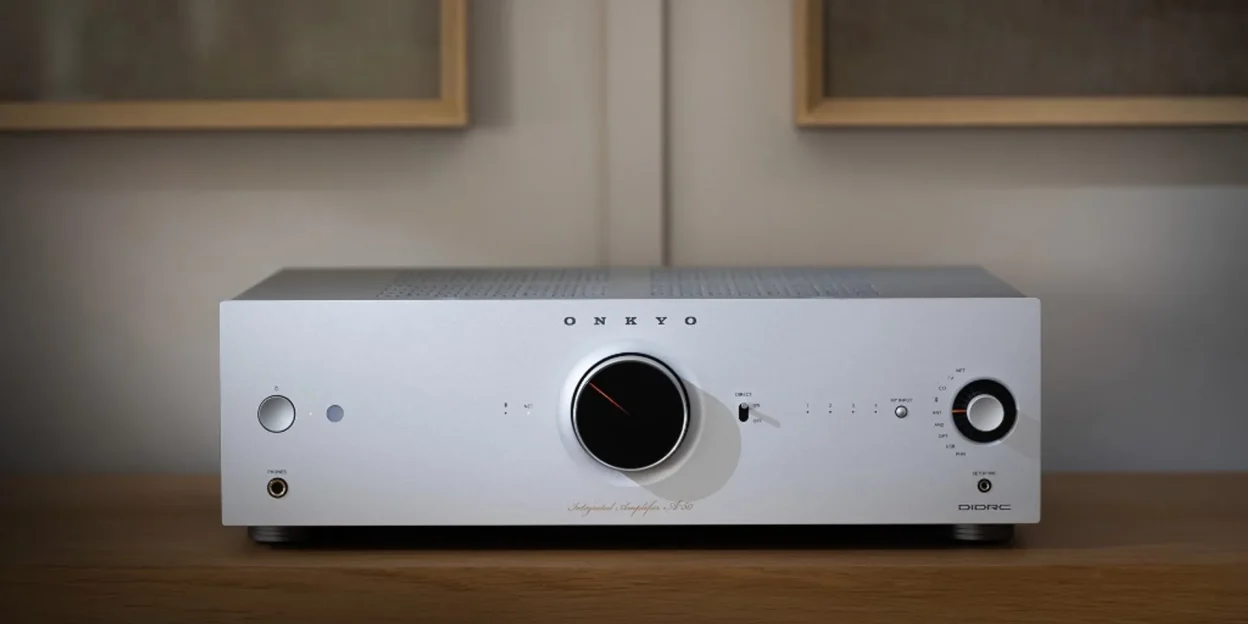
The Onkyo Icon A-50 is the network integrated amplifier slot in Onkyo’s Icon line: one chassis pitched at people who still want RCA and phono on the back, HDMI ARC for the TV, and cast-style streaming without hiding a separate streamer in another box. Onkyo’s product copy frames Icon as a brand reset not only a refresh of older hi-fi shapes but a stack that advertises Dirac Live room correction, a 32-bit / 768 kHz stereo DAC path, and a fan-less power layout built around an Inverted Darlington output stage.
Onkyo lists 180 W per channel into 4 Ω (1 kHz, 0.7 % THD, two channels driven) and 110 W into 8 Ω (20 Hz–20 kHz, 0.07 % THD, two channels driven). Inputs called out in marketing include three stereo RCA pairs, HDMI ARC, MM/MC phono, coaxial, optical, USB‑A, and a headphone jack, plus network streaming via Spotify Connect, TIDAL Connect, Qobuz Connect, Amazon Music, Qplay, TuneIn, AirPlay 2, Chromecast, and Roon Ready, with the Onkyo Controller app for setup. Dirac Live ships in a limited-bandwidth correction window unless you buy a full licence.
Icon series positioning
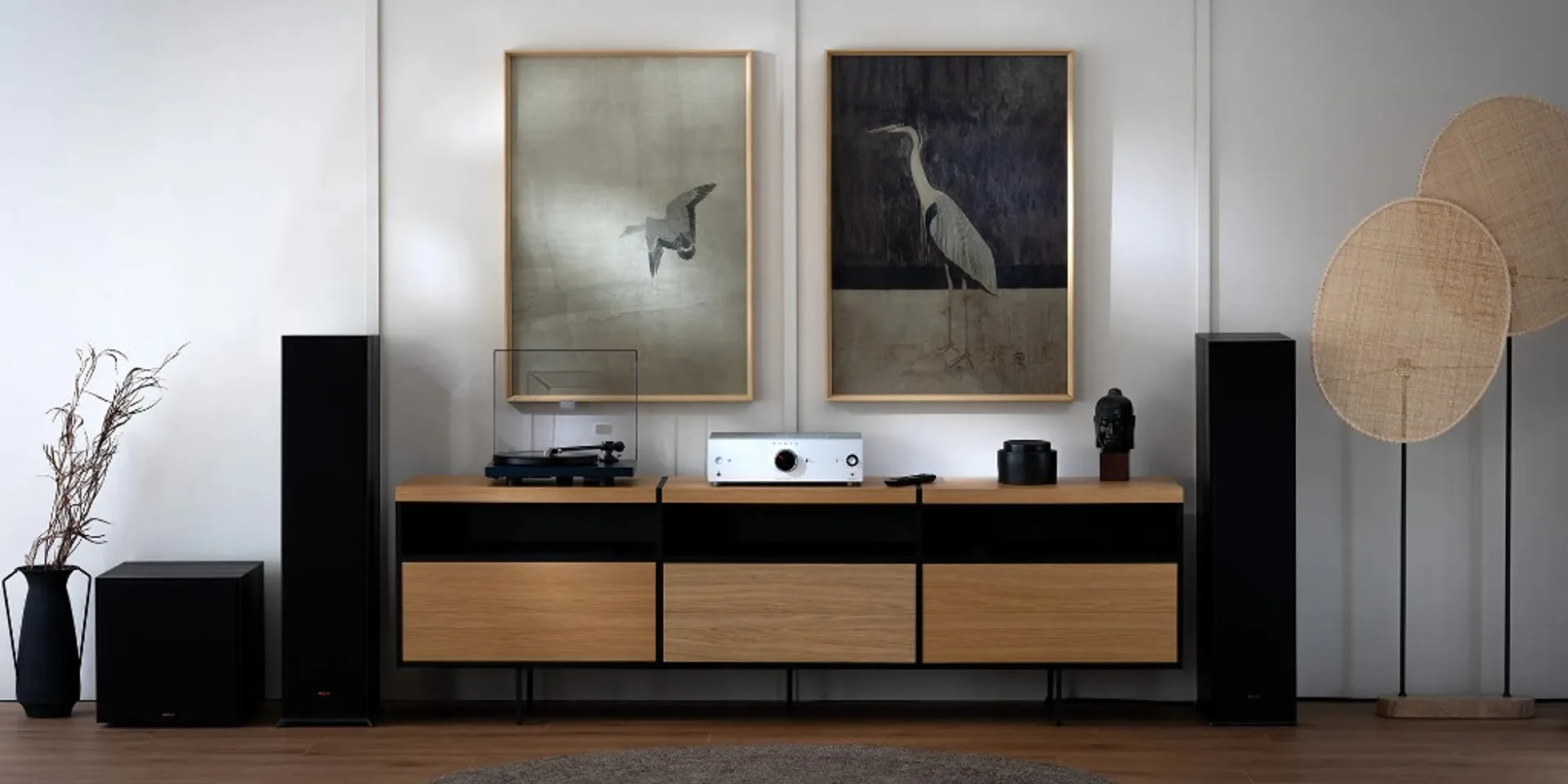
Onkyo describes Icon as the signature industrial and sonic statement for the current brand- a line that bundles accumulated tuning work into products meant to read as icons on the shelf, not anonymous black boxes. The A-50 sits in that narrative as the do-most-things integrated: enough amplifier headroom for floorstanders in the marketing copy, enough digital plumbing to behave like a network audio hub for people who still rotate vinyl and optical discs.
If you are already tracking Onkyo’s broader design experiments, the Creator Series desktop monitor skins piece is a different SKU family, but it shows the same instinct: retro-readable branding sold to people who care how hardware looks on camera.
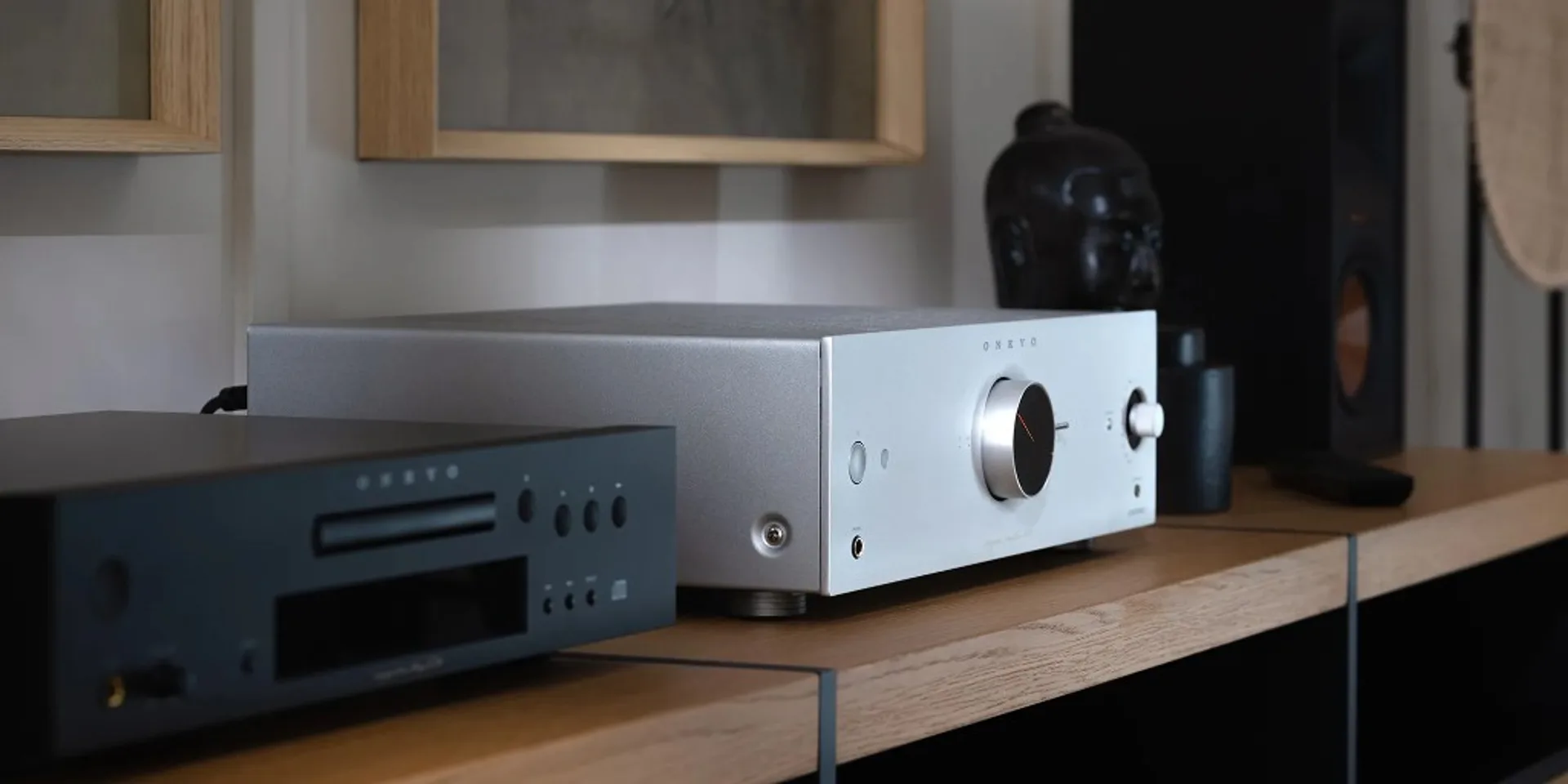
Amplification and mechanical story
Onkyo’s public accordion blocks spell out the A-50’s engineering talking points: a three-stage Inverted Darlington output section for high current with low distortion claims, DIDRC (Dynamic Intermodulation Distortion Reduction Circuitry) in the analog filter of the DAC, a 5 mm extruded aluminium front panel, an oval chassis with stamped lines to stiffen the base, fan-less cooling with an extruded heat sink, and 10 000 µF custom capacitors plus a copper bus bar to chase quieter supply behaviour.
The headline power sentence on the product page is explicit about different test conditions for the two headline numbers — narrower-band / higher THD for the 4 Ω figure versus full-band / tighter THD for the 8 Ω figure. That matters when you compare spec sheets side-by-side with competitors who cherry-pick a single asterisk pattern.
Inputs, streaming, and control
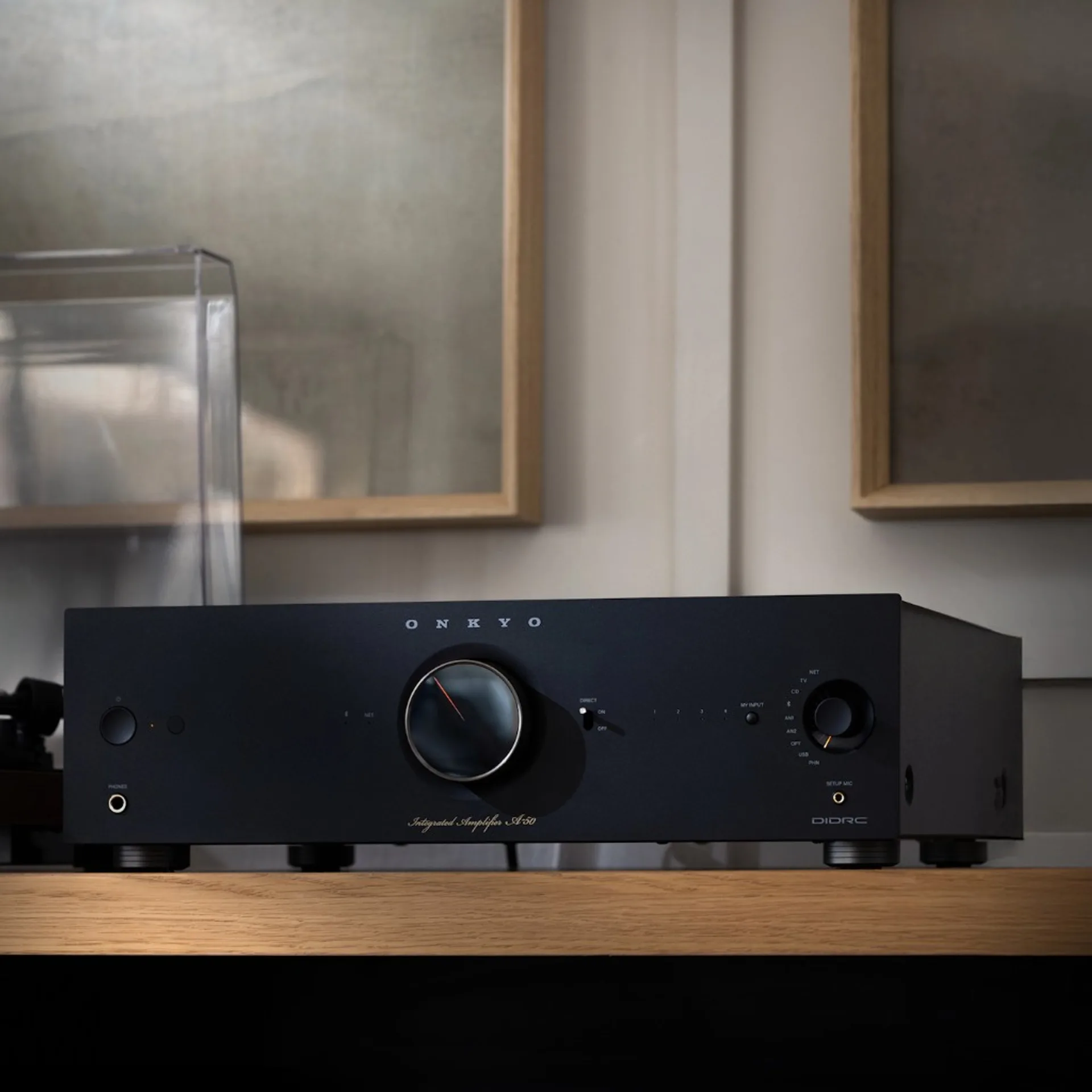
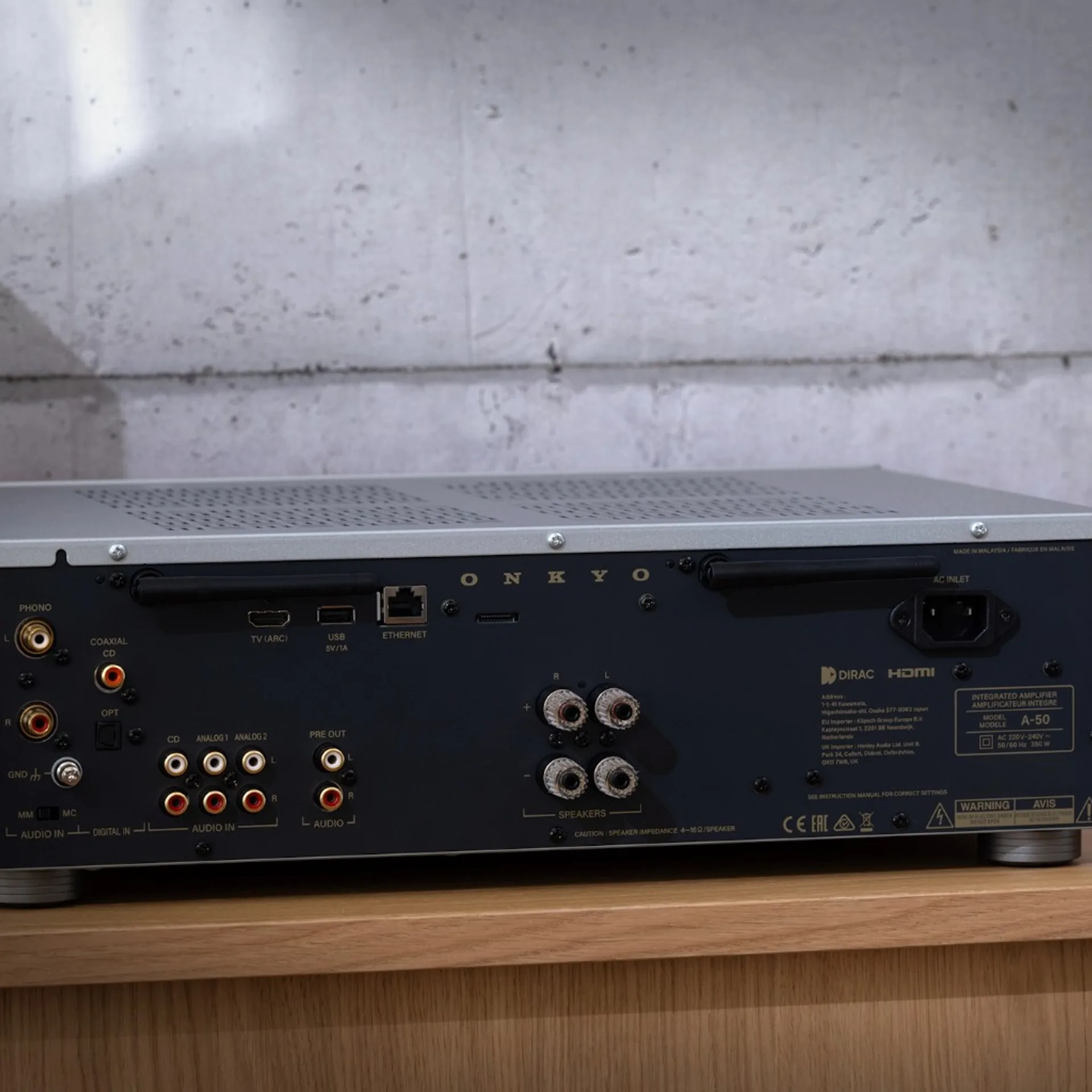
Marketing copy on the A-50 page promises a single-box living-room hub: hardwire turntables and CD transports while still casting from subscription services. The connectivity paragraph lists three RCA stereo pairs, HDMI ARC, MM/MC phono, coaxial, USB‑A, optical, and a headphone output. Parallel columns advertise cast/hardwire sources including Spotify Connect, TIDAL Connect, Qobuz Connect, Amazon Music, Qplay, TuneIn, AirPlay 2, Chromecast, and Roon Ready support, plus compatibility with the Onkyo Controller mobile app for day-to-day control.
For readers weighing integrated streamer + amp alternatives, our Eversolo Play CD Edition intro covers a different philosophy (disc ripping plus streaming in one tower), while Fosi S3 sketches the opposite extreme: compact separates logic at a fraction of the chassis size.
Dirac Live: what “built-in” actually means
Onkyo states that the A-50 includes the Dirac Live Room Correction Suite Stereo and spells out a split: limited frequency correction from 20 Hz to 500 Hz versus a licensed full-bandwidth version that requires purchasing a separate licence. The same block links to Onkyo’s Dirac explainer hub for readers who want the upgrade path before they buy.
Treat that footnote as a budget line item: room correction is only “free” until you need the bandwidth Dirac charges for.
Where it sits in the market map
Onkyo is clearly aiming the Icon stack at buyers who want Japanese big-box hi-fi manners — serious speaker taps, serious heatsinking, and streaming logos that reassure guests — without building a rack of half-width separates. The LEAK TruStream angle on Slow HiFi is a useful contrast: both products flirt with furniture audio, but TruStream is DAC-first while the A-50 is amplifier-first with network audio folded in.
Onkyo also surfaces first-party downloads at the bottom of the product page: region-specific spec PDFs, multilingual instruction manuals, setup guides, and a dated firmware update instruction PDF. Those files are the right place to confirm Bluetooth codecs, exact HDMI behaviour, and trim-level differences that marketing hero slides skip.
FAQ
Why do the 4 Ω and 8 Ω wattage figures use different THD and bandwidth notes?
Because Onkyo publishes them that way on the product page — the 4 Ω line is quoted at 1 kHz with 0.7 % THD, while the 8 Ω line is quoted across 20 Hz–20 kHz at 0.07 % THD. Compare competitors using the same footnote pattern, not raw headline watts alone.
Does Dirac Live cover the full audio band out of the box?
Onkyo’s page says the bundled correction is limited to roughly 20–500 Hz; a licensed upgrade unlocks full bandwidth. Read the Dirac room-correction explainer before you assume “Audyssey-class auto-eq everywhere.”
Where should I double-check codecs, HDMI version, and Bluetooth support?
Use the regional PDF spec sheet and the instruction manual linked from Onkyo’s product footer — those documents change when firmware or regional SKUs shift, while hero marketing text lags.
Does this page include speaker-matching or long-session listening notes?
No — it sticks to what Onkyo publishes about the A-50 today. Use your own ears and room once a unit is on the rack; treat the spec PDF and manual as the checklist before you commit money.
Note: PDF filenames include version stamps; if your dealer quote references an older revision, re-download the sheet the week you pay so voltage, warranty region, and HDMI claims still match the box.