
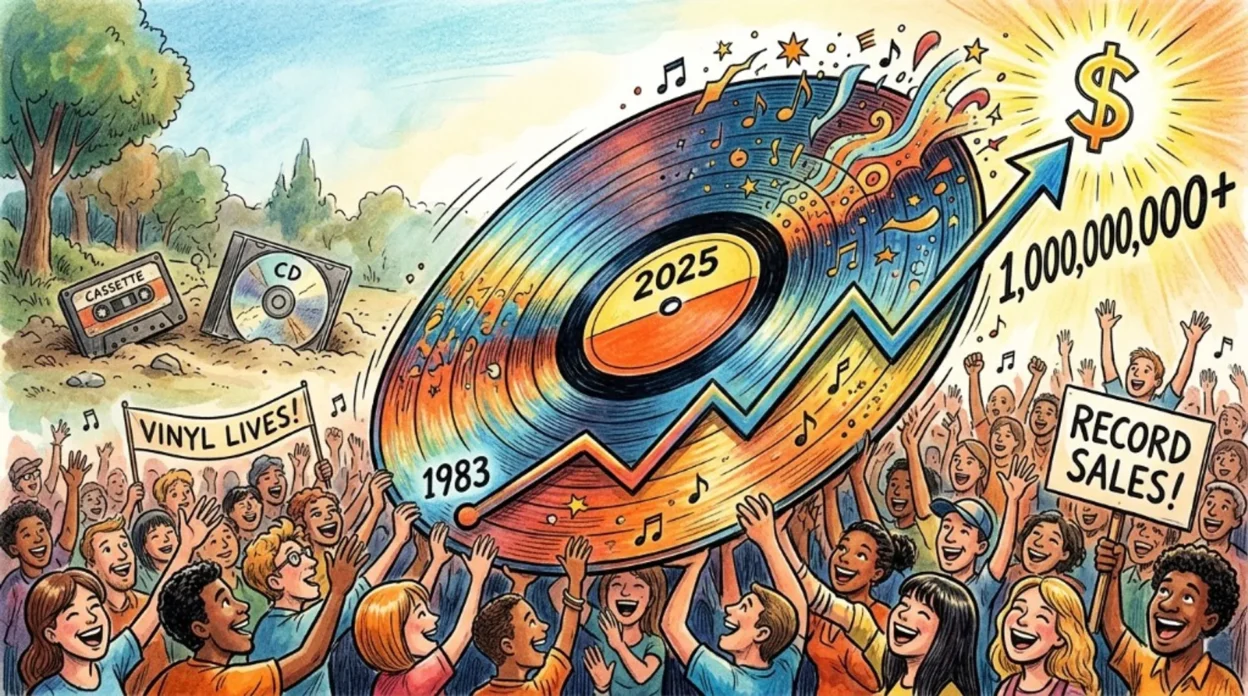
The Recording Industry Association of America (RIAA) publishes the closest thing the public gets to an official scoreboard for US recorded music. Its 2025 year-end report, released in March 2026, is the anchor for every headline about vinyl crossing one billion dollars in a single year. This piece walks through what that dollar figure actually measures, how vinyl sits next to streaming and CDs, and what it means if you care about turntables and records rather than quarterly earnings. Figures below follow the RIAA’s wholesale revenue basis unless noted; see the association’s news summary and the full 2025 revenue report (PDF).
What the RIAA counts (and what it doesn’t)
Industry reports are only as useful as their definitions. The RIAA is explicit that its recent figures are wholesale — money flowing through the label and distribution layer — not necessarily what you pay at a record shop or on a band’s D2C store. That matters when someone says “vinyl is a billion-dollar business.” It is, on the trade-revenue definition the RIAA uses to align with global reporting; it is not the same as adding up every fan’s sticker price.
The vinyl line item is defined as full-length vinyl albums, including direct and special-market sales. CDs are full-length albums on the same basis. Other physical captures CD singles, DVDs, cassettes, and similar SKUs so those sales sit outside the core LP vs CD album comparison.
Geography matters: this is United States revenue. A global listener market exists, but you cannot infer worldwide vinyl sales from this table alone. The RIAA’s narrative that the US represents nearly 50% of global vinyl value is a single-market dominance claim tied to their methodology; treat it as their framing of scale, not a consumer guide to pressing quality.
Headline numbers for 2025
The PDF tables give precise millions of dollars for 2024 and 2025. Rounded for readability:
- Total US recorded music (wholesale): about $11.54 billion in 2025 vs about $11.19 billion in 2024- roughly +3.1%.
- Total streaming: about $9.47 billion in 2025, up about +3.1% year over year.
- Paid subscriptions: 106.5 million accounts associated with about $6.4 billion in revenue; the RIAA highlights that paid streaming is about 55.3% of total US revenue. Premium paid subscription revenue grew about 6.8% to roughly $5.88 billion.
- Vinyl: 46.8 million units and about $1.043 billion wholesale — about +9.3% in dollars and +7.9% in units vs 2024.
- CD: 29.5 million units and about $312 million — down in both units and dollars vs 2024.
- All physical formats combined: about $1.38 billion, up about 5% — vinyl’s rise outpaced CD softness.
Doing the quick ratio: vinyl is roughly 9% of total US wholesale revenue in this report — small next to streaming, but material for pressing plants, retailers, and hardware ecosystems.
The vinyl milestone in context
Crossing one billion dollars in wholesale vinyl is as much a psychological threshold for headlines as an economic one. The more durable story is 19 consecutive years of growth in the format’s reported trade value: vinyl has long ceased to be a nostalgia blip and now behaves like a structured retail category with steady catalog reissues, deluxe editions, and ongoing fan spending on tangible goods.
The RIAA’s commentary ties that to labels diversifying touchpoints — streaming for reach, physical for object value and collector markets. You do not have to agree with every industry talking point to accept the empirical pattern: dollars and units in the LP row keep climbing while CD lines drift the other way.
RIAA leadership also cites broader economic footprint figures for music in the US (GDP contribution and jobs), with a link to the 50 States of Music project referenced from their release. Those macro numbers are not the same as the wholesale shipment tables; keep them mentally separate from per-format revenue.
Streaming is still the engine
Nothing in the 2025 report contradicts the long arc: on-demand access is the default for most listeners, and the money shows it. The RIAA states streaming at about 82% of total revenue for the fifth straight year, with paid subscriptions carrying the largest single slice. Free and ad-supported streams, other streaming categories (the report reorganised some line items in 2025), and the long tail of digital downloads fill out the rest.
For hi-fi readers, the interesting tension is unchanged: convenience scales to hundreds of millions of accounts, while vinyl scales to tens of millions of units — a different order of magnitude, but still growing. The two formats are complements in household behaviour more often than pure substitutes.
Physical: vinyl vs CD
The unit gap is stark: 46.8 million LPs against 29.5 million CDs. The revenue gap is wider still in proportional terms — the RIAA notes vinyl brought in more than three times the CD wholesale total. Average revenue per unit is not printed as a single line in the press release, but the table implies higher effective value per vinyl unit (new releases, deluxe pricing, and catalog SKUs skewing toward LP).
That does not mean CD is dead; it means CD is no longer the growth vector for physical in this data set. Collectors and car-and-kitchen listeners still move millions of discs; the trend lines simply favour grooves for now.
How to read this if you buy records
- Wholesale vs your receipt: Strong industry years do not guarantee your favourite title stays in print or drops in price; they describe aggregate trade flow.
- Hardware tailwind: Sustained LP unit growth supports continued entry-level turntable and upgrade markets. If you are new to the format, our vinyl explainer covers how playback works before you chase gear.
- Shopping reality: Pressing quality, mastering choices, and retail markups are not in the RIAA spreadsheet. The report tells you the trade is healthy; it does not rank which reissue sounds best.
- Compare carefully across years: The shift to wholesale reporting improves international comparability but means you should not casually stack old retail-based charts against 2025 without checking footnotes in the RIAA US sales database.
If you are weighing decks, our AT-LP70X vs AT-LP60X comparison stays on the spec-and-use axis rather than industry revenue — but the macro picture explains why new tables keep appearing at every price point.
FAQ
Did US vinyl sales really pass $1 billion in 2025?
On the RIAA’s wholesale definition, yes: the 2025 report shows about $1.04 billion in vinyl trade value. That is not the same as retail consumer spend summed across every store.
Is streaming dying because vinyl is up?
No. Streaming is still about 82% of US recorded music revenue in this report, with paid subscriptions the largest line. Vinyl growth is real but much smaller in absolute dollars.
How many LPs sold in the US in 2025?
The RIAA reports 46.8 million vinyl album units for 2025 vs 43.4 million in 2024.
Do these numbers include used vinyl?
The RIAA methodology targets trade revenue through reporting members and standard categories; used marketplace sales are generally outside this frame. Treat the data as new / trade-channel oriented unless the RIAA notes otherwise in their definitions.
Why does the press release say $11.5 billion but you wrote $11.54 billion?
The news article rounds to one decimal; the PDF table shows $11,535.3 million. Both refer to the same 2025 total.
Note: Figures and category definitions are summarised from RIAA materials dated March 2026 (2025 year-end). Reissue calendars and shop prices change weekly; use this as industry context, not a buying signal for a specific LP.