Fosi Audio sells several mono-channel boxes marketed as subwoofer amplifiers- plus one Bluetooth-first variant. They are not interchangeable: power supply headroom, switching amp silicon, filtering, and input choices change what each box is good at. This guide compares four current listings: TP-02, M04, M03, and M01-BT in plain language so you can match hardware to a passive sub, a salvaged woofer, or a second-room rig. Numbers and features below summarize manufacturer-published specs for each model; I have not bench-tested every SKU here. Treat watt badges as marketing ceilings unless you verify long-term thermal behavior in your load and ventilation.
What a mono sub amp actually does
A single-channel amplifier in this category usually sits after bass management: your AVR, processor, or miniDSP crosses over the main speakers and sends a mono line-level sub signal to the amp, which then drives a passive subwoofer or raw woofer in an enclosure. Many Fosi models also offer a PBTL or full-frequency mode so the same hardware can drive a single passive speaker channel (surround back, height, garage speaker) when you are not using it strictly as a sub amp.
If your sub already has a plate amplifier with RCA in, you do not need one of these boxes unless you are replacing a dead plate or building DIY.
How to read the wattage claims
Fosi (like most Class D consumer brands) lists peak-style numbers alongside RMS figures for some models. Real output depends on supply voltage, load impedance, heat sinking, and whether the signal is band-limited to the sub range. Use the table as a ranking hint, not a guarantee that your exact driver will see that power continuously at clipping edge.
At-a-glance comparison
Typical USD list figures at draft time — confirm at checkout on Amazon.
| Model | List | Amplifier IC | Inputs | Modes | Included PSU |
|---|---|---|---|---|---|
| TP-02 | $79.99 | TI TDA7498E + NE5532 | RCA | Sub or powered-sub wiring (per manual) | 24 V 4.5 A |
| M04 | $53.99 | Class D (Fosi cites 100 W @ 3 Ω max) | RCA | SUB or PBTL (full-range mono) | 19 V or 24 V SKU-dependent |
| M03 | $89.99 | TI TPA3255D2 | RCA | SUB vs PBTL; built-in LPF for sub band | 32 V 5 A (optional larger DC supply for max power) |
| M01-BT | $89.99 | TDA7498E | Bluetooth + RCA | SUB vs PBTL | 24 V 4.5 A typical; verify adapter label in box |
Fosi TP-02
The TP-02 is the most traditional “sub plate replacement” personality here: Texas Instruments TDA7498E, NE5532 in front, and marketing focused on a 220 W × 1 into 4 Ω subwoofer scenario with a 20 Hz–120 Hz band and 0.04 % THD at a stated test point. Fosi highlights dead-silent idle, aluminum chassis, and speaker protection circuitry. The current revision adds a dedicated sub-frequency trim compared with the older TP-02 revision- useful when you want to fine-tune overlap with mains without reopening the AVR menu.
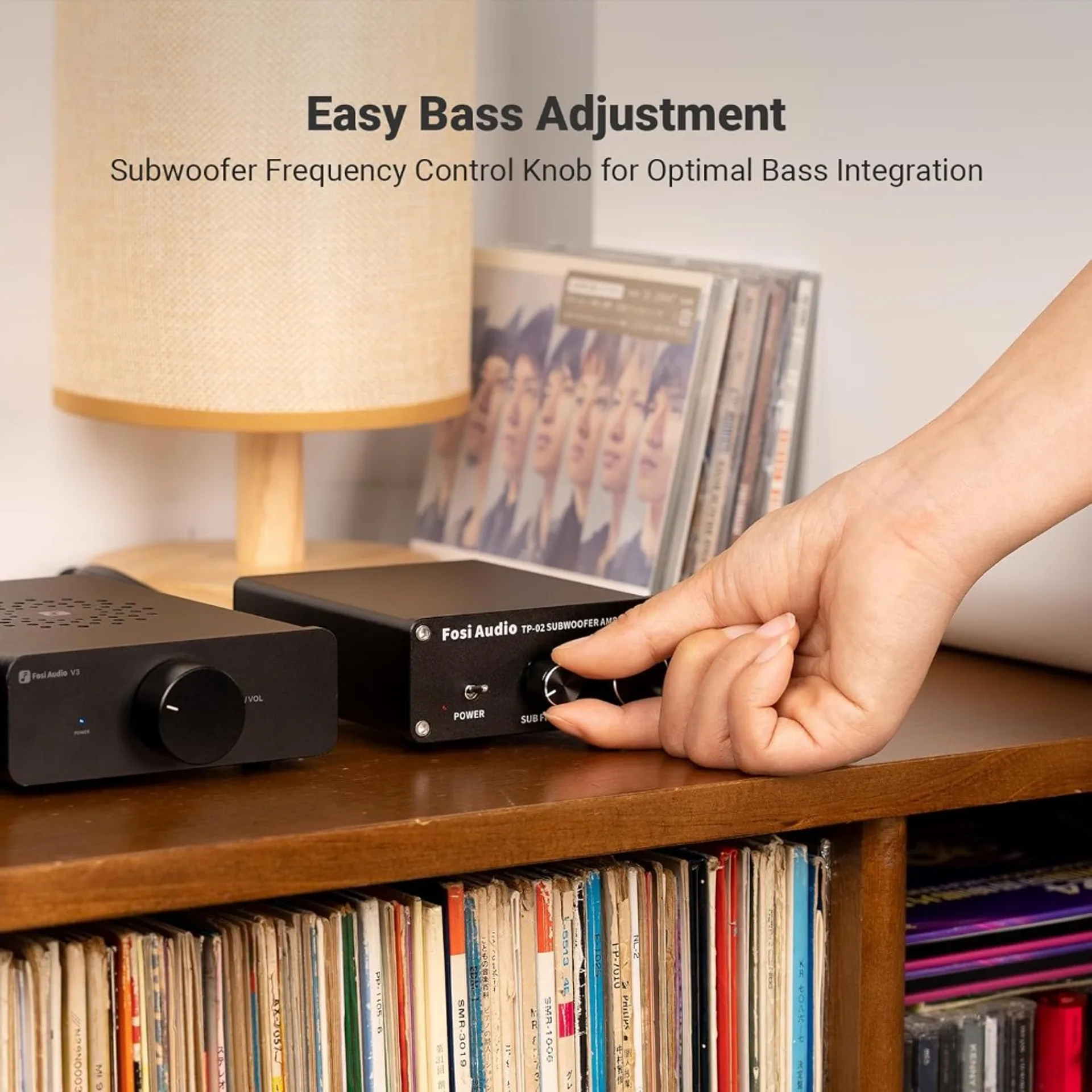
Electrical highlights from the spec table: RCA input, 2–8 Ω loads, ≥ 98 dB SNR, ≤ 280 mV input sensitivity, 12–24 V DC input window, 24 V / 4.5 A adapter in the box. Chassis size is quoted in inches on the product page for shelf planning.
Fosi M04
M04 is the smallest and least expensive option in this set: roughly 103 × 57 × 43 mm including knobs and only about 175 g. Fosi integrates the power switch into the volume control to save front-panel space. The SUB / PBTL switch selects between a low-passed subwoofer amplifier and a full-range mono block for passive speakers or unconventional wiring.
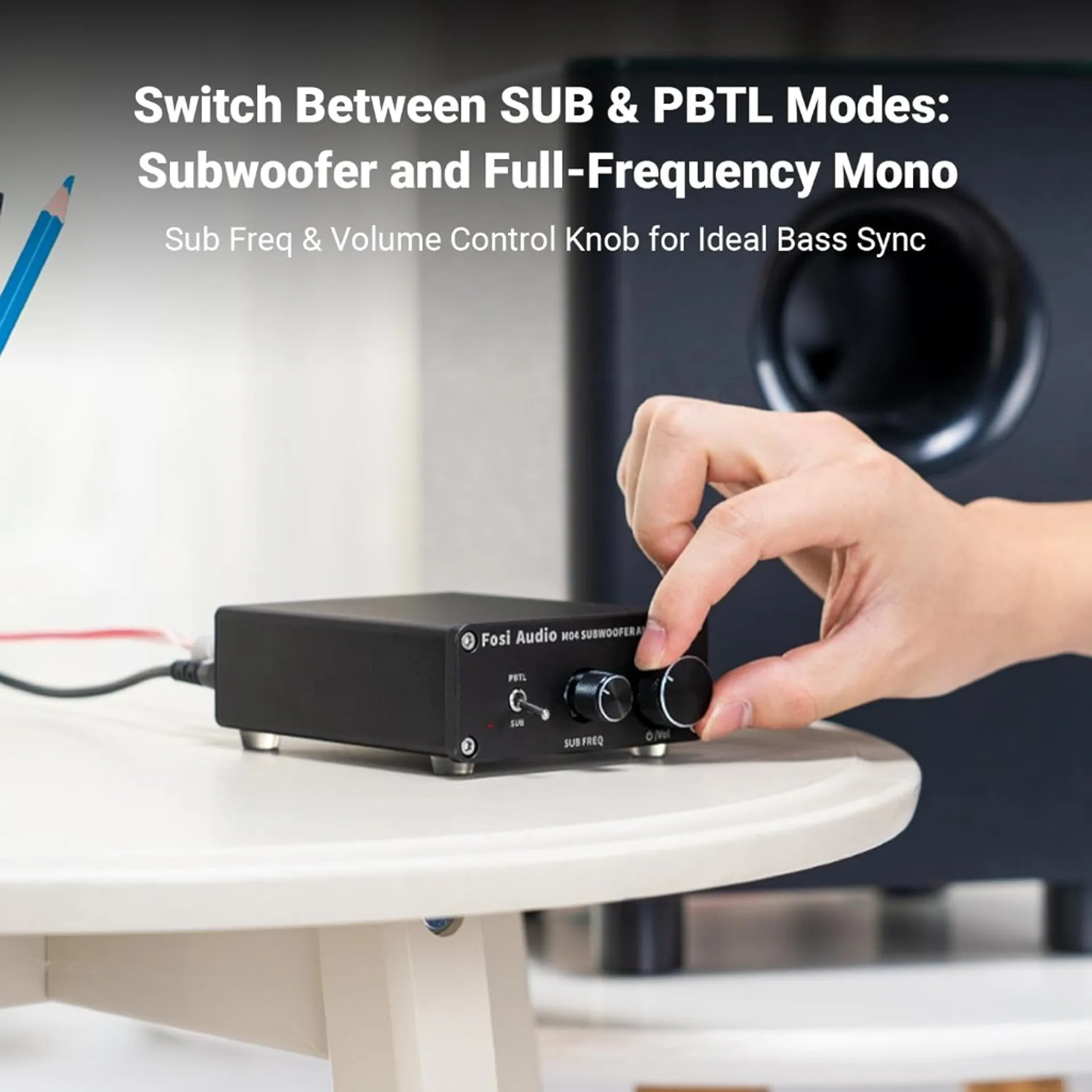
Specs worth noting: RCA in, 2–8 Ω supported, ≥ 102 dB SNR, ≤ 0.02 % THD at 1 kHz / 1 W, 600 mV input sensitivity, 20 Hz–20 kHz full-range window (±3 dB) with 20–200 Hz bass band called out for sub duty, and 100 W maximum at 3 Ω on Fosi’s sheet. You pick a 19 V or 24 V PSU SKU at purchase- the higher rail can matter for headroom into low-Z drivers.
Fosi M03
M03 steps up to TI’s TPA3255D2, which Fosi pairs with a 32 V / 5 A supply in the carton. Published RMS figures land around 150 W into 4 Ω and 120 W into 8 Ω, with headline 200 W maximum language on the page. There is a built-in low-pass filter for sub use with roughly 20–300 Hz adjustment in SUB mode; flip to PBTL for full-range mono into passive speakers or certain powered-sub wiring schemes as described on Fosi’s page.
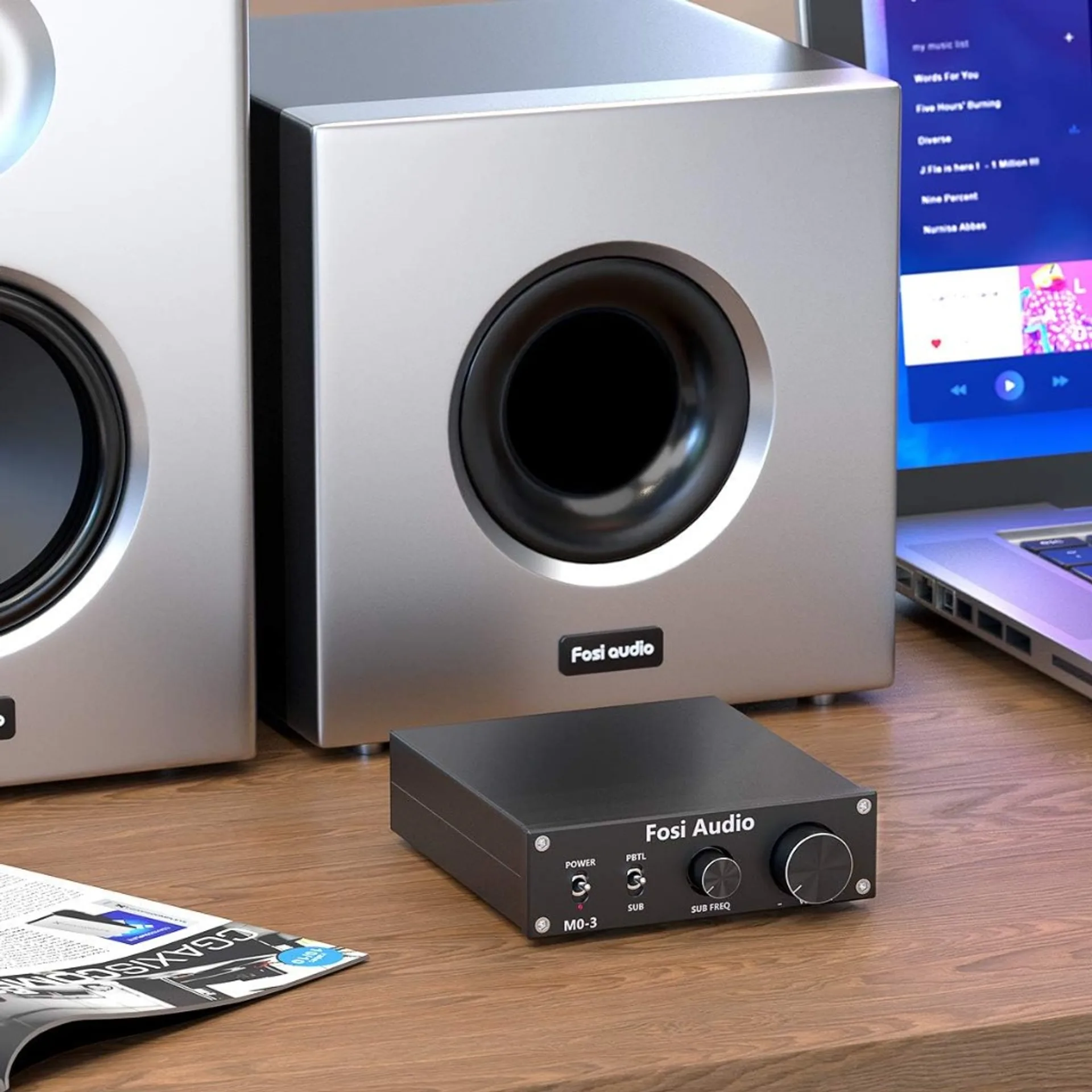
Fosi is transparent that chasing the absolute maximum power figure may require a stronger third-party DC supply than the bundled brick — budget for that if you plan to hammer high-SPL movie nights into a heavy driver.
Other table entries: ≥ 106 dB SNR, ≤ 0.03 % THD, 24–48 V DC input range, 4–8 Ω loads, 20 Hz–20 kHz full-range spec (±3 dB).
Fosi M01-BT
M01-BT mirrors the SUB / PBTL logic of the M03 family but adds Bluetooth alongside RCA, plus a pack-in Bluetooth antenna. The same TDA7498E marketing tier appears (300 W max language) with RMS 220 W @ 4 Ω / 110 W @ 8 Ω on the spec chart. Bass band is quoted 20–200 Hz; full-range window 20 Hz–20 kHz (±3 dB).
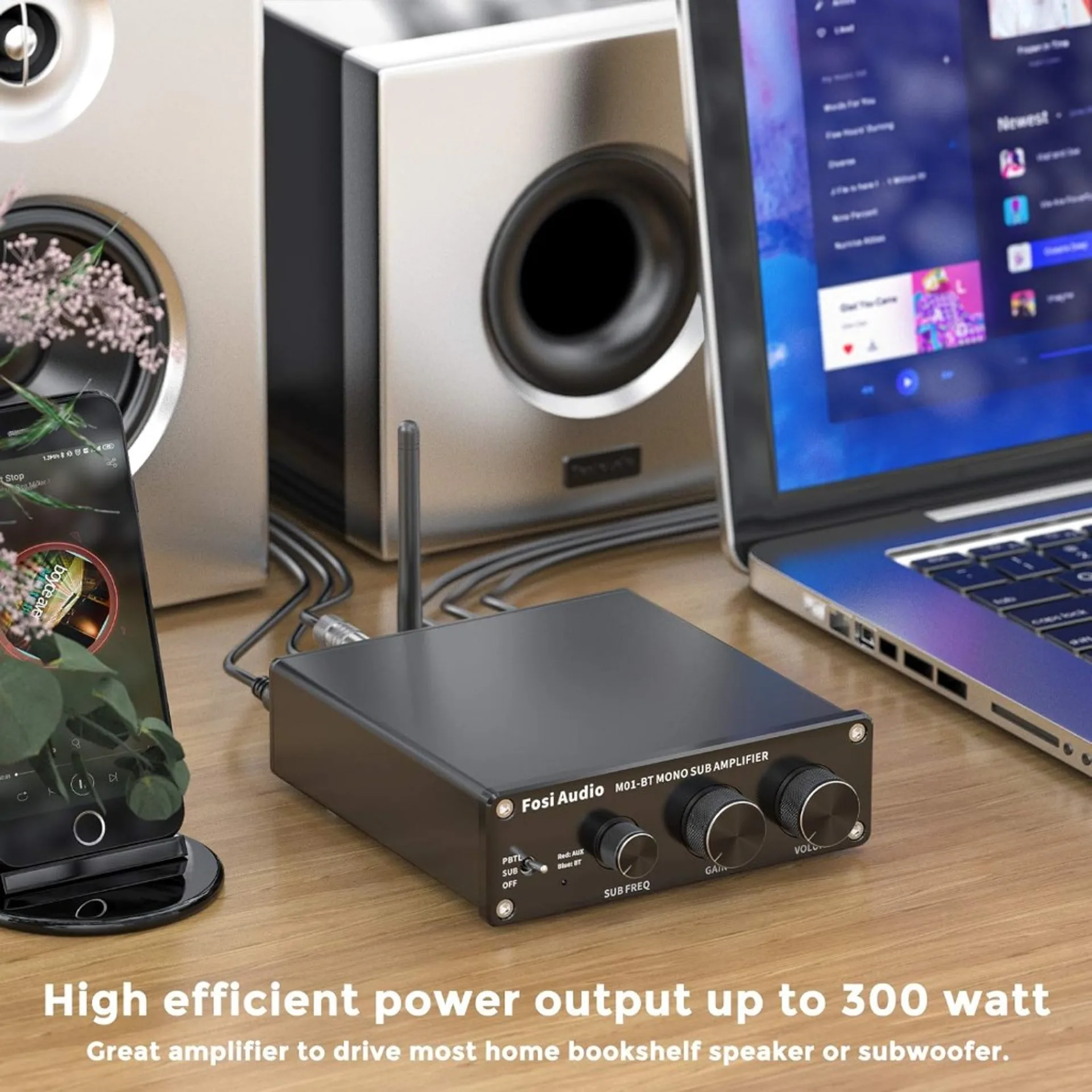
Critical compatibility note from Fosi: M01-BT is not suitable for active (powered) speakers as a drop-in — read that as a guardrail against naive wiring into self-powered monitors. It is aimed at passive subs, passive speakers in mono, and powered subs via the RCA path described on the product page.
Warranty copy on the listing mentions 18-month coverage in one bullet while the global Fosi footer still advertises 24-month support elsewhere — resolve at checkout for your region.
Which one should you buy?
- Choose TP-02 when you want a straight RCA sub amp with TDA7498E house sound, explicit sub-band marketing, and the extra sub-frequency knob on the new hardware revision — a strong default for AVR sub out → passive woofer.
- Choose M04 when size and cash dominate: in-wall shoves, nearfield experiments, or a second sub you do not want to over-invest in. Pick the 24 V SKU if you already know the load is hungry.
- Choose M03 when you need the strongest sustained narrative in this roundup for 4–8 Ω home-theater-style subs and you are willing to think about PSU upgrades later if you push limits.
- Choose M01-BT when Bluetooth is part of the story — garage, patio, workshop — and you respect Fosi’s no-active-speaker warning. Pair with a real volume strategy upstream so phone BT levels do not surprise you.
Power-up and wiring habits
Fosi’s own quick-start guidance on the TP-02 page stresses connection order for Class D supplies: DC barrel into the amp first, then AC to the wall, and RCA before power-on. They also explain that brief spark on first insert can be normal inrush into bulk capacitors when the procedure is wrong-way-around — still, if that makes you uneasy, power strips with switches downstream of a correct cable dress are your friend.
Banana plugs and torque tips live in Fosi’s global FAQ; all of these amps use the same 4 mm pin terminal story.
FAQ
Can any of these drive my powered subwoofer input?
These products are primarily about speaker-level output to passive loads. Some listings also describe RCA paths for powered subs in specific modes. Read the mode switch diagram on the exact listing before you rewire an existing powered cabinet.
Is Bluetooth on M01-BT low enough latency for video?
Expect typical Bluetooth codec delay. For lip-sync-critical HT, prefer RCA from the AVR or a wired transport.
Do I need a miniDSP if my AVR already has sub EQ?
Often no. Start with the AVR’s distance, level, and EQ tools. Add outboard DSP only if you hit room-mode problems the receiver cannot fix cleanly.
Why is M04 rated at 3 Ω for max power but the table says 2–8 Ω?
Fosi quotes peak power into 3 Ω as a highlight while still listing 2–8 Ω as the operating window. Treat the 3 Ω line as the stress case marketing number, not a recommendation to run unstable loads.
Note: If a listing’s box contents and spec table disagree on adapter voltage, trust the SKU you actually receive and the label on the brick. When in doubt, open a ticket with Fosi before powering rare drivers.