
Marshall’s headphone lineup has had a gap. Major V gives you the on-ear form factor and 100+ hours of battery—but no noise cancelling. Monitor III A.N.C. gives you ANC and spatial audio—but it’s over-ear, heavier, and $380. The new Milton A.N.C. fills the space between: on-ear, adaptive ANC, 80 hours without noise cancelling, 50+ with it, and a price tag of $229.99.
Where Milton fits in the lineup
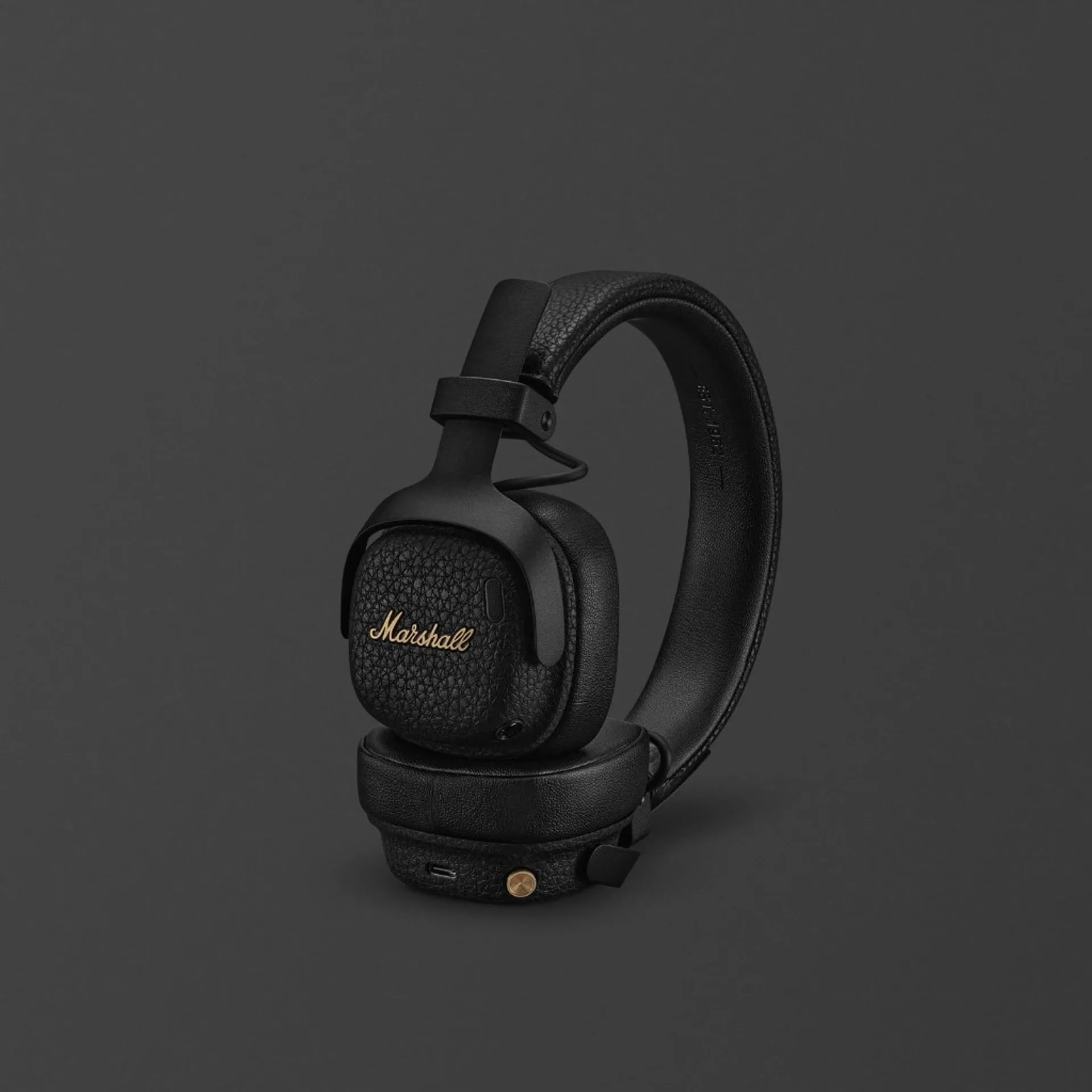
Marshall’s wireless headphone catalog currently has four on-shelf models: Minor IV (true wireless earbuds), Major V (on-ear, no ANC), Monitor III A.N.C. (over-ear ANC), and Motif II A.N.C. (ANC earbuds). Milton A.N.C. becomes the fifth—and the first to combine the on-ear form factor with active noise cancelling.
That distinction matters more than it sounds. On-ears breathe better than over-ears. Your ears don’t cook after a long session. But historically, that openness made noise cancelling less effective, so manufacturers skipped it. Marshall is betting that microphone arrays and adaptive algorithms have closed enough of that gap to make on-ear ANC worth shipping.
Marshall themselves position it clearly: lighter and more ventilated than Monitor III, but with the focus and isolation that Major V can’t offer. The ear cushions are larger than Major V’s—designed to improve both seal and comfort for longer wear.
The battery story
80 hours without ANC. 50+ hours with it on. At those numbers, this is a multi-week commuter headphone on a single charge—plug in once every ten days instead of every other night.
Quick charge is solid too: 15 minutes on the cable gives 9.5 hours. Forget to charge overnight, plug in while you make coffee, and you’re covered for more than a full workday.
For context: Major V quotes 100+ hours but has no ANC drawing power. Monitor III A.N.C. gets 70 hours with ANC on and 100 without, but it’s a bigger, heavier over-ear. Milton slots right between them on runtime—and right between them on price.
Adaptive ANC & transparency
Marshall calls the noise cancelling adaptive—the system uses multiple microphones to analyze ambient noise and adjusts cancellation automatically. You don’t cycle through strength levels manually; the headphones read the environment and respond.
Transparency mode pipes outside sound back in with a single press of the M-button. Marshall says Milton works particularly well in open offices and on commutes, where low-frequency noise dominates. That tracks with how most adaptive ANC systems perform: steady drones get cancelled effectively, sudden sharp sounds less so.
On-ear ANC will never isolate like a well-sealed over-ear cup. That’s physics. But the trade-off is less pressure on the ears and better awareness of your surroundings even in ANC mode—Marshall notes you’ll still hear someone calling your name nearby.
Codecs & wireless
Milton runs Bluetooth 6.0 with LE Audio support. Codec list: SBC, AAC, LC3, and LDAC.
LDAC matters if you’re streaming from an Android phone or a DAP that supports it—it pushes up to 990 kbps, well above SBC’s ceiling. LC3 is the LE Audio native codec: more efficient transmission at similar or better quality than SBC. AAC covers Apple devices.
Multipoint pairing is included, so you can stay connected to your phone and laptop simultaneously. Standard for this price range in 2026, but good to confirm it’s there.
Design & comfort
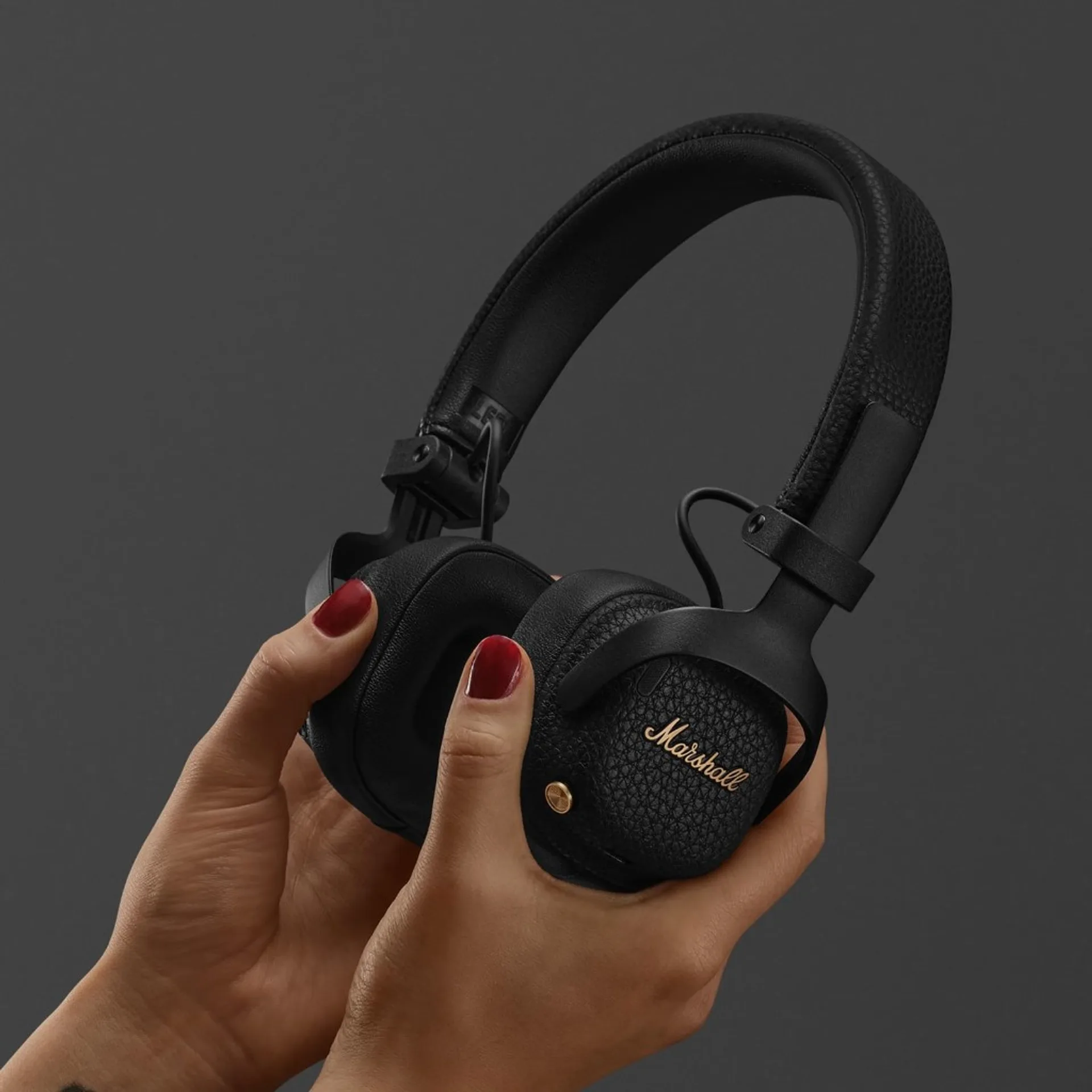
Foldable. That’s the practical headline. Milton collapses flat for bags and jacket pockets—same portability play as Major V, but with bigger ear cushions.
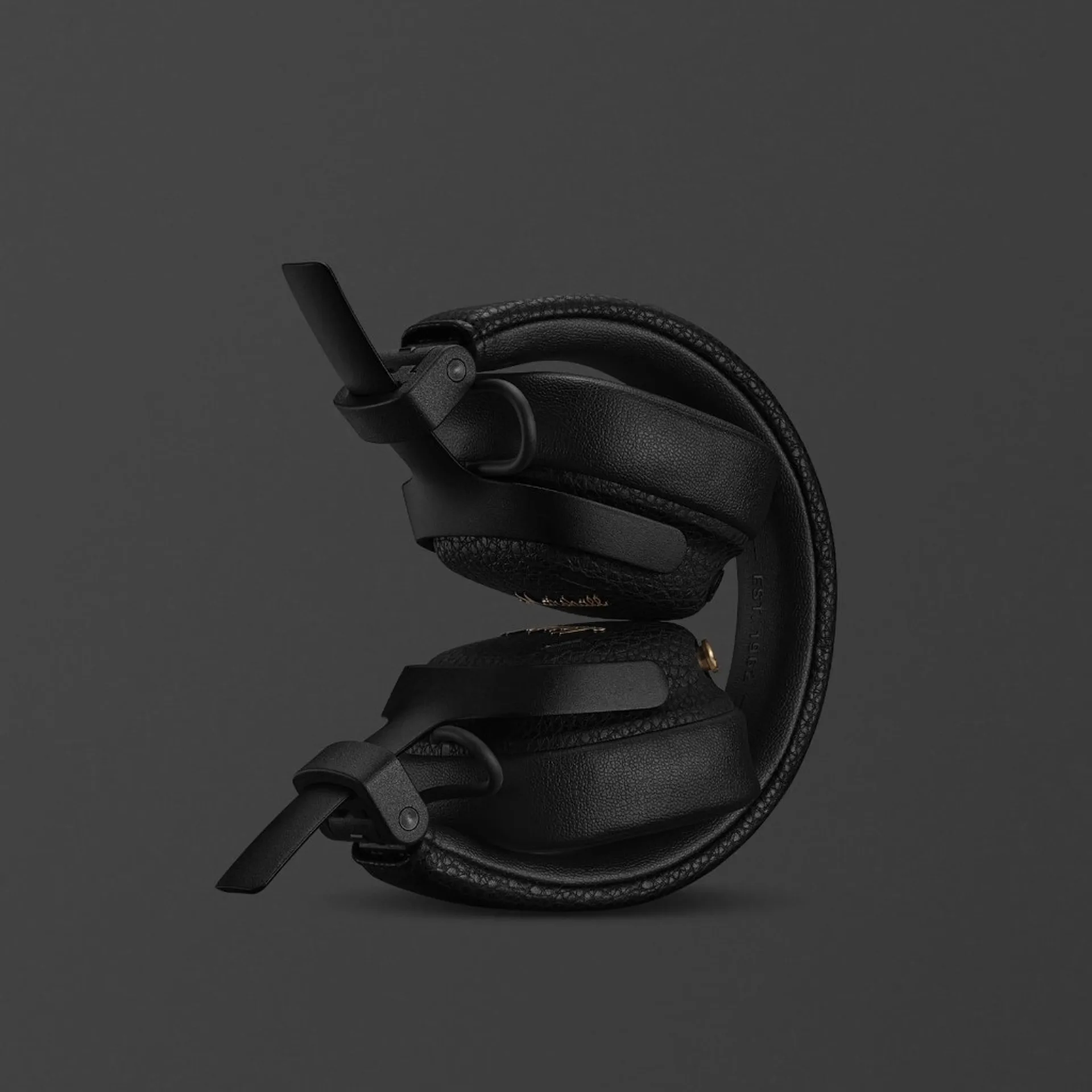
Marshall describes the cushions as memory foam, sized up from Major V specifically to improve the ANC seal and extend comfort for longer sessions. The headband is adjustable. A detachable cable option means you can go wired if battery runs out or if you want a physical connection for specific sources.
Visually, this is Marshall. Textured black, the script logo, brass-tone hardware details. If you’ve seen a Major V or Monitor III, you know the language.
Features worth knowing
Soundstage spatial audio
Marshall’s spatial processing DSP, also found on Monitor III A.N.C. It widens the perceived soundstage beyond the on-ear cups. How well it works varies by source material, but having it available through the M-button toggle means you can switch it on for music and off for podcasts without diving into the app.
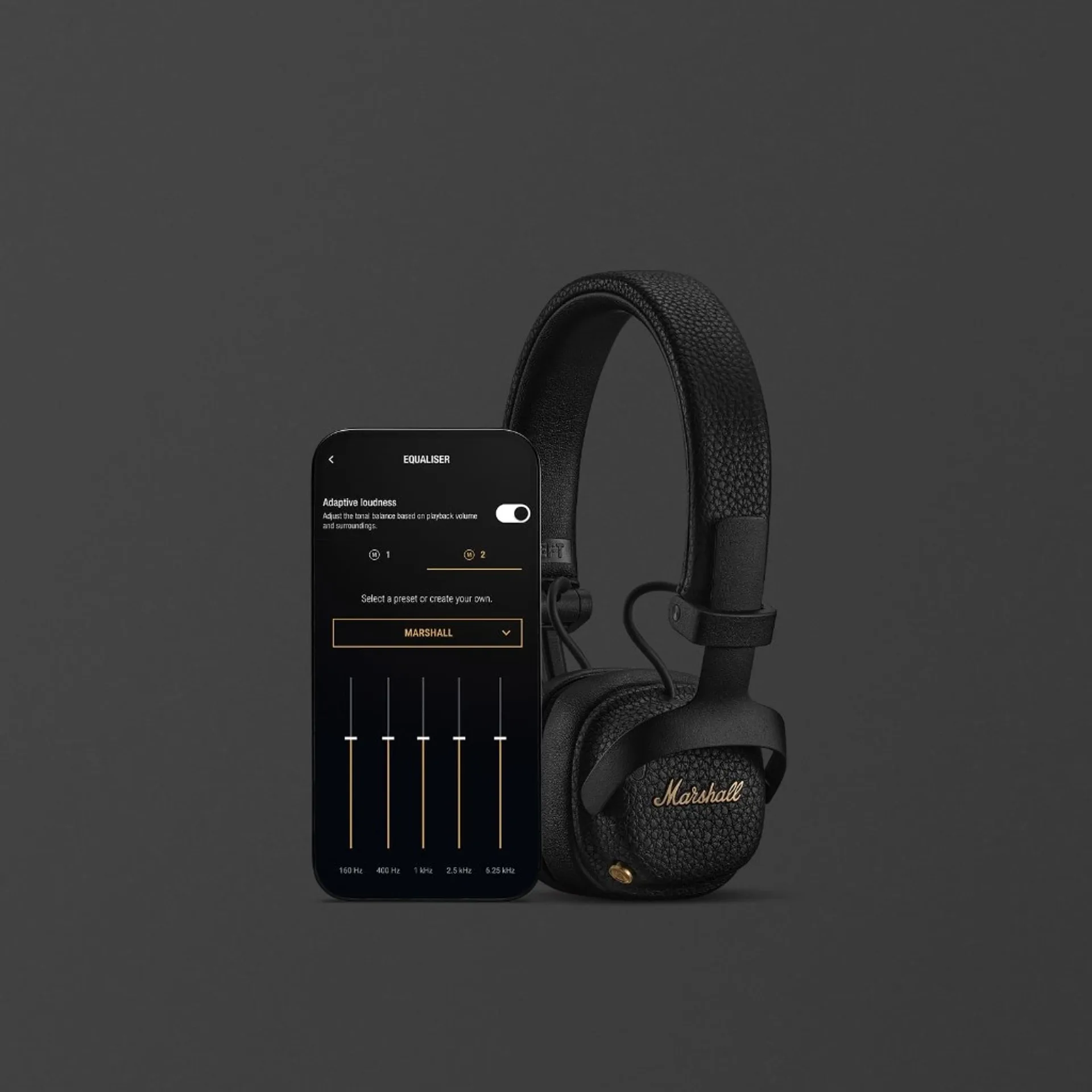
Adaptive loudness
When ambient noise rises, this feature lifts bass and lower mids to keep the detail audible without you cranking the volume knob. It’s a smarter alternative to just turning things up—your ears stay at a safer level while the perceived fullness compensates for background noise.
Customizable M-button
One physical button, six possible assignments: ANC, Transparency, Soundstage spatial audio, EQ preset, Spotify Tap, or voice assistant. You pick via the Marshall Bluetooth app. Spotify Tap is the fastest path to music if Spotify is your default—press the button, playback starts.
Sustainability & spare parts
Marshall states Milton A.N.C. contains 41% recycled material by weight. That includes post-consumer recycled plastics (PC/ABS, PC, ABS), recycled aluminum alloy, recycled rare-earth elements, recycled polyester, and recycled TPU. The figure excludes accessories and packaging.
More practically: Marshall now offers authorized repair and spare parts for the Milton. Battery, ear cushions, and USB-C cable are available directly through their site. Outer headband and jog assembly go through authorized service centers. That’s a genuine longevity commitment—the ear cushions especially, since foam degrades over a couple of years of daily use and replaceable pads extend the useful life significantly.
Spec summary
| Spec | Milton A.N.C. |
|---|---|
| Form factor | On-ear, foldable |
| ANC | Adaptive active noise cancelling + Transparency mode |
| Battery (ANC on) | 50+ hours |
| Battery (ANC off) | 80 hours |
| Quick charge | 15 min → 9.5 hours |
| Bluetooth | 6.0 with LE Audio |
| Codecs | SBC, AAC, LC3, LDAC |
| Multipoint | Yes |
| Spatial audio | Soundstage (DSP) |
| Detachable cable | Yes |
| Recycled material | 41% by weight |
| App | Marshall Bluetooth |
| Price (US) | $229.99 |
Who this is for
If you like Major V’s portability but wish it had noise cancelling, Milton is the direct answer. Same on-ear shape, now with adaptive ANC and upgraded ear cushions.
If you want Monitor III’s features but find over-ears too warm or heavy for daily commuting, Milton trades some isolation depth for ventilation and lighter weight—at $150 less.
If you need absolute maximum ANC performance and don’t mind an over-ear seal, Monitor III (or Sony / Bose) still wins on raw isolation. Physics doesn’t change because the logo is cool.
At $229.99, Milton sits in a competitive bracket. It’s not the cheapest ANC on-ear, but the battery life, LDAC, LE Audio, and spare-parts program give it a distinct identity. The open question is how much cancellation adaptive ANC can squeeze from an on-ear seal—the spec sheet says yes, physics says there are limits.

Availability
Marshall Milton A.N.C. is available now in Black at $229.99 through marshall.com and select retailers. Marshall lists free delivery with 1–3 business day shipping in the US.
FAQ
How does Milton ANC compare to Major V?
Both are on-ear and foldable. Major V has longer battery (100+ hours) but no ANC. Milton adds adaptive noise cancelling, transparency mode, soundstage spatial audio, and adaptive loudness. Milton’s ear cushions are also larger than Major V’s. Major V is cheaper; Milton costs $229.99.
How does Milton ANC compare to Monitor III ANC?
Monitor III is over-ear with longer ANC battery (70 hours vs 50+) and stronger passive isolation due to the larger cups. Milton is lighter, more ventilated, and $150 less. Both have adaptive ANC, soundstage spatial audio, and the customizable M-button.
Does Marshall Milton ANC support LDAC?
Yes. Milton supports SBC, AAC, LC3, and LDAC. LDAC pushes up to 990 kbps, which is the highest-quality Bluetooth codec in the lineup. You’ll need an LDAC-capable source (most modern Android phones and some DAPs).
Can I replace the ear cushions?
Yes. Marshall offers ear cushions, battery, and USB-C cable as spare parts through their website. Headband and jog assembly replacements are handled by authorized service centers.
Is there a wired option?
Milton A.N.C. includes a detachable cable for wired listening. Useful as a battery backup or when connecting to sources that don’t support Bluetooth.