
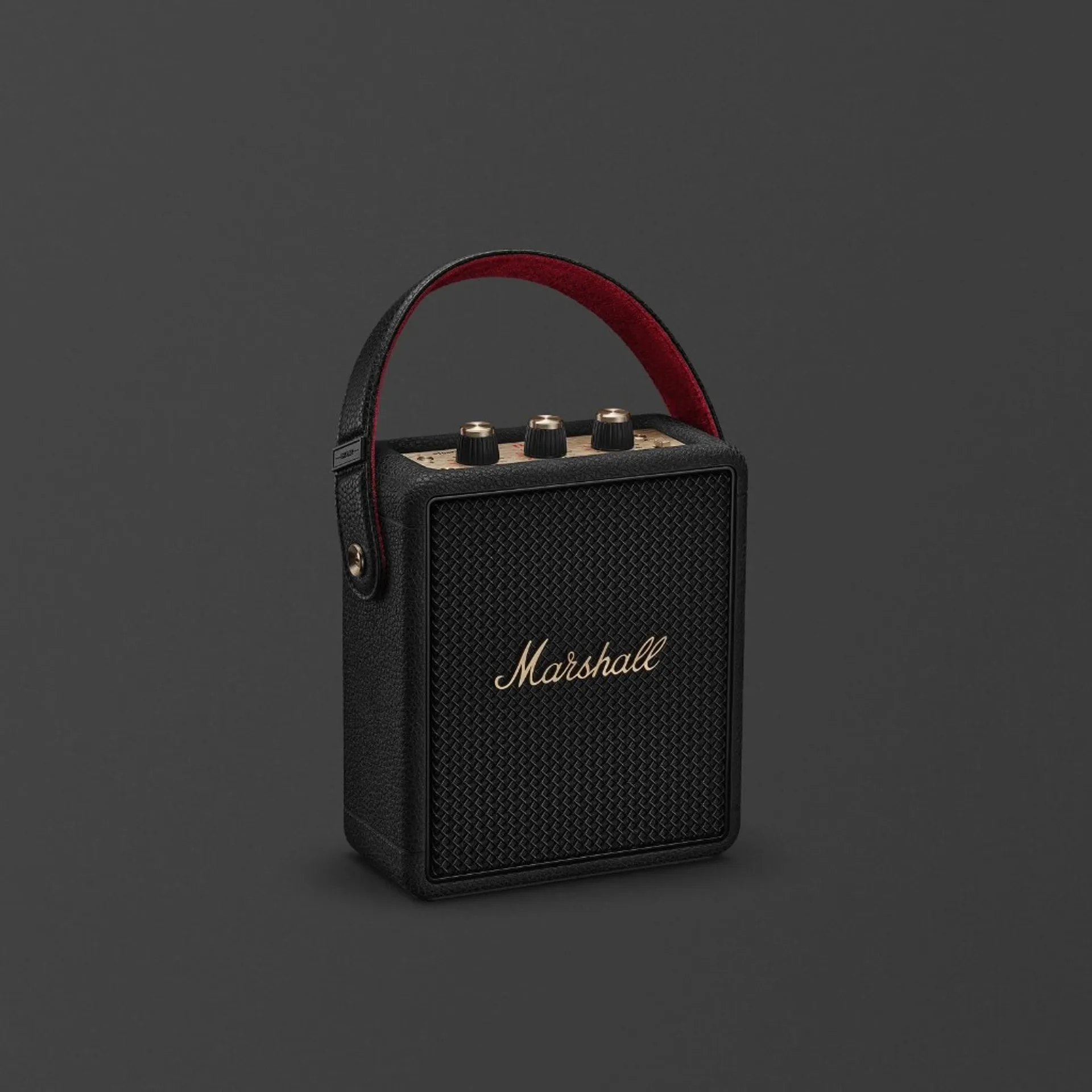
Marshall Stockwell III is the long-awaited refresh of the brand’s vertical portable line: still a mini amp on a strap, but now built around 40+ hours of quoted playtime, IP55 dust and splash resistance, and the same True Stereophonic 360° positioning Marshall uses on larger portables. Where Stockwell II topped out at 20+ hours and IPX4 with no app support, Stockwell III adds Marshall Bluetooth control, Bluetooth 5.3 with Auracast, a user-replaceable battery, and a refreshed brass control deck with an M-button and media jog.
Where Stockwell III sits in Marshall portables
Marshall’s portable catalog spans pocket-scale (Emberton), mid-size grab-and-go (Stockwell, Middleton), and larger handle-first boxes (Kilburn, Tufton). Stockwell III stays in the slim vertical niche: small enough for a shelf or bag, loud enough for a desk or patio circle, and visually unmistakable as a Marshall amp rather than a generic cylinder.
The generational jump matters because Stockwell II aged on paper: splash-only weather sealing, no Marshall app, and battery life that felt generous in 2019 but looks modest next to current portables. Stockwell III closes those gaps without abandoning the strap-and-grille identity that made the line recognizable.
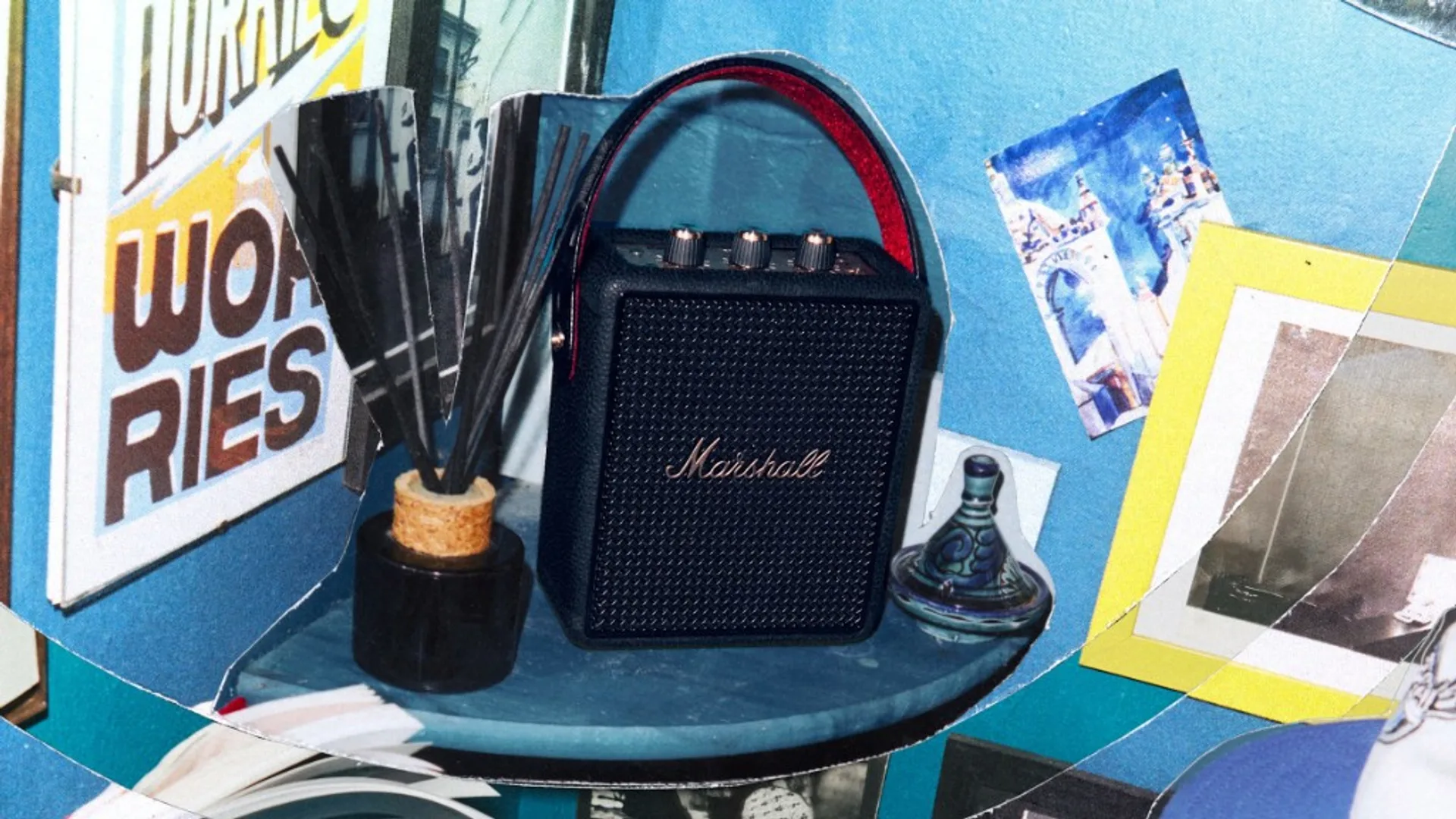
True Stereophonic, Dynamic Loudness, and SPL
True Stereophonic is Marshall’s label for multi-directional stereo from a single cabinet: the pitch is that listeners standing around the speaker get a coherent image instead of fighting for a front-row sweet spot. On Stockwell III that pairs with a three-driver layout (woofer plus two wide-band units) and sealed enclosure tuning with a passive radiator.
Dynamic Loudness is Marshall’s volume-aware EQ: at low levels bass and treble lift to preserve detail; as you turn up, the curve settles so the mix does not feel artificially hyped at party volume. It is the same class of feature Marshall uses elsewhere to keep small speakers listenable on a kitchen counter without cranking SPL.
Marshall lists 86 dB SPL @ 1 m maximum for Stockwell III. Treat that as a manufacturer ceiling under their test conditions, not a guarantee of how loud it feels outdoors with wind and conversation. For context, this is a compact portable, not a Bromley-class party rig; our Bromley 450 intro covers Marshall’s higher-SPL outdoor party tier if you need more headroom.
Amp-inspired design and controls
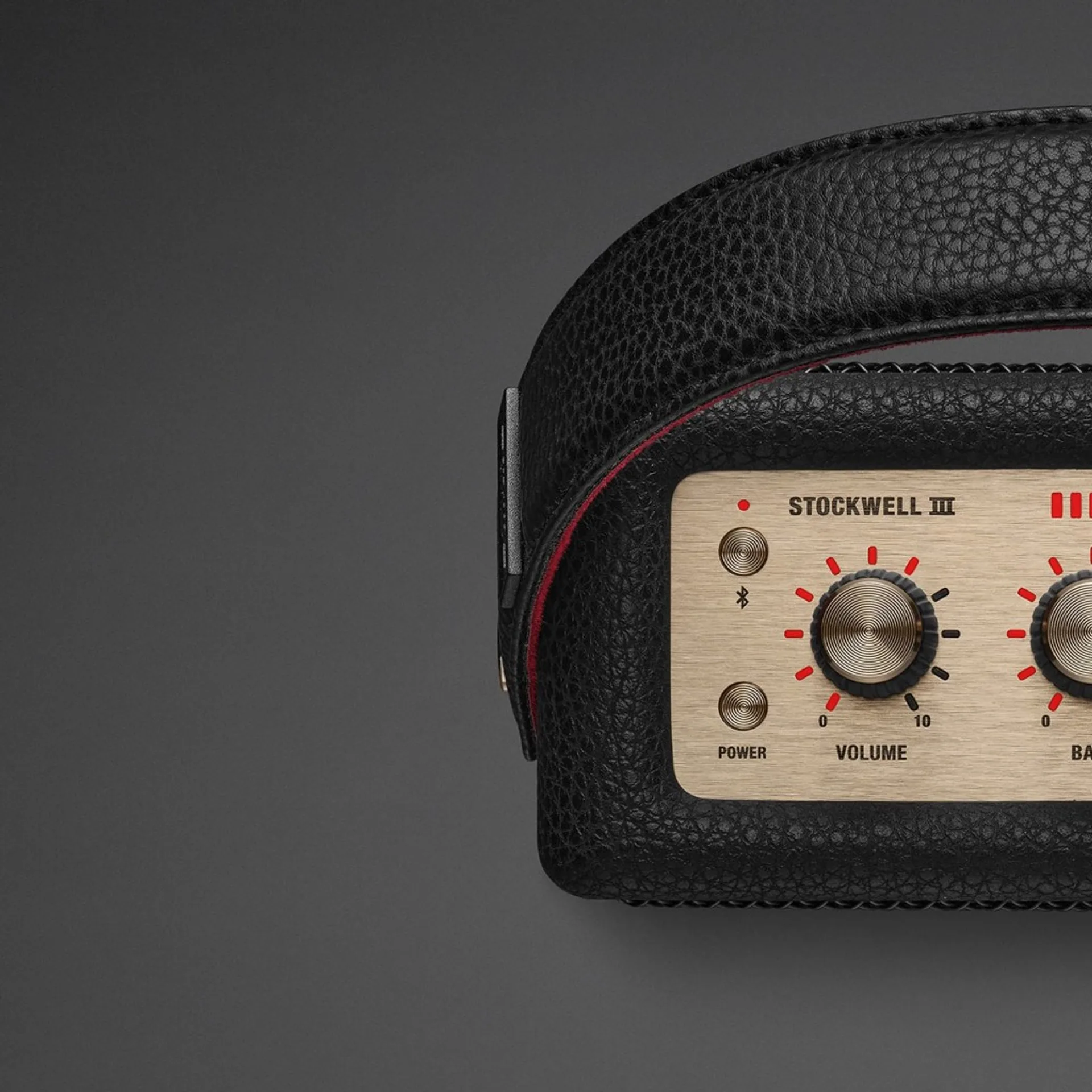
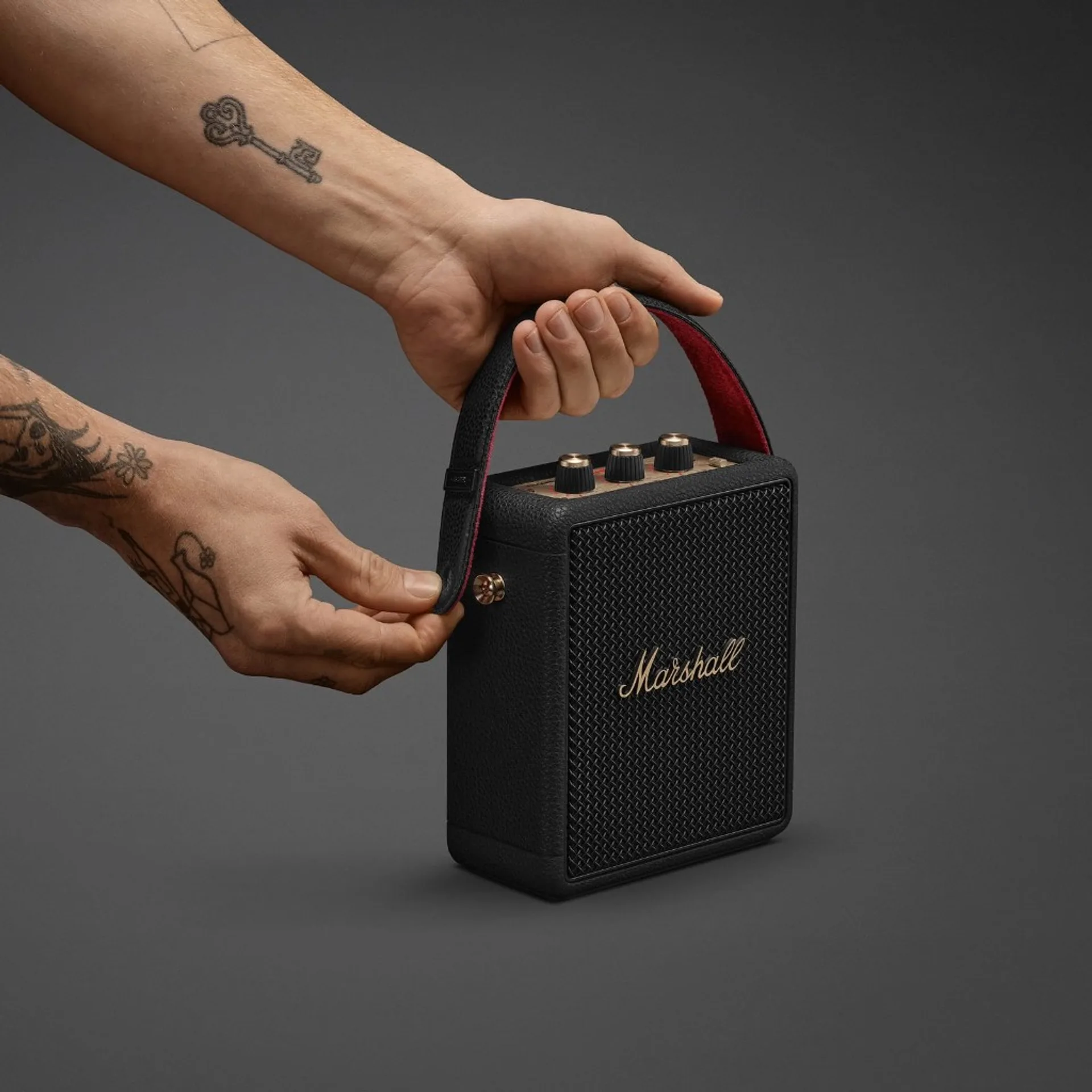
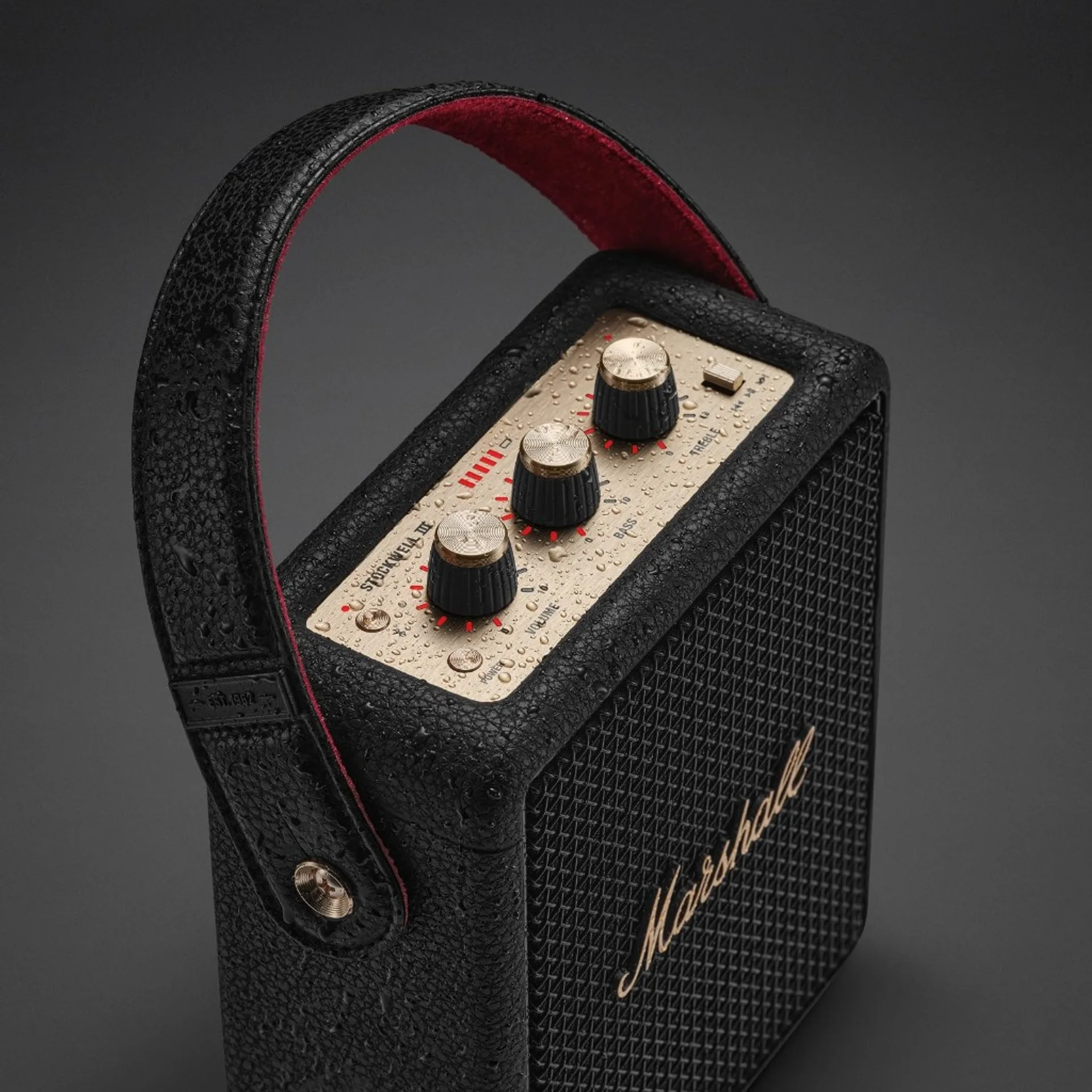
Stockwell III keeps the guitar-amp cues: PU leather carry strap, textured silicone sleeve, metal front and rear grilles, and a brass top panel. Marshall updates the control surface with a dedicated power button, M-button for presets, and a media jog for track skip alongside classic bass, treble, and volume knobs.
That matters in daily use. Bluetooth speakers that hide everything in an app frustrate guests; Stockwell III still reads as hardware-first Marshall, with app EQ and firmware as a backup layer rather than the only interface.
Battery, charging, and USB power bank
The headline upgrade is runtime: Marshall quotes 40+ hours on a charge, roughly double Stockwell II’s 20+ hour figure. For travel and desk duty that shifts the mental model from charge every few days to charge once a week for many users, depending on volume and content.
Charging is USB-C throughout. With a 30 W USB-C PD adapter, Marshall claims 20 minutes on the cable delivers 8 hours of playback, and a full refill in under three hours. The same port can charge a phone or tablet from the speaker while it is powered on, useful when your phone is the playback source and the battery is fading.
The battery itself is replaceable, with preservation settings in the Marshall app to slow long-term degradation. Replacement packs are sold through Marshall’s spare-parts program rather than forcing a whole-speaker upgrade when capacity drops.
IP55 and repairability
Weather sealing moves from Stockwell II’s IPX4 splash rating to IP55: protected against dust ingress and low-pressure water jets from any direction. That is a meaningful step for patio tables, workshops, and festival campsites where dust and sudden rain show up together. It is still not a dunkable pool toy; IP55 means splashes and sprays, not submersion.
Marshall also markets user-serviceable parts: strap, silicone sleeve, front and rear grilles, and the battery are called out as replaceable, with spares on marshall.com. The chassis cites 27% recycled content by weight (excluding accessories and packaging). If longevity matters more than novelty, that repair path is a real differentiator against sealed disposable portables.
Bluetooth 5.3, app, and wired I/O
Wireless stack: Bluetooth 5.3 with multipoint and Auracast listed on the product page. Codecs include SBC, AAC, and LC3 (LE Audio family). Range is quoted at 10 m / 32.8 ft in open space.
Unlike Stockwell II, Stockwell III works with the Marshall Bluetooth app for EQ, presets tied to the M-button, firmware updates, and battery preservation. Wired fallback is 3.5 mm AUX for a turntable, laptop, or travel adapter when Bluetooth is inconvenient.
Stockwell III vs Stockwell II
If you own Stockwell II and it still meets your volume and weather needs, there is no forced upgrade. If you are shopping fresh, Stockwell III is the default unless discounted Stockwell II stock fits a tight budget.
| Feature | Stockwell II | Stockwell III |
|---|---|---|
| Quoted playtime | 20+ hours | 40+ hours |
| Weather rating | IPX4 (splash) | IP55 (dust + water jets) |
| Marshall Bluetooth app | No | Yes |
| Bluetooth generation | 5.0 (II era) | 5.3 + Auracast listed |
| Replaceable battery | No | Yes |
| USB charge-out | Yes (USB-C) | Yes (5 V / 3 A) |
| True Stereophonic | Yes | Yes |
| Dynamic Loudness | Not listed on II PDP | Yes |
Size-class alternatives inside Marshall: want smaller and tougher? See our Emberton III coverage. Need more output and handle portability? Kilburn III is the next step up in the portable ladder.
Spec table
| Spec | Stockwell III |
|---|---|
| Drivers | 1 × 3 in woofer; 2 × 1.75 in wide-band |
| Amplification | 65 W + 2 × 31 W Class D |
| Frequency range | 54–20,000 Hz |
| Max SPL | 86 dB @ 1 m |
| Playtime | 40+ hours |
| Quick charge | 20 min → 8 hours (30 W USB-C PD) |
| Full charge | <3 hours (30 W USB-C PD) |
| Bluetooth | 5.3, multipoint, Auracast listed |
| Codecs | SBC, AAC, LC3 |
| Wired I/O | 3.5 mm AUX; USB-C in/out |
| IP rating | IP55 |
| Dimensions (H × W × D) | 181 × 150 × 72 mm |
| Weight | 1.3 kg / 2.9 lb |
| Recycled content | 27% by weight (product) |
| App | Marshall Bluetooth |
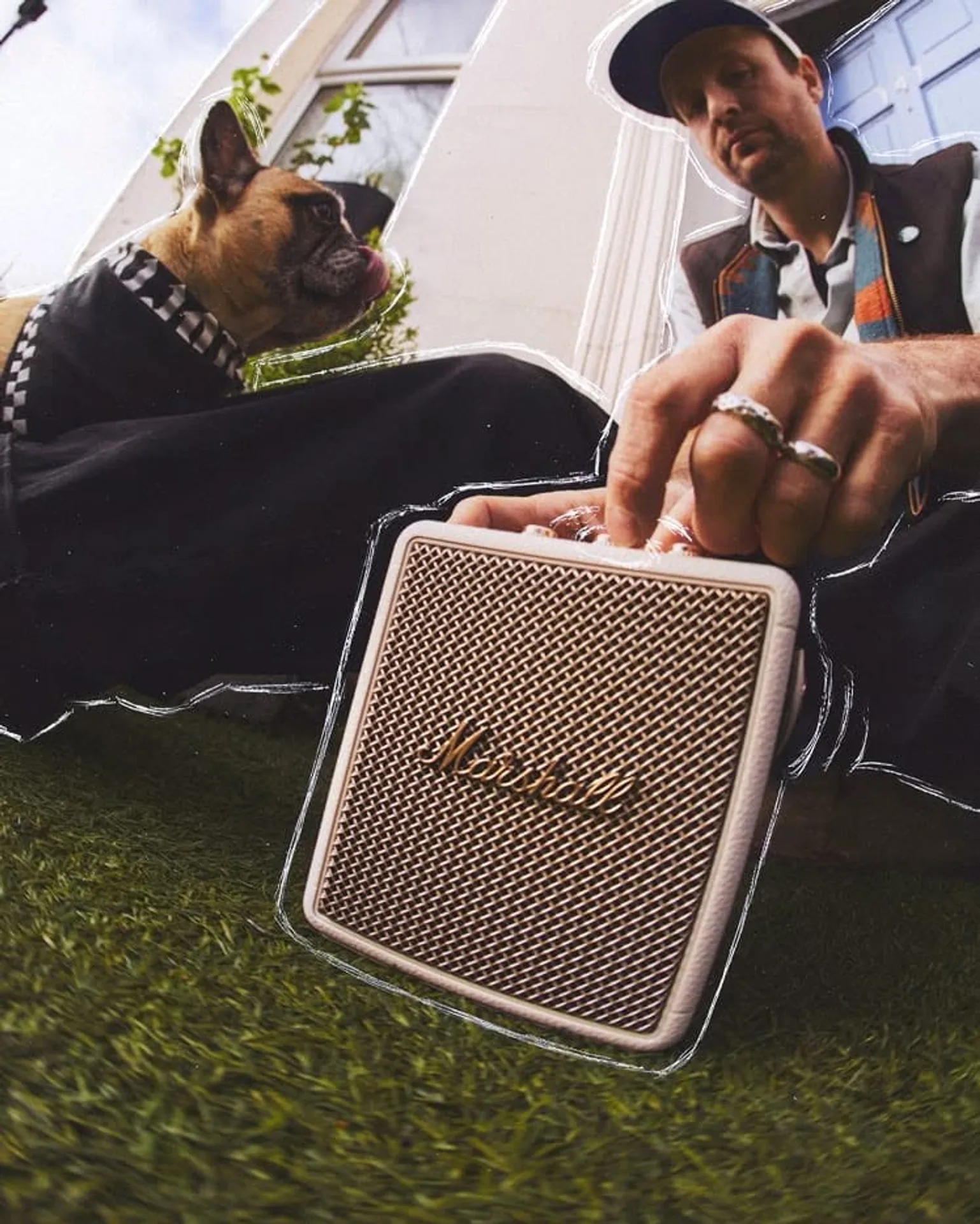
| Colorways | Black and Brass; Cream |
| In the box | Speaker, strap, USB-C cable, quick start, legal/safety |
Who should care, who can skip
Track Stockwell III if…
- You want a strap portable with Marshall styling and week-scale battery without jumping to Kilburn size.
- You play music in dusty or splash-prone spaces where IPX4 felt thin.
- You care about replaceable batteries and spare grilles for a long service life.
- You liked Stockwell II but wanted app EQ and modern Bluetooth 5.3 features.
You can wait if…
- Emberton III already covers your pocket-and-pool use case at lower weight.
- You need party-room SPL; look at Kilburn III or the Bromley lines instead.
- You are happy with Stockwell II and do not need double the quoted runtime or IP55.
- You require confirmed regional pricing and ship dates before buying: verify on marshall.com for your market.

FAQ
What is the Marshall Stockwell III?
Stockwell III is Marshall’s updated portable Bluetooth speaker in the vertical amp-style form factor. It adds 40+ hours of battery, IP55 weather sealing, True Stereophonic 360° tuning, Dynamic Loudness, and Marshall Bluetooth app support versus Stockwell II.
How long does the Stockwell III battery last?
Marshall quotes 40+ hours of portable playtime on a full charge. With a 30 W USB-C PD adapter, 20 minutes of charging yields about 8 hours of playback; a full recharge takes under three hours. Real-world runtime varies with volume, content, and temperature.
Is the Marshall Stockwell III waterproof?
It is IP55-rated: protected against dust ingress and low-pressure water jets from any direction. That covers splashes and light outdoor use, not submersion. It is a step up from Stockwell II’s IPX4 splash rating.
Can Stockwell III charge my phone?
Yes. The USB-C port supports charge-out at 5 V / 3 A while the speaker is on, so you can top up a phone or tablet during playback using the included USB-C cable.
Does Stockwell III work with the Marshall app?
Yes. Stockwell III supports the Marshall Bluetooth app for EQ, presets, firmware updates, and battery preservation. Stockwell II did not support Marshall’s app.
Stockwell III vs Stockwell II: worth upgrading?
The meaningful upgrades are battery life (40+ vs 20+ hours quoted), IP55 vs IPX4, app support, replaceable battery, and refreshed controls. If your Stockwell II still fits your spaces and runtime, upgrade only when you need those extras or when III pricing makes sense in your region.
Sources
- Marshall: Stockwell III product page (drivers, SPL, battery, IP55, connectivity, repairability, dimensions): marshall.com
- Marshall: Stockwell III support hub (firmware, manuals, spare parts): marshall.com/support
- Marshall: Stockwell II product page (generation comparison): marshall.com