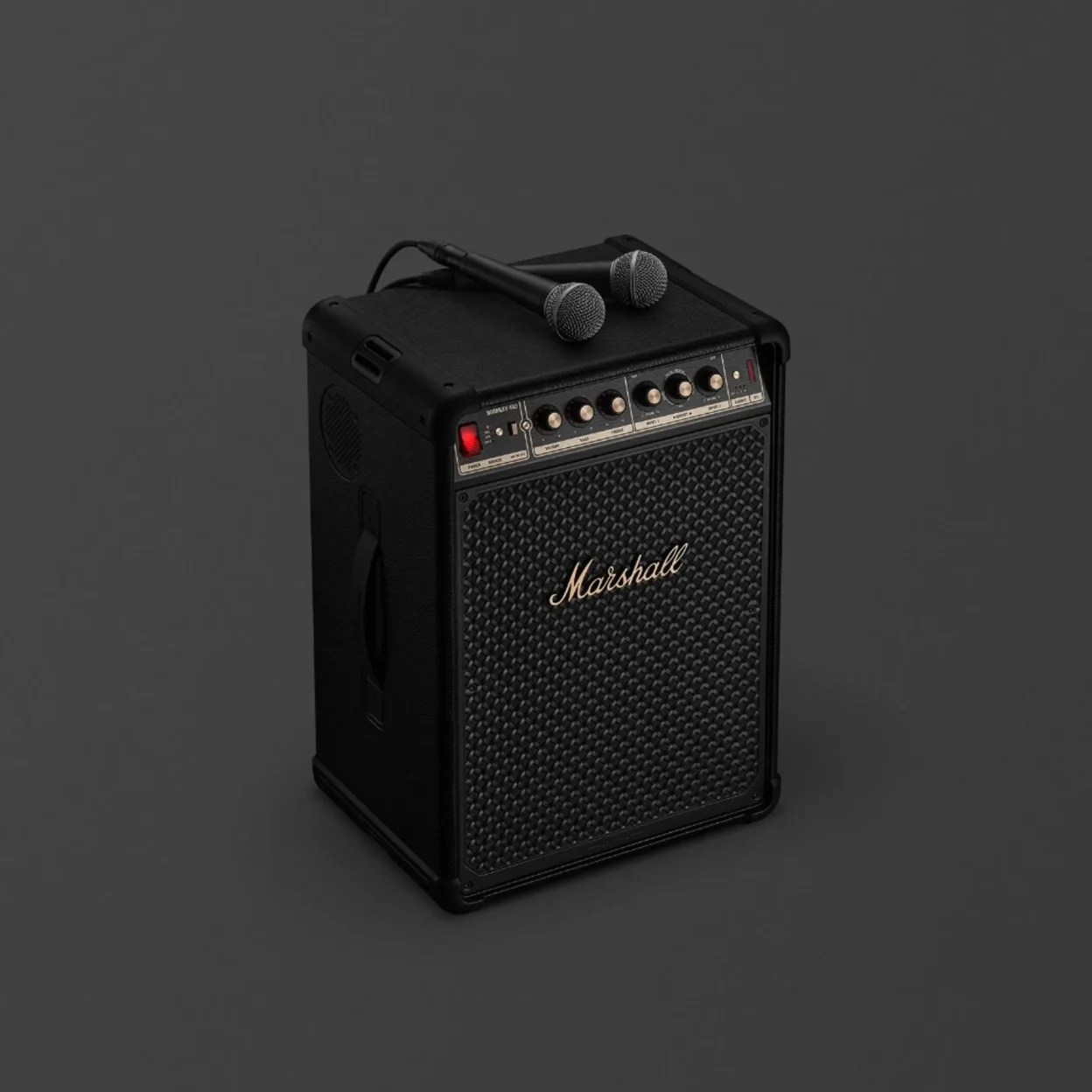
The Marshall Bromley 450 is the smaller, handle-first sibling in Marshall’s Bromley party line: still a stage-amp silhouette and still built around True Stereophonic 360° marketing, but tuned for yards, campsites, and house parties where you want IP55 resilience and ~27 lb lift-with-a-handle portability instead of a wheeled festival rig.
MSRP: USD $799.99 (Black and Brass at time of writing- confirm live). Playtime: 40+ hours at mid volume (Marshall notes temperature, content, and EQ affect runtime). Charge: about 3.5 hours to full; battery can charge in the speaker or separately; unit runs on AC without the battery installed. Weather: IP55 dirt and splash resistance. Max SPL (Marshall FAQ vs 750): 100 dB @ 1 m for Bromley 450. Dimensions: 366 × 261 × 492 mm (imperial figures on Marshall’s U.S. PDP follow the same L × W × H spec block). Weight: 12.32 kg speaker; 16.5 kg including packaging. Wireless: Bluetooth 5.3, Auracast listed. Sustainability copy: Marshall cites ~15% recycled content by weight on the PDP narrative block.
What the Bromley 450 is (and who it skips)
Marshall positions Bromley 450 as a portable party speaker first: marketing leans on moving the rig to the hang, not on hi-res codec badges or living-room furniture integration. The official FAQ contrasts it with Bromley 750 by calling out higher IP rating, smaller and lighter chassis, lower price, and outdoor / around-the-home use — while still promising enough output to carry a crowd when you are not trying to replicate a 127 dB-class flagship.
Lineup table and MSRP ladder: Best Marshall Bluetooth Speakers →
True Stereophonic 360° & SPL context
True Stereophonic is Marshall’s label for omnidirectional stereo imaging from one cabinet: the pitch is that guests standing around the speaker still get a coherent stereo field rather than a “sweet spot only in front” bookshelf presentation. That is as much acoustic industrial design as it is DSP — driver aim, enclosure tuning, and limiting behaviour all show up in how loud it stays before compression.
Marshall’s FAQ states a 100 dB SPL @ 1 m maximum for Bromley 450 when comparing loudness expectations to Bromley 750. Treat that figure as a manufacturer ceiling under their test framing, not a guarantee of how loud it feels on grass with wind noise and conversation in the mix. The practical read is: medium-to-large social rooms and modest outdoor circles, not the same headroom class as the 750 — Marshall itself frames 750 as the model with sound character control for in/outdoor tone shaping, which 450 omits.

Inputs, hosting, and “impromptu gig” use
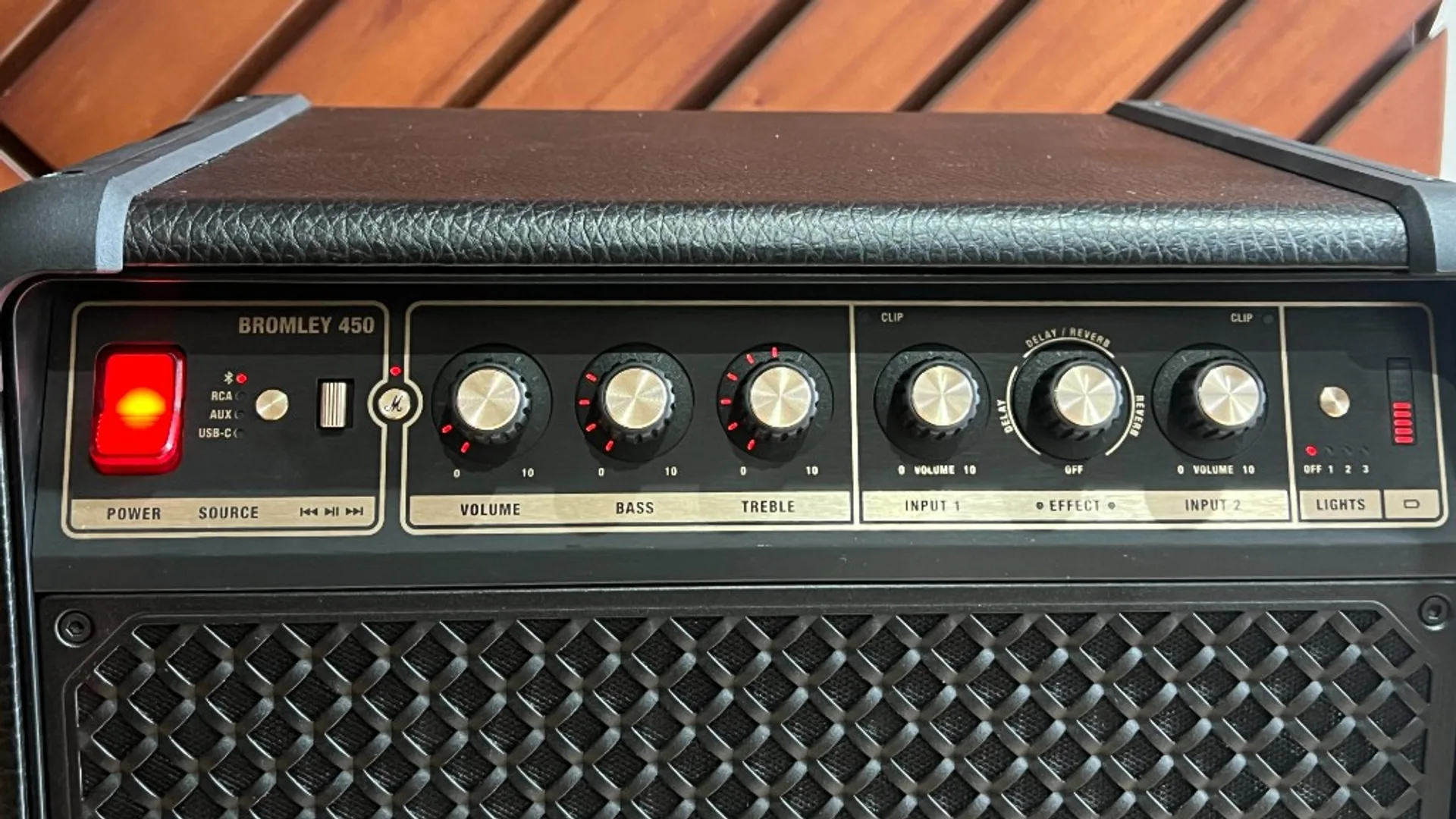
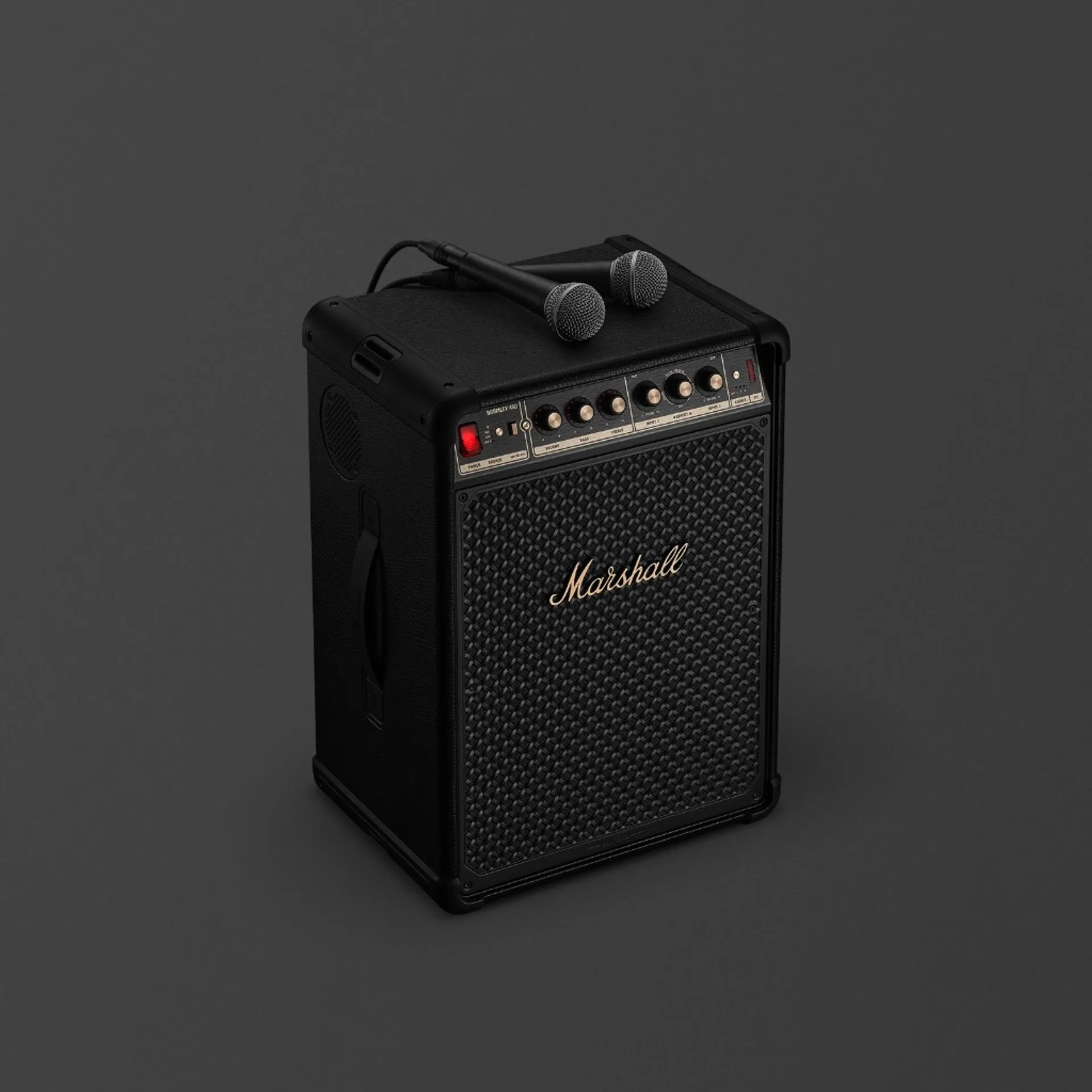
Marshall highlights mic and instrument inputs so hosts can run karaoke, MC work, or a quick instrument pass-through alongside Bluetooth playback. The PDP copy explicitly notes Mic not included — budget a dynamic mic and appropriate cable before the event. Marshall does not, on the consumer PDP we mirrored, spell out every jack format in plain text the way the Bromley 750 sheet documents XLR / 6.35 mm combo pairs; if your rider needs exact connector types for backline adapters, pull the downloads / quick guide from Marshall or confirm with regional support before you buy.
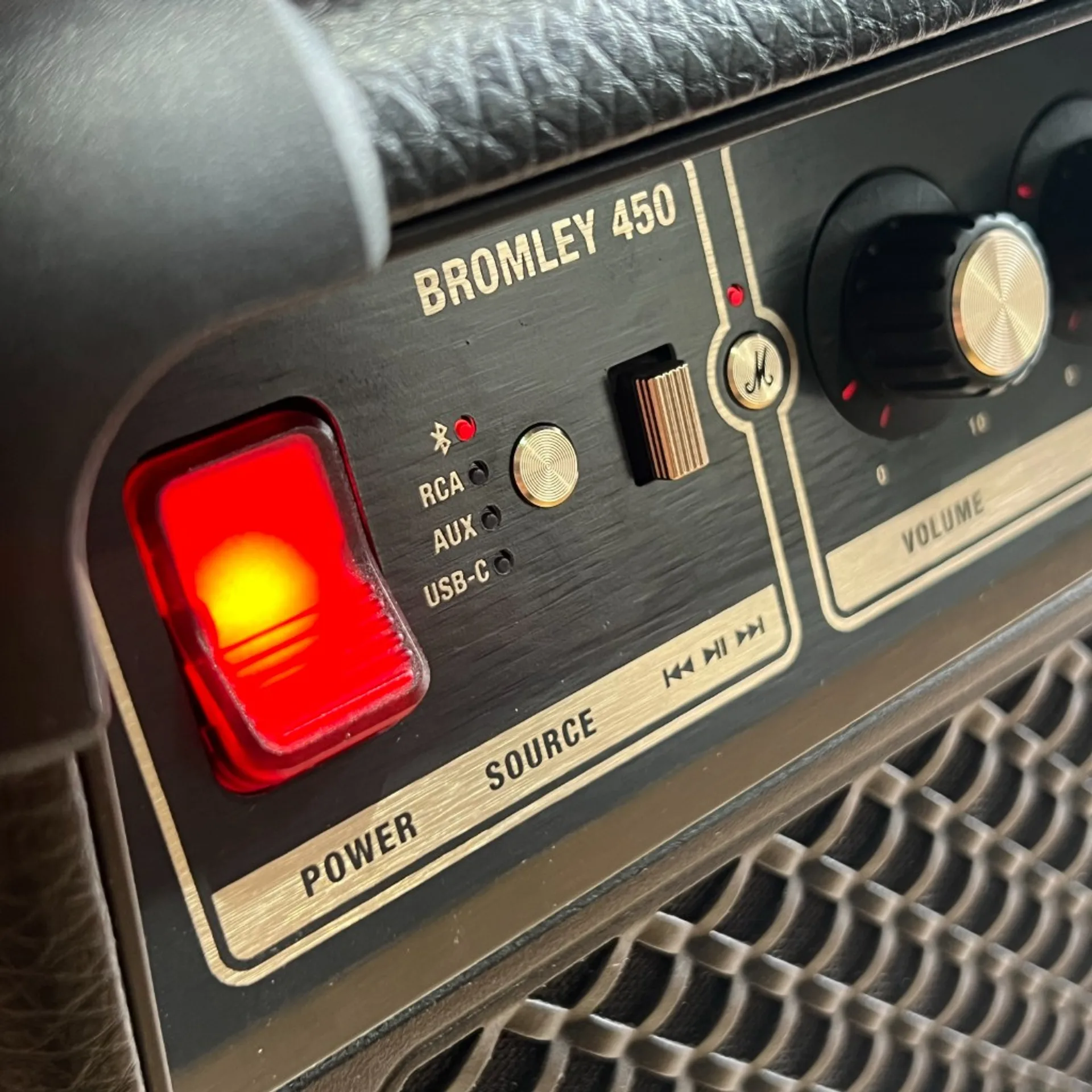
Integrated stage lights
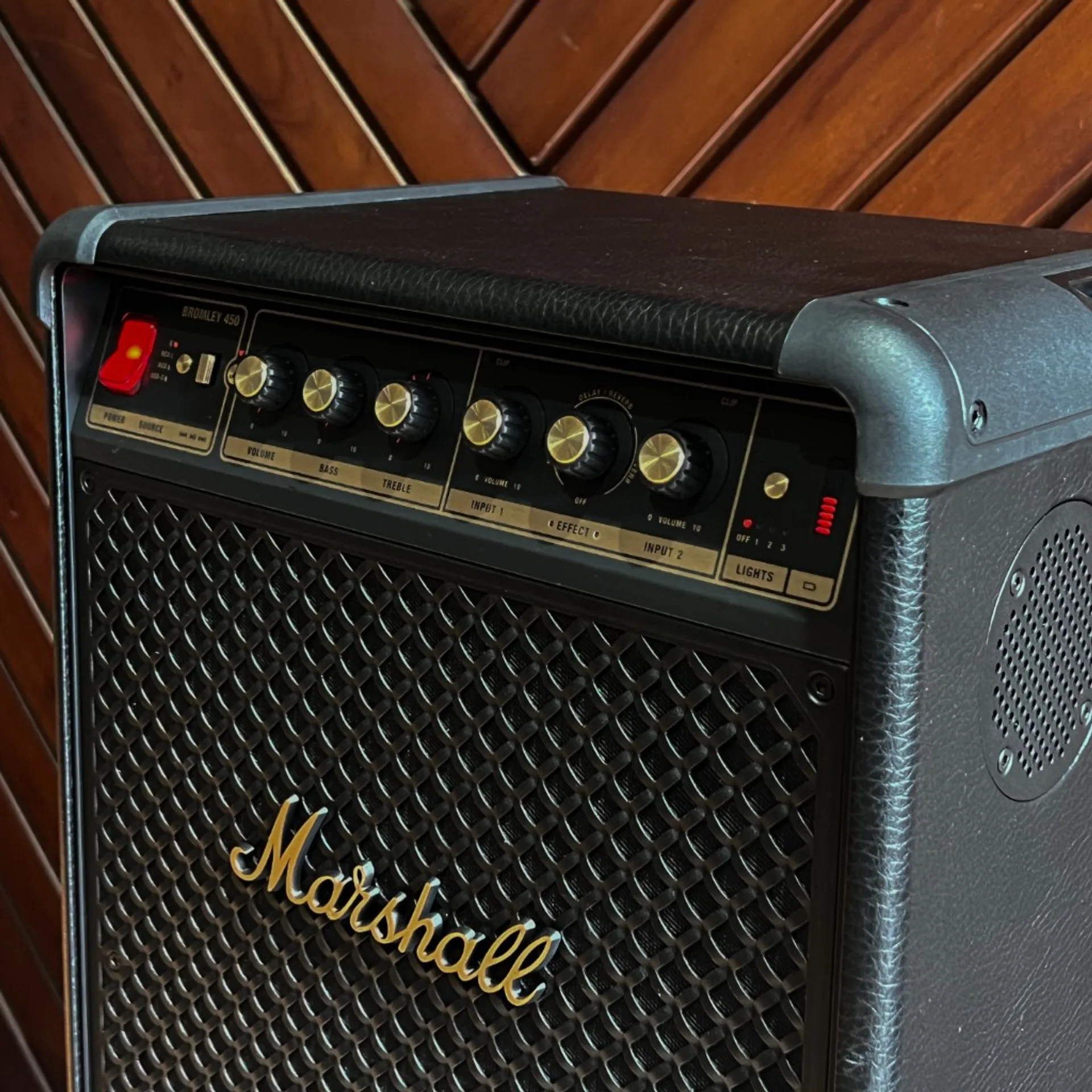
Rather than RGB disco overload, Marshall markets three light presets tuned as stage-inspired energy think warm white rig accents that react to the program rather than a laser show. If you are sensitive to flicker or run photo / video alongside audio, preview behaviour in person when possible; marketing renders rarely match your eyes in smoke and LED haze.
IP55, handle, no wheels
IP55 pairs dust ingress protection with water jet / splash tolerance at a level Marshall believes suits parks and festivals more than pool submersion. The FAQ is explicit: Bromley 450 ships with a built-in handle and does not include wheels — so stairs, van lifts, and one-handed carries are part of the ownership loop. If you need roll-up cart ergonomics, that is the 750 branch of the family.
LFP battery, charging, and longevity story
Marshall fits an easily replaceable LFP (LiFePO4) pack and markets adaptive charging to slow calendar wear when the speaker spends long stretches on wall power. The PDP footnote block explains the chemistry trade-off in plain language: lower energy density and more mass than typical consumer Li-ion, in exchange for longer cycle life and a lower thermal-runaway risk profile — sensible positioning for a rental-adjacent party product that may live on charge between weekends.
Marshall also publishes a recycled-content narrative (~15% by weight, with a breakdown of plastics, aluminium, rare-earth fractions, and polyester in the long-copy block). Treat sustainability numbers as brand-reported composition, not third-party LCA unless Marshall supplies audited documents.
Bluetooth 5.3 & Auracast
The spec strip on Marshall’s page lists Bluetooth 5.3 with Auracast alongside wired operation. Auracast is still an ecosystem play: usefulness depends on phone OS, headphone / receiver support, and firmware maturity on both ends. If broadcast audio to multiple listeners is core to your purchase, verify device compatibility matrices at purchase time rather than assuming every guest handset will join cleanly.
Bromley 450 vs Bromley 750
Condensed from Marshall’s own comparison FAQ and product tables:
- Use bias: 450 — outdoors and around the home; 750 — styled for in and out with more output class and wheeled logistics.
- Weather: IP55 on 450 vs IP54 on 750 (per Marshall’s positioning — not a huge numeric gap, but the FAQ leans 450 for outdoor tilt).
- Acoustic controls: 750 adds Marshall’s sound character knob for tone shaping between environments; 450 does not list that control.
- SPL: Marshall quotes 100 dB @ 1 m max for 450 vs 127 dB @ 1 m for 750 in FAQ copy.
- Transport: 450 — handle, no wheels; 750 — wheels and retractable handle story.
Deep dive on the flagship: Marshall Bromley 750 guide →
Independent analysis (NotebookCheck)
First-party pages tell you what Marshall intends to ship; long-form reviews tell you how a unit behaves under measurement rigs, long playback sweeps, and editorial taste. NotebookCheck’s Marshall Bromley 450 review (2026) positions the speaker as a strong all-rounder in the party category, with praise around balanced, warm listening character, low-end body, and the utility of live inputs for hosting scenarios. Their write-up also flags app depth as a limitation compared with what some buyers expect from flagship Bluetooth ecosystems — worth cross-checking against current Marshall Bluetooth app release notes before you assume a specific EQ or grouping feature exists on day one.
We do not reproduce NotebookCheck’s lab charts here; if you need exact SPL curves, THD+N sweeps, or battery discharge tables, read their article directly and cite their methodology.
Marshall Bromley 450
Available at Amazon — confirm SKU, seller, warranty, and finish (e.g. Black and Brass) on the listing.
View on AmazonFAQ
Is the Marshall Bromley 450 waterproof?
Marshall rates it IP55 for dirt and water splashes, not submersion. Rinse mud carefully per Marshall care guidance; do not treat it like an IP67 pool float.
Can I run it plugged in without the battery?
Yes — Marshall states the speaker works on AC without the battery installed, and the pack can be charged in the unit or separately.
How long does charging take?
Marshall quotes about 3.5 hours for a full battery charge. Runtime on battery still depends on volume, lights, content, and ambient temperature.
Should I buy Bromley 450 or Bromley 750?
Choose 450 when you want lighter carry, IP55, and a lower U.S. MSRP while keeping 360° party voicing and live inputs. Choose 750 when you need wheels, higher SPL class, sound character control, and the broader stage-rig control surface- see our Bromley 750 guide and Marshall’s comparison FAQ.