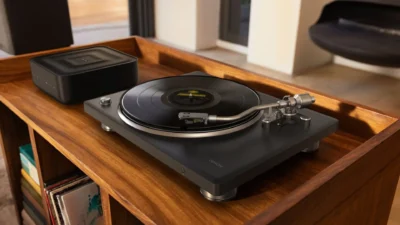

Audio-Technica sells two fully automatic belt-drives in the same lane: the long-running AT-LP60X and the step-up AT-LP70X. Same pitch — 33/45, press Start, let the arm do the commute, flip LINE for powered speakers or PHONO for a receiver. The LP70X is still that machine; it just brings a die-cast platter, a VM95-class cart fixed into a J-shaped arm, and a stronger output from both taps so downstream gear has an easier job. I have lived with an LP60X-class deck; I have not spent a long session with an LP70X on my rack yet, so this split is product logic and listening priorities, not a shootout scorecard. Details on the LP70X live on Audio-Technica’s US product page; the manual PDF is there when you need wiring and care spelled out.
What both decks share
Audio-Technica markets both as fully automatic belt-drive turntables: motor spins, arm lifts, cues, returns, and shuts down without you babysitting the tonearm. That matters for the same person in both cases — someone who wants vinyl without a setup hobby.
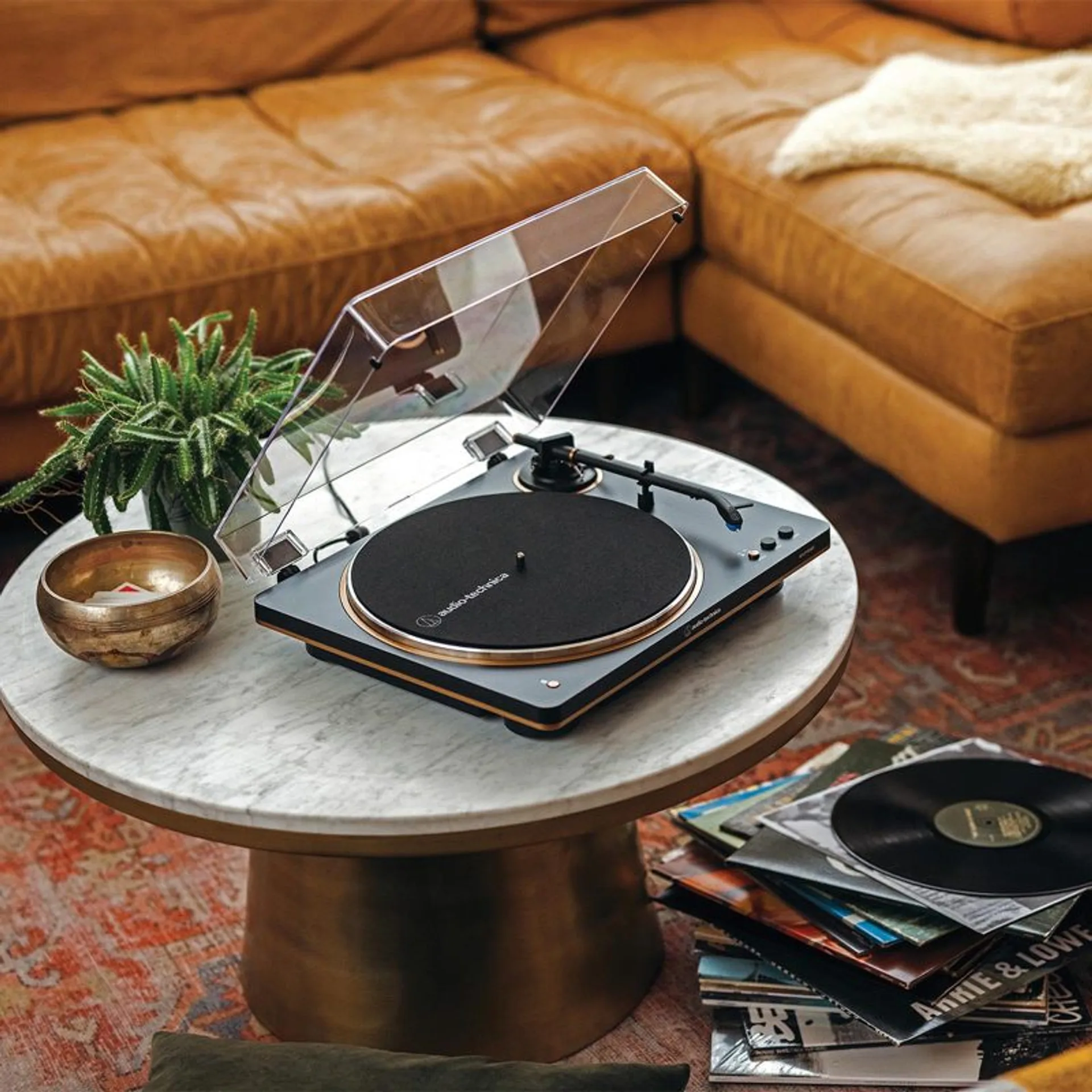
Each includes a built-in RIAA phono preamp you can bypass in spirit by switching to PHONO output when you already own a good external stage or a receiver phono input. Flip to LINE when you are plugging into anything that expects a line-level signal.
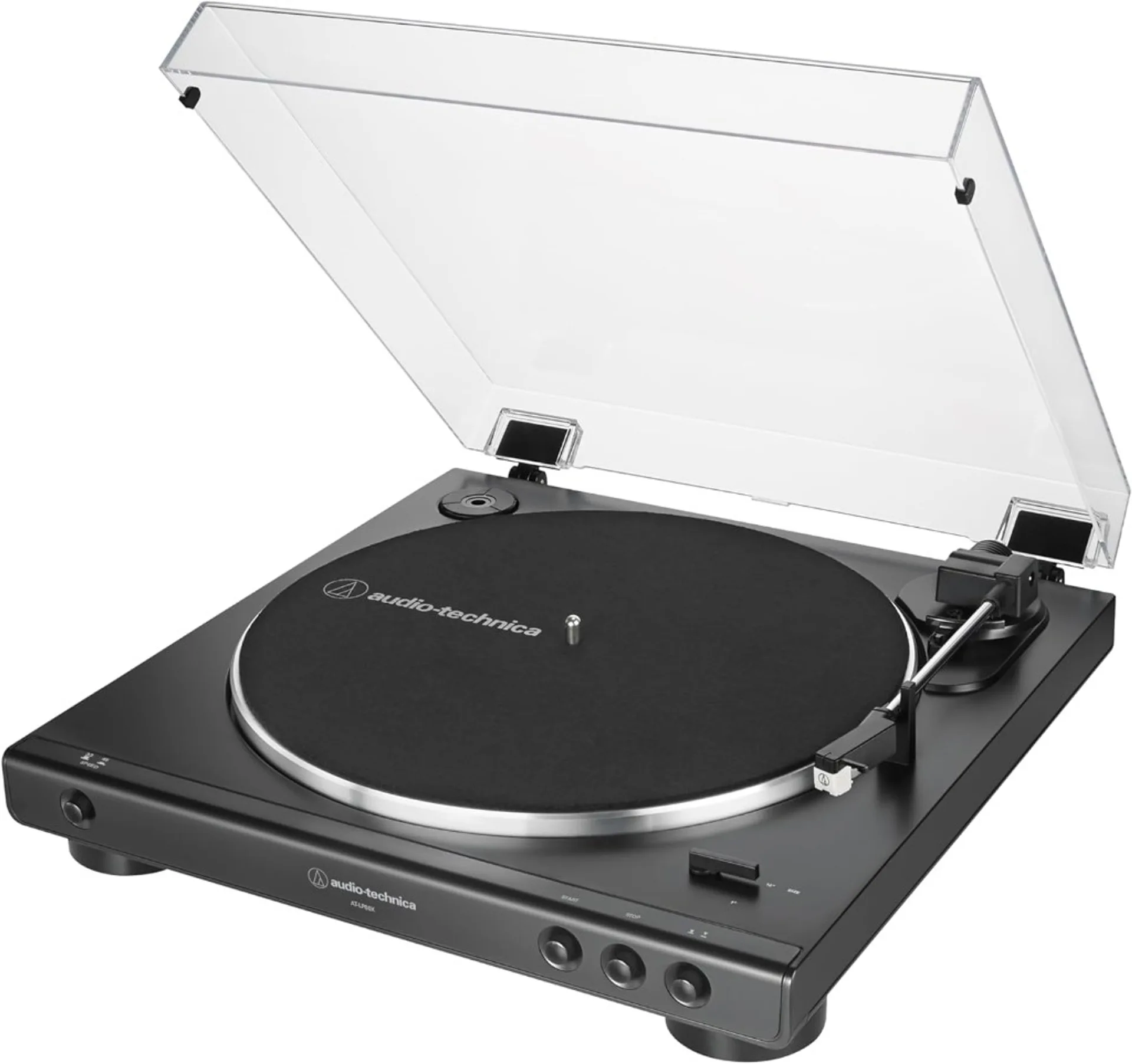
Neither gives you a removable headshell or a counterweight you dial for exotic carts. The trade-off is the same: simplicity and repeatability over modularity. For why arm geometry still matters even on automatics, see tonearm geometry and vinyl sound. For the rest of the playback chain, how vinyl playback works is still the right primer.
The hardware split
One view of the mechanical and electrical differences — handy for shelf space, stylus upgrades, and knowing what you are moving between if you trade up later.
| Specification | AT-LP60X | AT-LP70X |
|---|---|---|
| Drive | Belt, fully automatic | Belt, fully automatic |
| Speeds | 33⅓, 45 RPM | 33⅓, 45 RPM |
| Platter | Aluminum | Die-cast aluminum |
| Wow and flutter | <0.25 % (WTD) at 3 kHz | <0.25 % (WTD) |
| Signal-to-noise | >50 dB (DIN-B) | >55 dB |
| Phono output (nominal) | 2.5 mV @ 1 kHz, 5 cm/s | 4.0 mV @ 1 kHz, 5 cm/s |
| Line output (nominal) | 150 mV @ 1 kHz, 5 cm/s | 252 mV @ 1 kHz, 5 cm/s |
| Built-in phono gain | 36 dB nominal, RIAA | 36 dB nominal, RIAA |
| Cartridge | VM-type Dual Magnet™, integrated headshell | AT-VM95C integral (not removable) |
| Replacement stylus | See ATN3600 family (LP60X review) | AT-VMN95C; other VM95 series styli per A-T |
| Tonearm | Integrated headshell design | J-shaped, 220 mm effective, 18 mm overhang, <2.0° tracking error angle |
| Weight | 2.6 kg (5.73 lb) | ~2.9 kg (6.4 lb) |
| Dimensions | 359.5 × 97.5 × 373.3 mm (W × H × D) | 400 × 330 × 110 mm (W × D × H) |
| Power consumption | 1.0 W | 1.5 W |
Shelf tip: the two decks use different width/depth/height ordering in their factory copy — sketch the footprint on paper before you assume one is “smaller” from three numbers alone.
Platter, arm, and cartridge
The die-cast platter on the LP70X is the obvious mechanical upgrade: more rotational inertia, less of the thin, nervous feel some light platters get when a groove gets loud. Audio-Technica frames it as an anti-resonance move versus the LP60X’s standard aluminum platter.
The VM95 cartridge built into the LP70X is the longer play for many buyers. Stock tip is the conical AT-VMN95C, but the VM95 family lets you step the stylus up later- elliptical, finer profiles- without bolting on a new cartridge body, because the generator stays fixed in the arm.
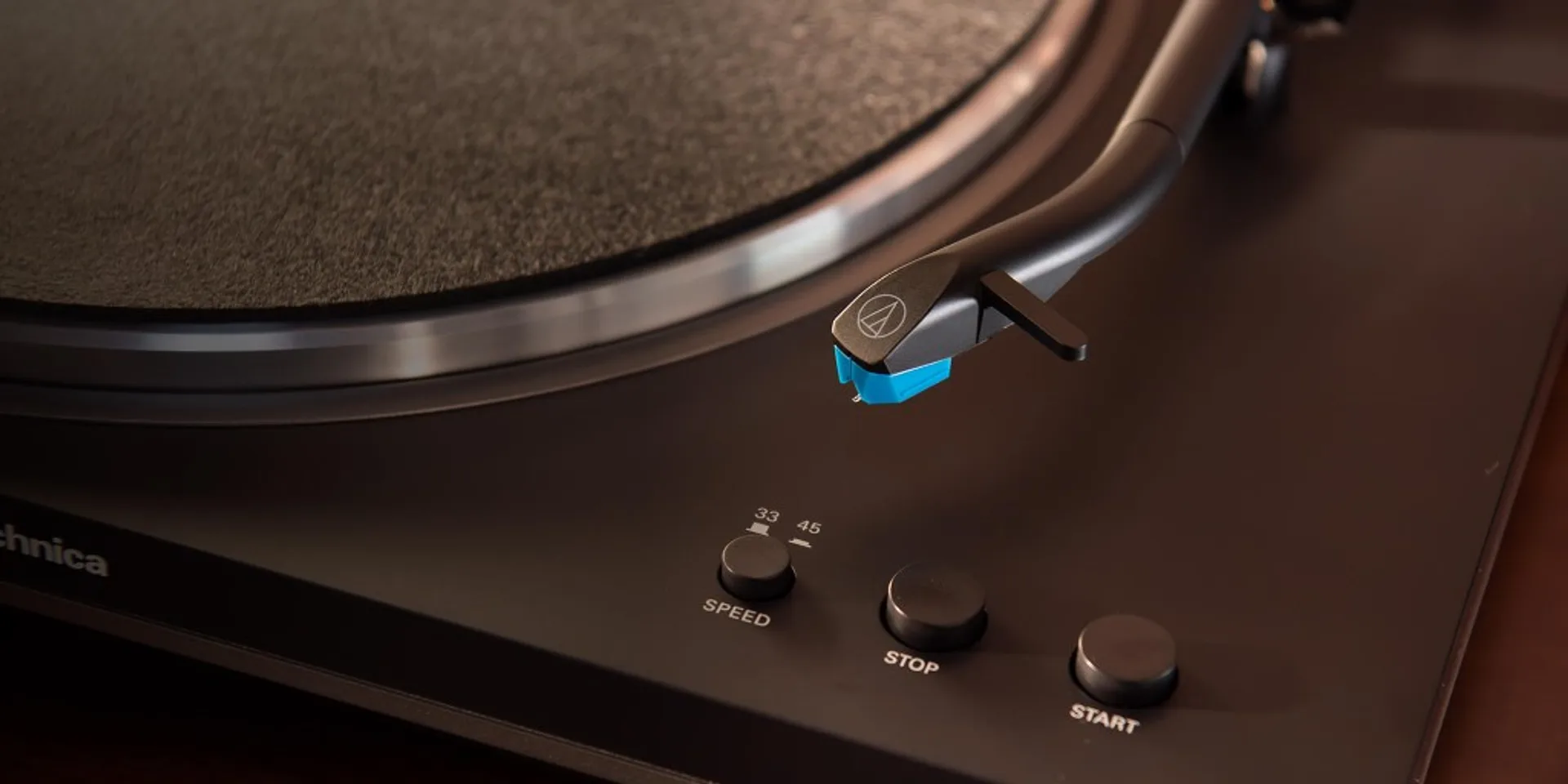
The J-shaped arm is Audio-Technica’s way of chasing lower tracking error across the record than a simpler straight automatic arm. You still do not get user antiskate or VTF knobs; both decks stay factory-set, same philosophy.
Outputs and gain
The LP70X sends a stronger MM signal out of the PHONO jacks than the LP60X generation, and its LINE output is louder too. In practice that can mean less strain on a borderline phono stage or a powered speaker pair that always felt a little shy on the LP60X.
A serious outboard phono stage still wins if you are chasing every last detail- the internal stage is a convenience feature on both models, not a statement piece.
Finishes and variants
US marketing for the LP70X lists Black/Gray, Black/Bronze, and White/Silver trim combinations- availability varies by region and retailer. The LP60X family spreads across more color/SKU variants including AT-LP60XBT for Bluetooth.
If you need wireless from the LP70X chassis, Audio-Technica sells a separate AT-LP70XBT class SKU in the same product generation (check audio-technica.com for your country’s exact model code and codec support). I am not folding BT pricing here- it moves too often.
Which one I’d buy
LP60X when the mission is minimum cash, minimum anxiety, and you might gift or resell the thing in two years. It is the correct default for “I just want albums to play.”
LP70X when you already know you will keep spinning and want more platter under the record, a clearer stylus ladder inside the VM95 world, and beefier outputs without leaving the automatic comfort zone.
If you are hunting DJ cues, adjustable VTA, or a half-inch mount for cart rolling — walk past both and shop manual decks. These two are siblings, not opposites.
FAQ
Is the AT-LP70X worth the extra money over the AT-LP60X?
You are paying for platter mass, the VM95 path, the J-arm layout, hotter outputs, and a quieter noise floor in Audio-Technica’s factory description of the LP70X. Whether that matches your budget depends on street pricing the week you buy – weigh stylus replacement cost and how long you plan to keep the deck, not just the sticker on the box.
Can I swap the cartridge on the AT-LP70X?
No – the AT-VM95C body is integral to the tonearm per Audio-Technica. You upgrade by changing the stylus within the compatible VM95 range.
Do both work with powered speakers?
Yes – set the rear switch to LINE and run RCA (or the bundled adapter strategy your region ships) into the speakers’ line input. Use PHONO only into a phono input or external phono stage.
Is wow and flutter better on the LP70X?
Treat them as the same league for pitch stability. If you want a night-and-day jump in how locked-in the speed feels, you are usually shopping another price tier entirely- not the gap between these two.