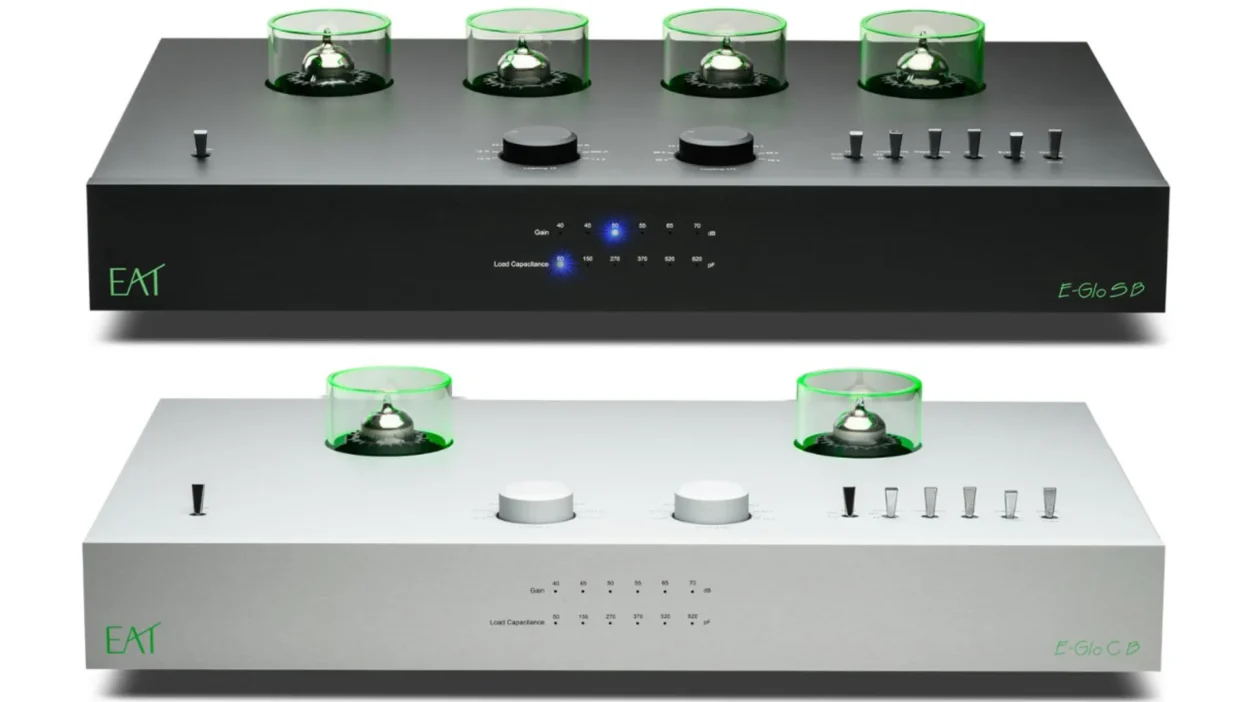
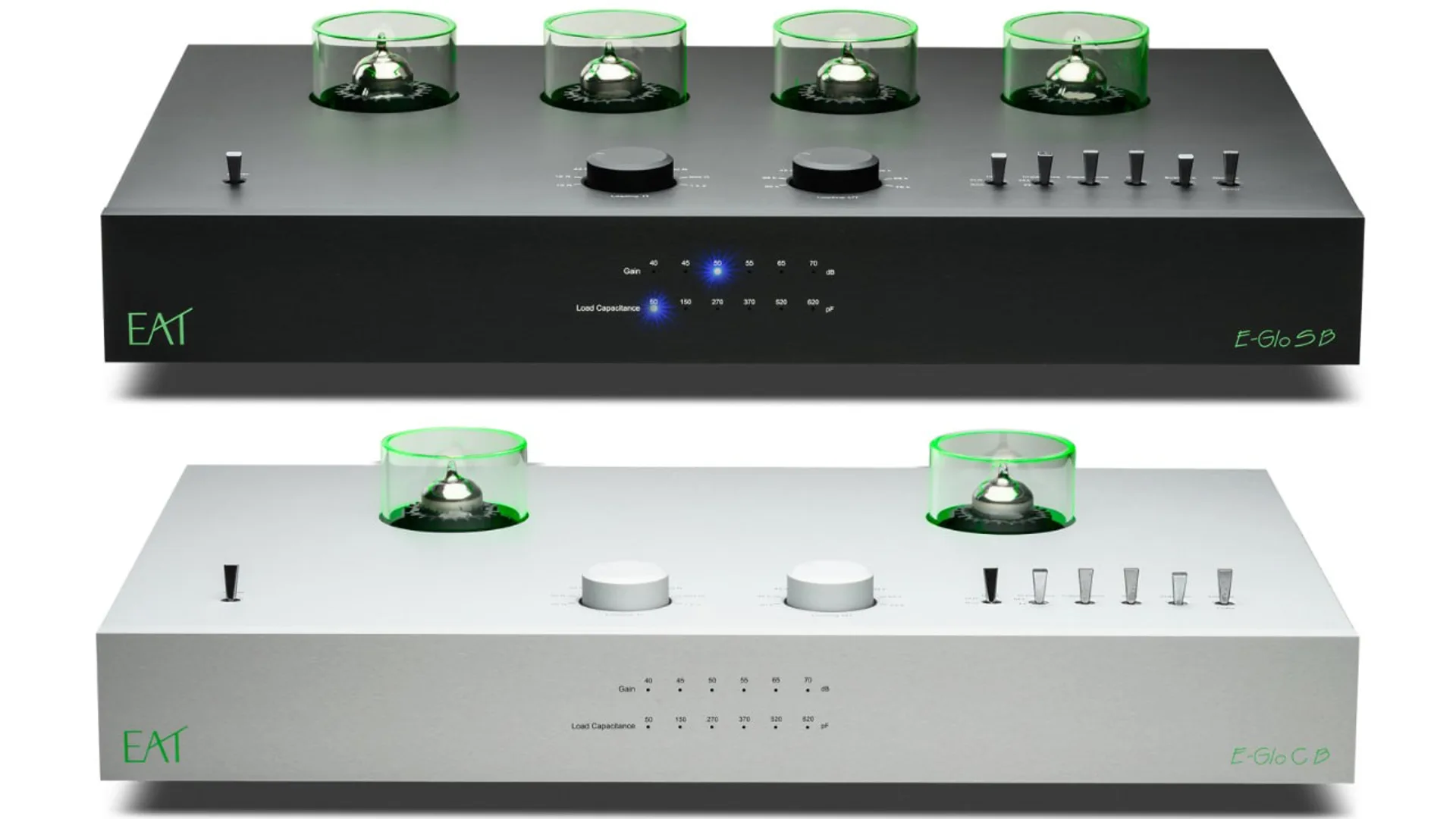
European Audio Team (EAT) has filled the gap between its compact E-Glo Petit B and flagship E-Glo FB with two full-width balanced phono stages: the E-Glo CB at $4,599 and the E-Glo SB at $6,250 (U.S. SRP via North American distributor VANA Ltd). Both inherit the family’s “B” idea – balanced XLR connectivity and symmetrical gain thinking – but they are not stripped-down FB clones. The CB leans hybrid tube-transistor in the middle gain stage; the SB pushes closer to flagship architecture with a fully tube-based second stage and a higher-grade capacitor set.
Where CB and SB sit in the E-Glo family
EAT’s phono catalogue already had a clear ladder on paper. The E-Glo Petit B is the compact balanced hybrid. The E-Glo FB is the reference all-tube, fully balanced chassis with a separate power supply. CB and SB occupy the middle floor: full-width boxes with the loading flexibility serious MC systems need, without jumping straight to FB money and tube count.
That matters for buyers who already run a balanced preamp or a turntable with true balanced wiring. Balanced phono stages remain uncommon in the tube world; EAT is treating the “B” line as a family, not a one-off flagship stunt. For the broader vinyl signal-path context – cart, arm, RIAA gain – see our vinyl playback guide.
Shared balanced architecture
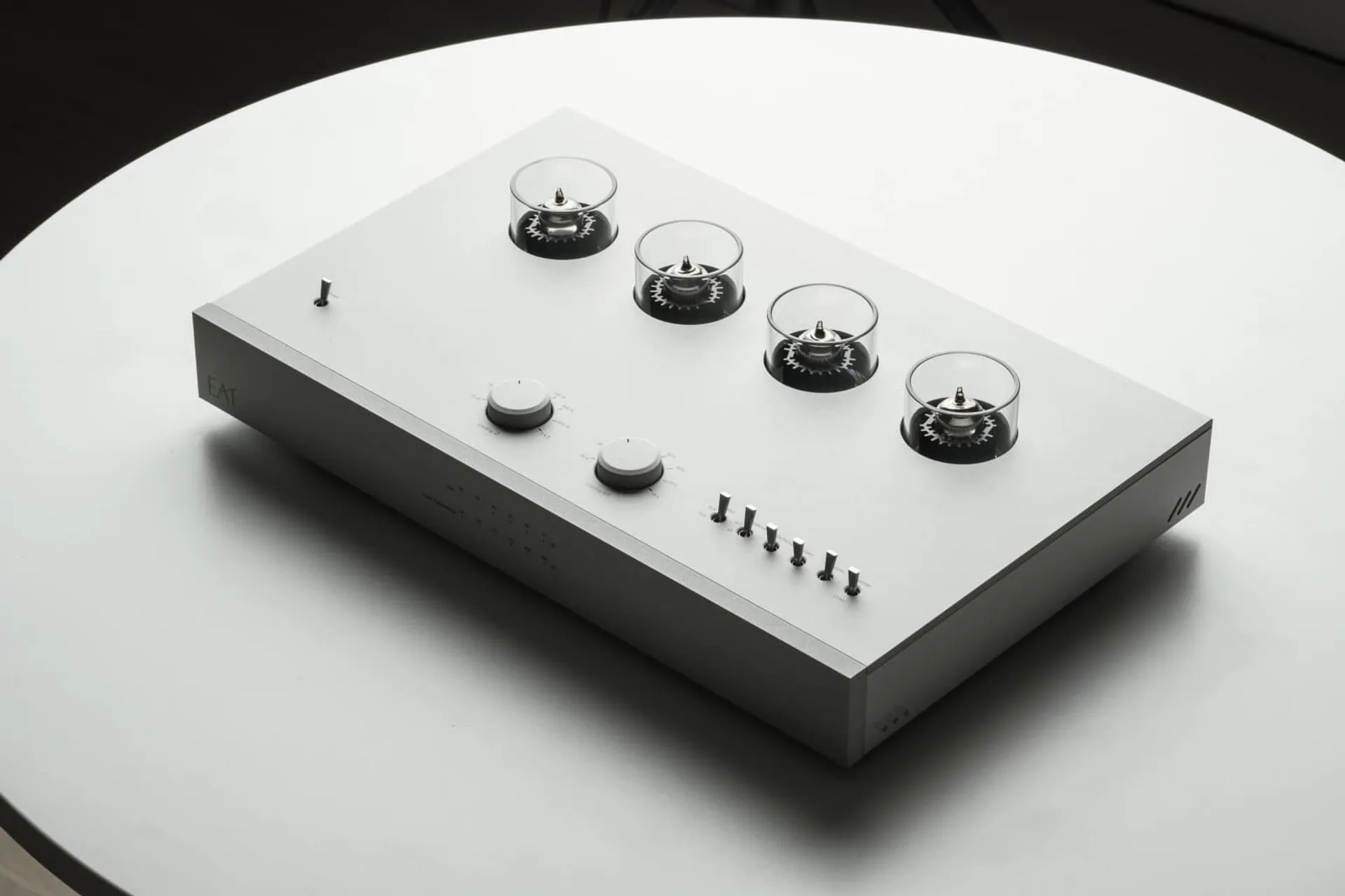
Both models use a three-stage gain path with dual-mono construction and discrete semiconductor amplifiers rather than chip op-amps. The first stage handles the balanced phases with three discrete amp circuits: one for the positive phase, one for the negative, and one that sums them to cancel common-mode noise. High-frequency RIAA work also lives here.
The final stage is a dual discrete semiconductor op-amp path that restores a balanced output and keeps output impedance low, with DC servo circuits to hold offset in check. RIAA accuracy is specified within 0.5 dB from 20 Hz to 20 kHz. Both units include a 20 Hz subsonic filter at 18 dB/octave – useful when warps, suspension bounce, or a hungry subwoofer try to amplify non-musical junk.
Power is kept off-chassis: an external 18 V supply, so the transformer sits away from circuitry that amplifies millivolt-level cartridge signals.
CB vs SB: the second-stage fork
This is where the two models stop being twins.
E-Glo CB – hybrid middle stage
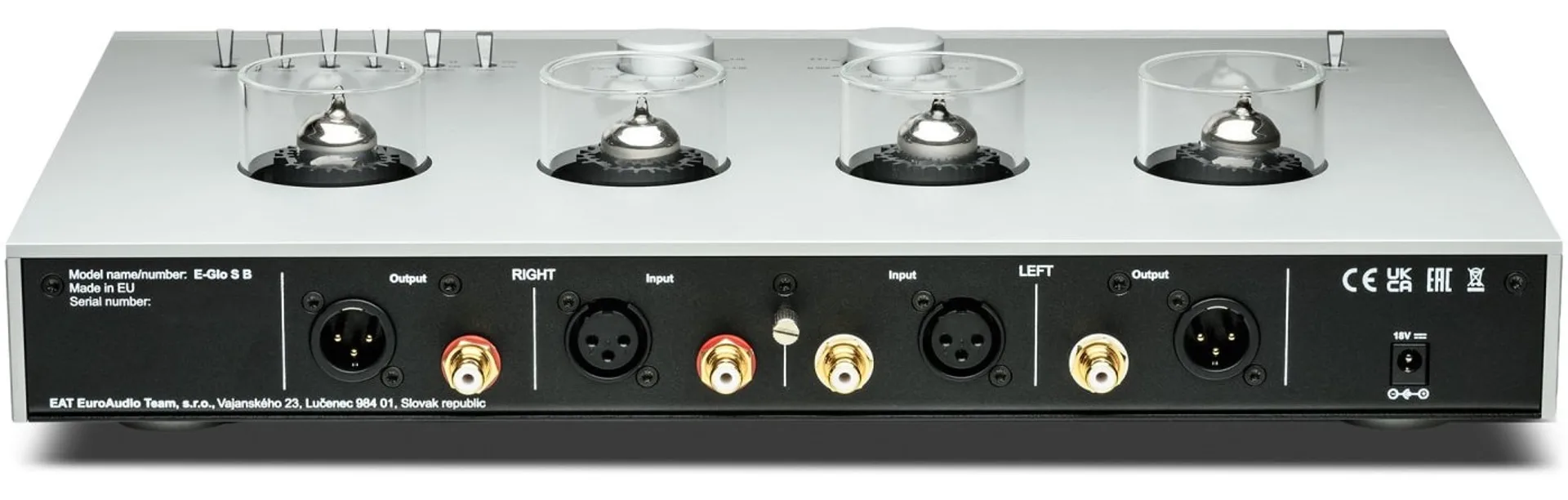
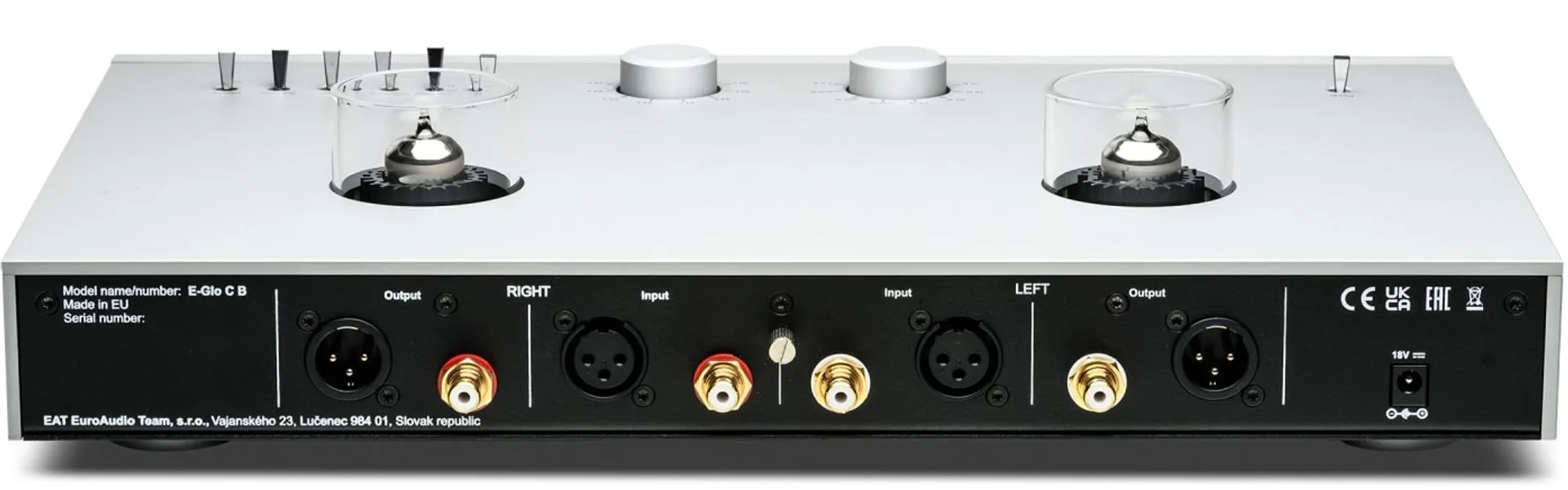
The CB’s second stage is a hybrid single-ended tube-transistor block: two ECC83S triodes plus one transistor. It handles the low-frequency RIAA boost and the switchable subsonic filter. Balanced input processing and balanced XLR outs remain; the middle of the chain converts to single-ended before the output stage recreates a balanced drive. That is still a serious balanced input strategy – especially valuable for low-output MC – but it is not a fully differential path from pin to pin the way the flagship story is sold.
E-Glo SB – closer to FB thinking
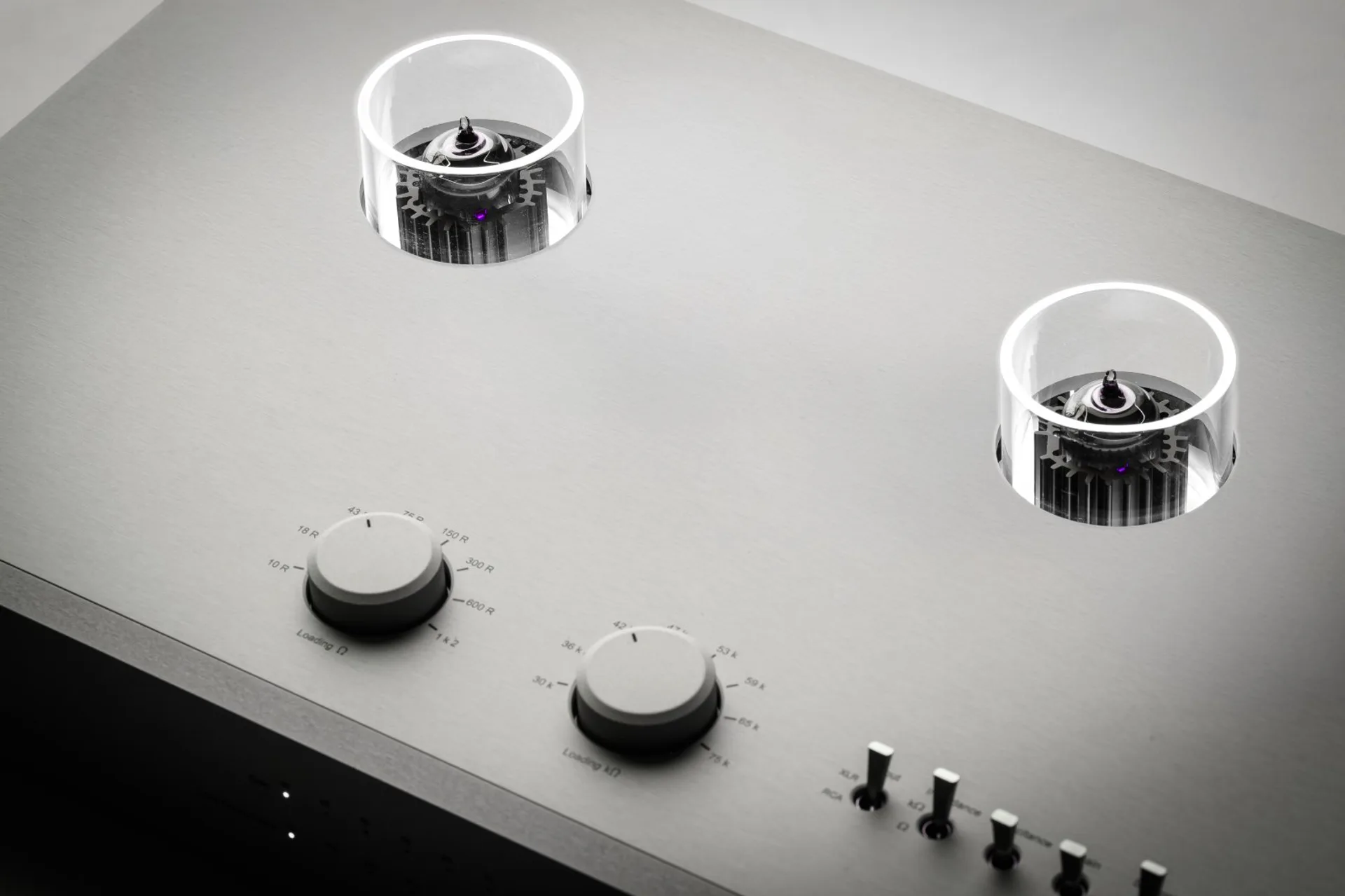
The SB keeps the second stage as a symmetrical tube design: two ECC83S and two E88CC triodes, plus higher-grade semi-crystalline hydrocarbon polypropylene capacitors in the gain and RIAA networks. Balanced operation continues through that middle stage, which is why the SB is pitched as the nearer cousin to the E-Glo FB for listeners already living in a high-end balanced system.
Cartridge loading and gain
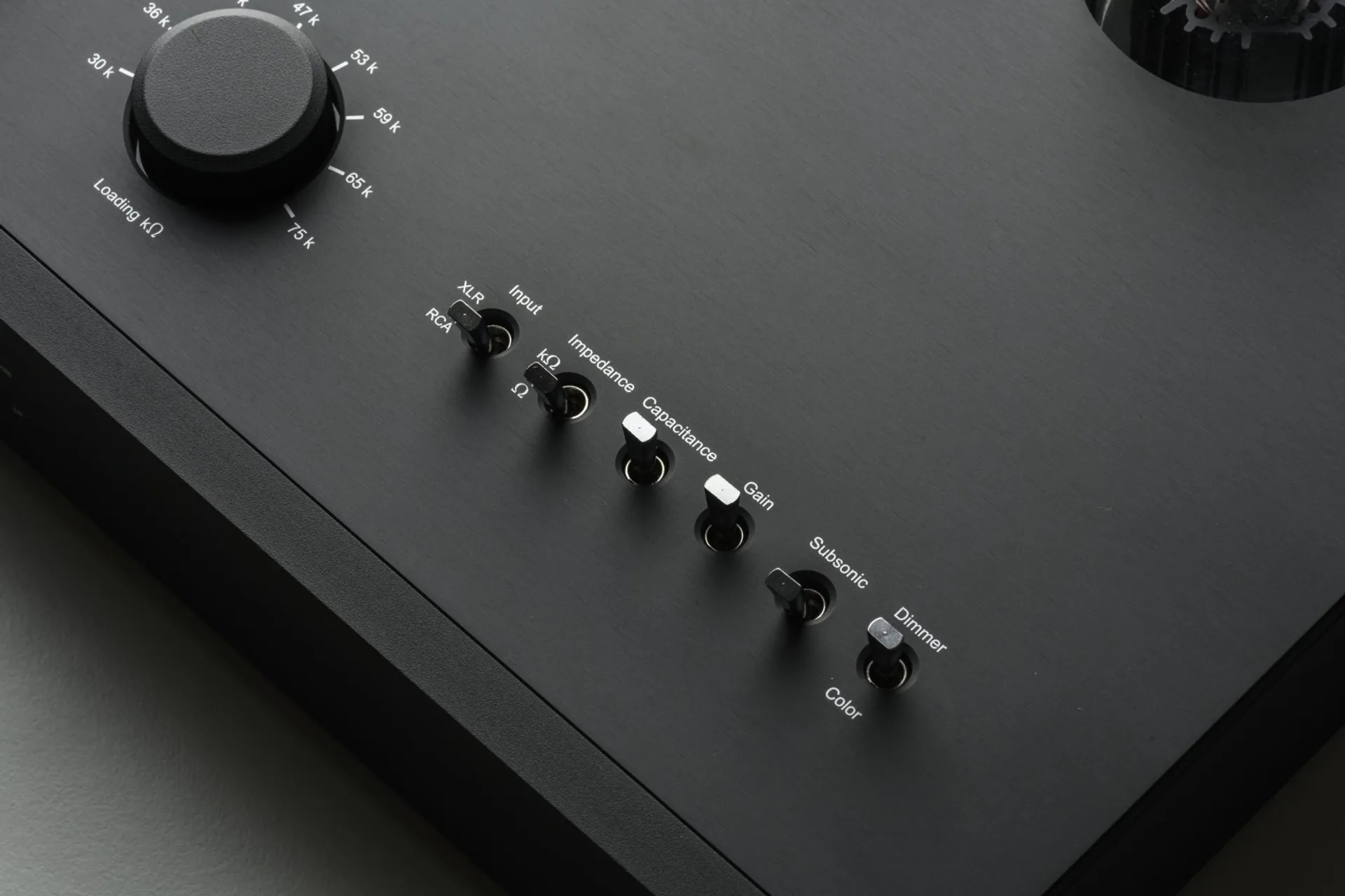
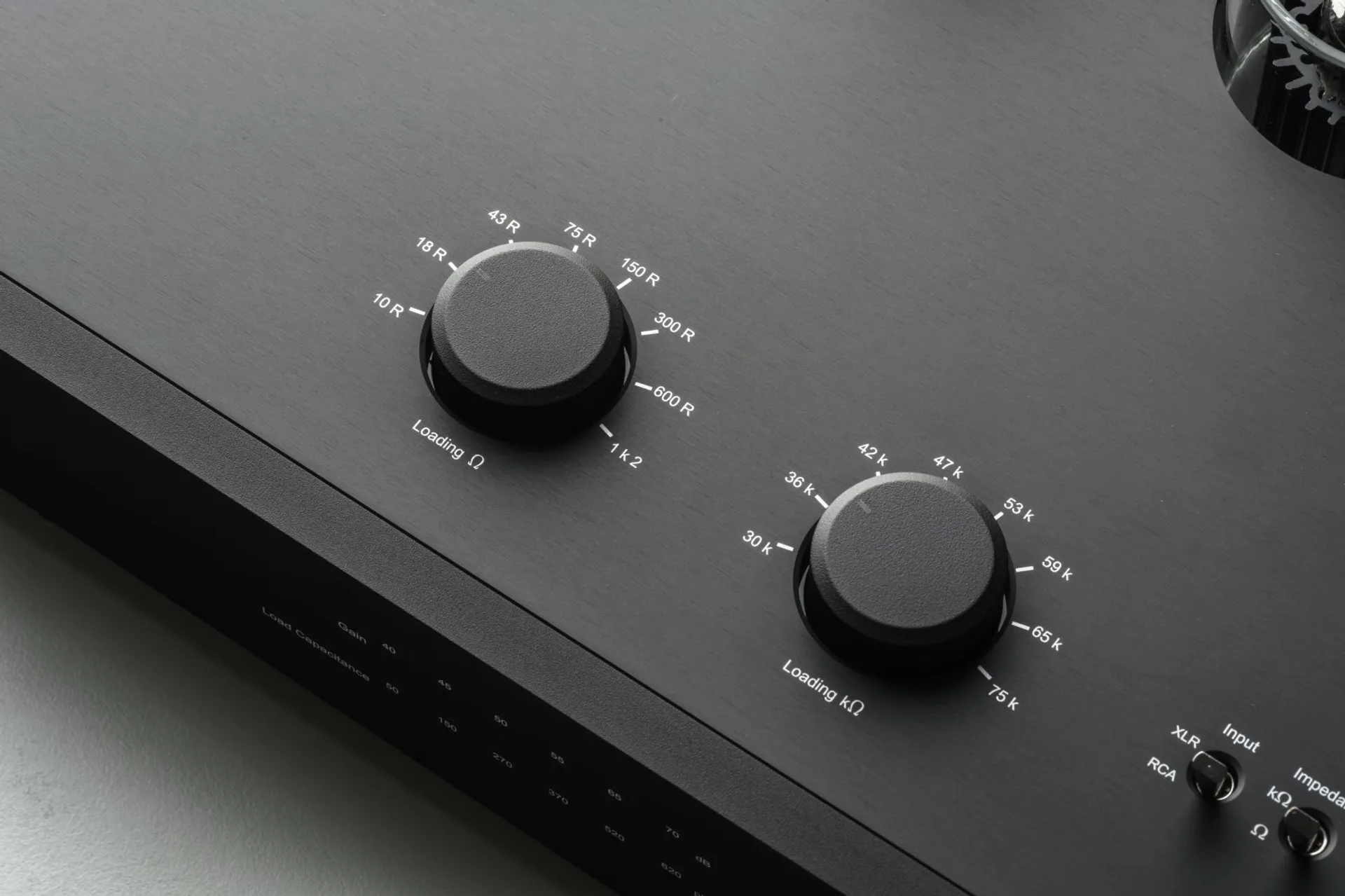
Both boxes are built for owners who change carts more often than they change apartments. Front-panel (and rear) adjustment covers the practical range:
- MM resistance: 30,000–75,000 Ω
- MM capacitance: 50–620 pF
- MC loading: 10 Ω to 1.2 kΩ
- Gain steps: 40, 45, 50, 55, 65, 70 dB (balanced XLR outs add another 6 dB)
Noise figures (manufacturer): CB quotes MM >92 dBV and MC >80 dBV; SB quotes MM >90 dBV and MC >80 dBV. Treat those as datasheet ceilings under EAT’s test framing, not a substitute for how quiet your specific cart and cable run will be.
If you are still building the mechanical front end, tonearm geometry and setup still decide more than any phono badge – start with our tonearm primer before chasing another 5 dB of gain.
Inputs, outputs, and chassis
Both support balanced XLR connectivity aimed at MC cartridges (where common-mode rejection pays off most) and RCA for MM and MC. RCA and XLR outputs can run at the same time – handy when you feed a balanced preamp and keep a single-ended tap for a second system or measurement chain.
Dimensions match the full-width E-Glo aesthetic: 395 × 86 × 262 mm (15.6 × 3.4 × 10.3 in). Weight: about 5.0 kg (CB) and 5.1 kg (SB).
Spec comparison table
| Feature | E-Glo CB | E-Glo SB |
|---|---|---|
| U.S. SRP | $4,599 | $6,250 |
| Second stage | Hybrid: 2× ECC83S + transistor (single-ended mid) | Symmetrical tube: 2× ECC83S + 2× E88CC |
| Capacitors (gain/RIAA) | Standard for CB platform | Higher-grade semi-crystalline hydrocarbon PP |
| Gain steps | 40–70 dB (+6 dB XLR) | 40–70 dB (+6 dB XLR) |
| MM load / capacitance | 30k–75k Ω / 50–620 pF | Same |
| MC loading | 10 Ω–1.2 kΩ | Same |
| Subsonic | 20 Hz, 18 dB/oct (switchable) | 20 Hz, 18 dB/oct |
| S/N (MM / MC) | >92 / >80 dBV | >90 / >80 dBV |
| Dimensions | 395 × 86 × 262 mm | Same |
| Weight | ~5.0 kg | ~5.1 kg |
| Power | External 18 V | External 18 V |
For a completely different price floor – desktop MM/MC boxes rather than full-width tube stages – see our Fosi BOX X1–X5 comparison. Different problem, different money.
Who should track which model
Look at the E-Glo CB if…
- You want balanced MC input, serious loading range, and some tube character without five-figure phono spend.
- Your system is strong but not already built around a fully balanced tube signal path end to end.
- You value a switchable subsonic filter for warped records or a lively subwoofer.
Look at the E-Glo SB if…
- You already run a balanced preamp and a low-output MC, and you want the middle gain stage to stay tube and symmetrical.
- You were eyeing the E-Glo FB but want a step below flagship tube count and PSU complexity.
- Capacitor grade and fully tube second-stage topology are part of how you shop, not marketing wallpaper.
You can wait if…
- Your deck is still on a built-in phono or a basic MM stage and the cart is entry-level – fix the mechanical front end first.
- You need confirmed regional pricing outside the U.S. SRP ladder before budgeting.
- You want the absolute reference path: the E-Glo FB remains the all-tube, fully balanced statement piece in EAT’s own catalogue.
FAQ
What are the EAT E-Glo SB and E-Glo CB?
They are two new balanced phono stages from European Audio Team, sitting between the compact Petit B and flagship E-Glo FB. U.S. SRPs are $6,250 (SB) and $4,599 (CB).
What does the “B” mean on EAT E-Glo models?
In EAT’s naming, B points to the balanced architecture: balanced XLR connectivity and symmetrical gain-stage thinking, not just a badge on an RCA box.
How do E-Glo CB and SB differ?
The shared platform covers loading, gain steps, dual-mono layout, and I/O. The fork is the second gain stage: CB uses a hybrid tube-transistor mid stage; SB uses a fully tube symmetrical mid stage with upgraded capacitors and stays closer to the FB design idea.
Do these support MM and MC cartridges?
Yes. Loading covers MM resistance/capacitance and a wide MC impedance range, with gain from 40 dB to 70 dB. Balanced XLR inputs are aimed especially at MC systems where common-mode rejection helps most.
How does this compare with the E-Glo FB?
The FB remains EAT’s flagship all-tube, fully balanced phono stage with a separate PSU and higher tube count. CB/SB borrow the balanced-family philosophy at lower price points with different mid-stage implementations rather than cloning the FB wholesale.
Where can I buy E-Glo SB or CB?
In North America, availability is through VANA Ltd dealers. Elsewhere, check EAT’s phono stages page and local authorised partners for regional pricing.
Sources
- European Audio Team: Phono Stages catalogue (Petit B, E-Glo FB family context): europeanaudioteam.com
- European Audio Team: E-Glo FB product page (flagship reference): europeanaudioteam.com
- European Audio Team: E-Glo Petit B product page (compact balanced sibling): europeanaudioteam.com
- VANA Ltd (North American distributor): brand / dealer channel: vanaltd.com