Web developers and digital designers earn a median $98,090 per year, according to the U.S. Bureau of Labor Statistics (May 2024 data). Employment is projected to grow 7% from 2024 to 2034 — faster than the average for all occupations — with roughly 14,500 job openings per year over that period. The challenge in 2026 is not whether to learn web development. It is choosing where to start. Between free platforms like freeCodeCamp and The Odin Project, subscription courses on Scrimba and Codecademy, video libraries on Udemy, and mentor-led bootcamps like CareerFoundry, the options are substantial — and most beginners either pick something that does not match how they learn or bounce between resources without finishing any of them. This guide compares the major platforms side by side: what each includes, what it costs, how long it takes, and who it is genuinely suited for.
What web development actually covers
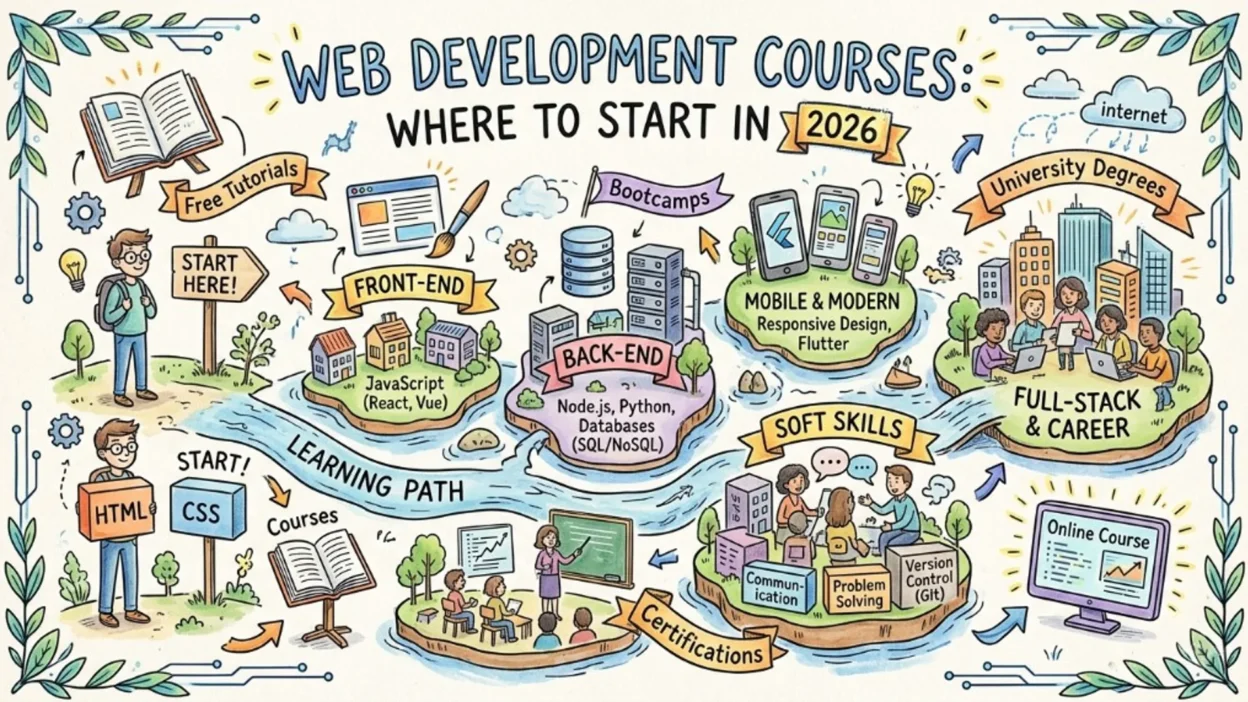
Web development splits into three areas:
- Front end (client-side): What users see and interact with — built with HTML, CSS, and JavaScript. Front-end developers add frameworks like React or Vue on top of those foundations.
- Back end (server-side): Server logic, APIs, authentication, databases, and infrastructure. Common technologies: Node.js, Python (Django, FastAPI), PHP, SQL.
- Full stack: A developer comfortable working on both sides of the application.
JavaScript is the backbone of modern web development. According to the Stack Overflow 2025 Developer Survey — 49,009 respondents across 177 countries — JavaScript is the most commonly used programming language for the 13th consecutive year, used by 66% of all developers and 68.8% of professional developers. Every worthwhile web development course in 2026 covers JavaScript. How thoroughly each one teaches it determines the course’s real value.
The main platforms, compared
Prices reflect published rates as of early 2026. Udemy prices fluctuate with sales.
| Platform | Price | Format | Duration | Technologies | Best For |
|---|---|---|---|---|---|
| Scrimba Frontend Path | Free tier / $24.50/mo annual ($294/yr) | Interactive screencasts | 81.6 hrs | HTML, CSS, JS, React, accessibility | Hands-on learners; MDN-aligned |
| Scrimba Fullstack Path | $24.50/mo annual | Interactive | 108.4 hrs | JS, React, Node, Next.js, TypeScript, SQL, Supabase, AI | Career changers wanting a complete path |
| freeCodeCamp | Free | Text + challenges | 300+ hrs | HTML, CSS, JS, React, Node, Python | Self-disciplined learners with zero budget |
| The Odin Project | Free | Project-based | Self-paced | HTML, CSS, JS, React, Node, Ruby | Self-starters comfortable with real dev tools |
| Codecademy Full-Stack | $39.99/mo | Browser exercises | ~150 hrs | HTML, CSS, JS, React, Node, SQL | Structured exercises with immediate feedback |
| Coursera IBM Full-Stack | Free audit / ~$49/mo | Video + projects | ~12 months | HTML, CSS, JS, React, Node, Python | Learners who want a recognized credential |
| CareerFoundry | ~$6,900 | Mentor-led bootcamp | 5–10 months | HTML, CSS, JS, React | Career changers needing 1-on-1 support & job guarantee |
| Frontend Masters | $39/mo | Expert workshops | Self-paced | JS, React, Vue, TypeScript, Node | Working developers leveling up |
| Udemy — Angela Yu | ~$15–20 on sale | Video | 66 hrs | HTML, CSS, JS, React, Node, Web3 | Video learners wanting comprehensive depth |
| Udemy — Colt Steele | ~$15–20 on sale | Video | Self-paced | HTML, CSS, JS, Node, Express, DBs | Project-driven full-stack ramp |
| MDN Learn Web Development | Free | Documentation | Self-paced | HTML, CSS, JS | Authoritative reference; no certificate |
| Mimo | Free / $12.49/mo | Mobile gamified | Self-paced | HTML, CSS, JS, Python | Mobile learners building daily habits |
Free options: what you actually get
Free does not mean thin. The strongest free platforms offer complete curricula, not trimmed previews of a paid product.
freeCodeCamp
freeCodeCamp is entirely free with no paid tier. Its curriculum covers responsive web design, JavaScript algorithms, front-end libraries, APIs, relational databases, and more — organized into 15 certification tracks totaling 300+ hours. The format is text-based with browser challenges. There are no video explanations and no instructor interaction. Learners who can stay self-directed through that format get a complete education at no cost. The freeCodeCamp YouTube channel (10 million+ subscribers) adds free video content for learners who prefer watching.
The Odin Project
The Odin Project is free and open-source. Unlike most platforms, it requires setting up a real development environment from day one using professional tools — the same workflow a working developer uses. Every module ends with a portfolio project. The curriculum covers HTML, CSS, JavaScript, React, Node.js, and either a Ruby or JavaScript backend track. The community Discord is active. The trade-off: the learning curve is steeper, and learners who need step-by-step guidance often find it frustrating.
MDN Learn Web Development
MDN Learn Web Development is Mozilla’s official HTML, CSS, and JavaScript curriculum. Documentation-style: no videos, no interactive exercises, no certificates. It is the most authoritative standards-based instruction available — maintained by the organization behind Firefox and the web standards themselves. Scrimba’s Frontend Path teaches the entirety of this curriculum in an interactive format for learners who prefer guided instruction.
Paid options: where the money goes
Paid platforms offer structure, interactivity, feedback, and community — elements that help learners stay consistent and finish.
Scrimba
Scrimba is built on an interactive scrim format: you pause the instructor’s screencast and edit their code directly in the browser, with no local setup required. The Frontend Developer Career Path (81.6 hours) is the only interactive course platform aligned with Mozilla’s MDN Curriculum. The Fullstack Path (108.4 hours) takes learners from their first HTML line through Node.js, Next.js, TypeScript, Supabase, SQL, and AI engineering, with 12+ solo projects included. The Fullstack Path was ranked #1 on Product Hunt in Education. Scrimba Pro costs $24.50/month on the annual plan ($294/year), with regional and student discounts available. The platform’s Discord has over 75,000 members, and students report landing developer jobs within 4–11 months of enrollment.
Codecademy Full-Stack Engineer
Codecademy ($39.99/month) uses a split-screen browser editor with instant pass/fail feedback across roughly 150 hours of content. It suits learners who want frequent, small practice loops with clear progression across HTML, CSS, JavaScript, React, Node.js, and SQL.
Coursera IBM Full-Stack Software Developer
Free to audit; the certificate requires approximately $49/month through Coursera Plus. The IBM and Coursera names carry weight on a resume, particularly for career switchers without a technical background. Note: Coursera and Udemy announced a merger in December 2025, with the deal expected to close in the second half of 2026 — worth monitoring for long-term subscribers of either platform.
CareerFoundry
Approximately $6,900 for a mentor-led program running 5 to 10 months. Every student gets a personal mentor and career coach. The program includes a job guarantee: if you do not find work within six months of graduation, you receive a full refund. For career changers who need structured accountability, that model justifies the cost.
Frontend Masters
Frontend Masters ($39/month) is not for beginners. Expert-led workshops taught by framework authors and core contributors — the place to go once you already know JavaScript and want to go significantly deeper into React, TypeScript, Vue, or performance optimization.
Udemy (Angela Yu / Colt Steele)
Udemy courses regularly go on sale for $15–20 and offer 66+ hours of comprehensive video instruction. Strong value for video learners. One caution: check the “last updated” date before purchasing, as large Udemy courses can fall behind the newest framework releases.
Frontend vs. fullstack vs. backend: which path to choose
Frontend covers what users see: HTML, CSS, JavaScript, and a framework (typically React). Every web development path starts here.
Fullstack combines frontend with server-side work: back-end logic, databases, APIs, and deployment. Most entry-level fullstack job postings in 2026 expect at minimum — React on the front end, Node.js or Python on the back end, SQL or NoSQL databases, and working knowledge of REST APIs.
Backend focuses on server-side code, APIs, and databases. It typically requires existing frontend or programming fundamentals before specializing here makes sense.
Where to start: If you are new to web development, start with frontend. HTML, CSS, and JavaScript are prerequisites for every other path. Once you can build interactive web pages, decide whether to stay frontend or expand into fullstack. Most learners who want maximum job flexibility should target fullstack — not because backend is unimportant, but because companies hiring junior developers often prefer candidates who can work across the stack.
Realistic timelines
| Goal | Realistic timeline |
|---|---|
| Build basic websites | 2–3 months of consistent study |
| Job-ready as a frontend developer | 4–8 months of focused practice |
| Job-ready as a fullstack developer | 6–12 months |
These ranges assume consistent daily or near-daily practice. Completing a course and feeling job-ready are different milestones. Job readiness comes from building multiple projects independently — without step-by-step guidance. Structure your coursework around finishing projects you can show, not just watching lessons.
Do you need a degree?
No. The U.S. Bureau of Labor Statistics notes that web developer educational requirements range from a high school diploma to a bachelor’s degree. Employers in web development hire primarily based on demonstrated skills: a portfolio of projects, code quality, and the ability to explain what you built and why. Certificates from Scrimba, freeCodeCamp, and Coursera IBM signal completion and commitment. A portfolio project deployed to the web demonstrates capability. Most hiring managers weigh the portfolio over the certificate.
How to choose
- If you learn by doing (not just watching): Scrimba’s format keeps practice active throughout — you edit the instructor’s code directly. freeCodeCamp and The Odin Project require you to build constantly.
- If budget is zero: freeCodeCamp, The Odin Project, and MDN cover everything from fundamentals to production-ready projects. freeCodeCamp’s YouTube channel adds free video instruction.
- If you need 1-on-1 support: CareerFoundry’s mentorship model (~$6,900, job guarantee) is built for career changers who need accountability that self-paced platforms cannot provide.
- If you want a recognized credential: Coursera’s IBM Full-Stack certificate adds institutional name recognition, useful for career switchers without a technical background.
- If you are already a developer and want to go deeper: Frontend Masters is taught by framework authors and core contributors. Not a beginner platform.
- If you want to learn on a phone: Mimo works for building daily habits. It does not cover React or backend, so treat it as an on-ramp rather than a complete curriculum.
The single most important decision is picking one platform and staying with it long enough to complete real projects. Most learners who fail to learn web development do not fail because they chose the wrong course — they fail because they switched too early or consumed content without building.
FAQ
What is the best free web development course in 2026?
freeCodeCamp and The Odin Project are the strongest free options with complete curricula. freeCodeCamp offers 300+ hours of structured challenges covering the full frontend and backend stack. The Odin Project uses real development tools from the start and requires portfolio projects at the end of every module. Both can take you from beginner to job-ready at no cost.
How long does it take to learn web development?
Most learners can build basic websites within 2–3 months of consistent practice. Reaching job-readiness as a frontend developer typically takes 4–8 months. Fullstack readiness takes 6–12 months, depending on daily hours and prior experience.
Do I need a computer science degree to become a web developer?
No. The U.S. Bureau of Labor Statistics confirms education requirements range from a high school diploma to a bachelor’s degree. Employers hire based on portfolio projects and demonstrated skills, not formal credentials.
Should I learn frontend or fullstack first?
Start with frontend. HTML, CSS, and JavaScript are foundational to every web development path. Once you can build interactive pages, add backend skills if you want fullstack capability.
Is a coding bootcamp worth it?
For career changers who need structured accountability and coaching, CareerFoundry’s model (roughly $6,900 with a job guarantee) can justify the cost. For self-directed learners, freeCodeCamp or The Odin Project deliver equivalent technical education at zero cost. The better choice is the one you will consistently finish while building real projects.
What programming languages should I learn for web development?
JavaScript is non-negotiable. Start with HTML and CSS for structure and styling, then JavaScript for interactivity. Once comfortable, add a framework (React is most in-demand), then consider TypeScript and a backend language (Node.js stays in the JS ecosystem; Python is the common alternative). According to the Stack Overflow 2025 Developer Survey, JavaScript has been the most-used language for 13 consecutive years at 66% of all developers.
How much do web developers earn in 2026?
According to the U.S. Bureau of Labor Statistics (May 2024 data): web and digital interface designers earn a median $98,090/year; web developers earn a median $90,930/year. There are currently 214,900 web developers and digital designers employed in the US, with 7% job growth projected through 2034.
Sources
- U.S. Bureau of Labor Statistics, Web Developers and Digital Designers — Occupational Outlook Handbook (May 2024 data)
- Stack Overflow, 2025 Developer Survey — 49,009 respondents, 177 countries; published December 2025
- Scrimba, Best Web Development Courses and Tutorials [2026]
- Hackr.io, 16 Best Web Development Courses in 2026 — reviewed January 2026
- Mozilla, MDN Curriculum