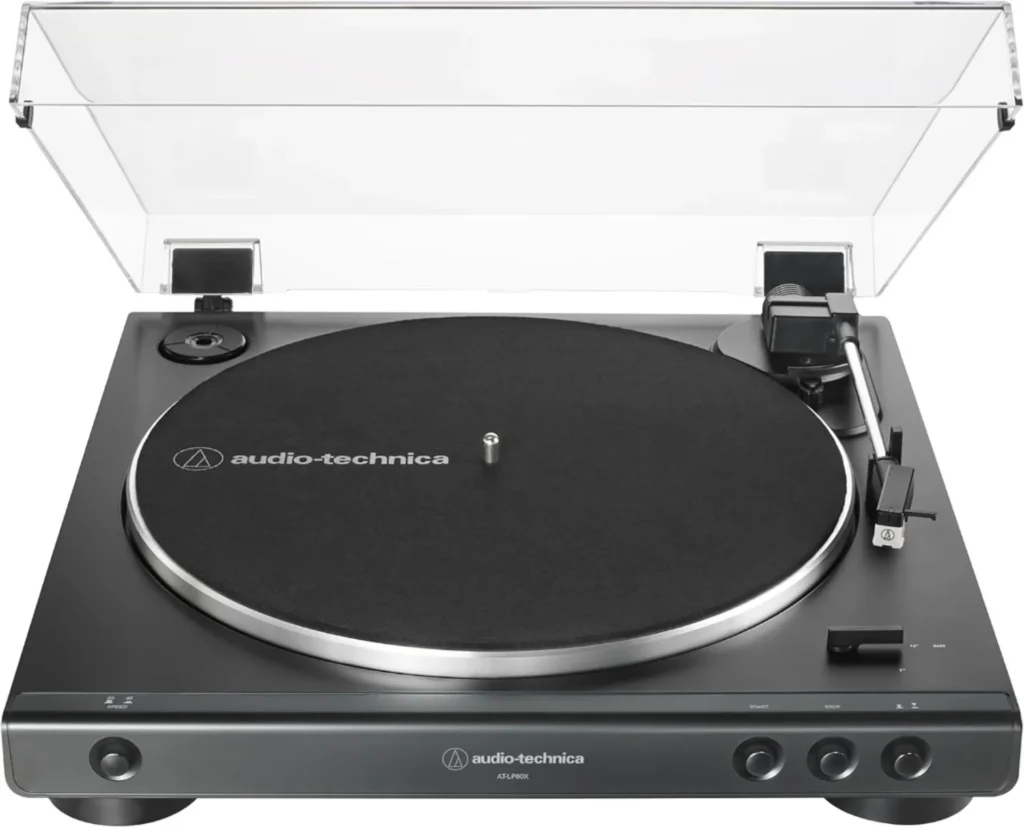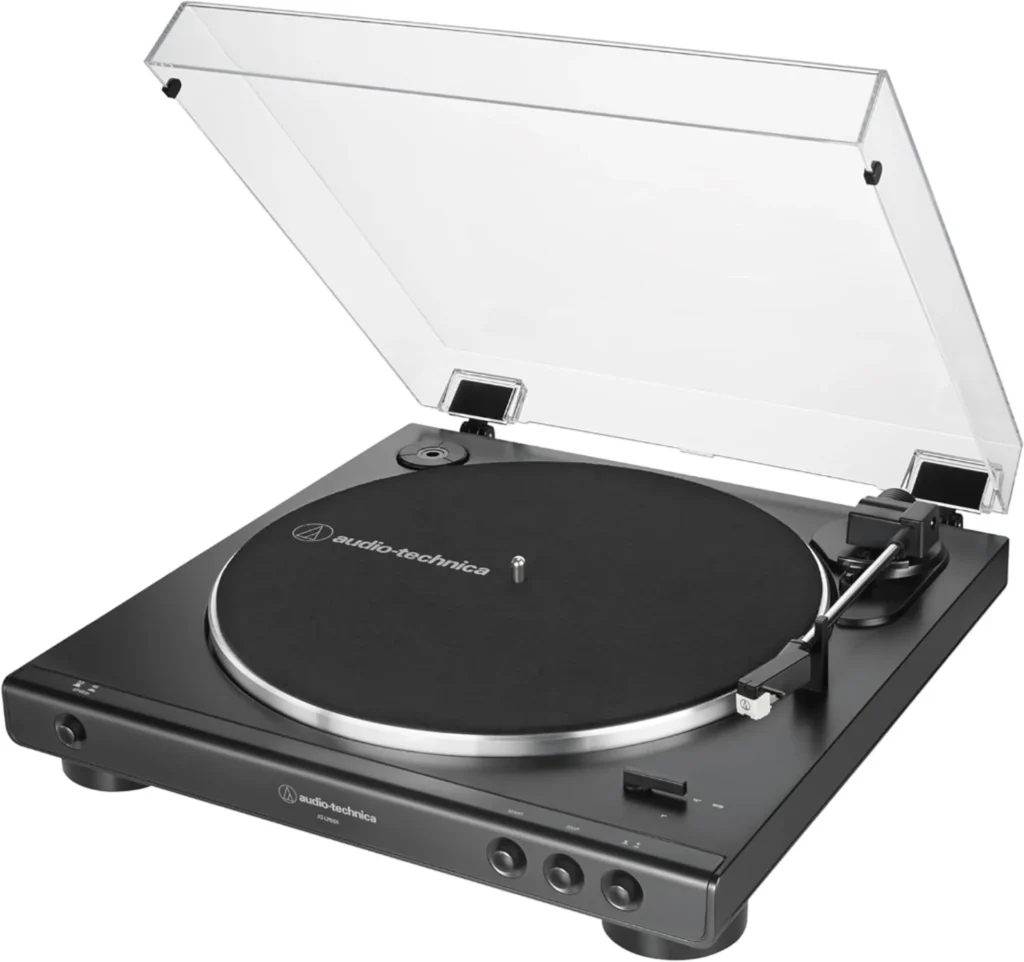
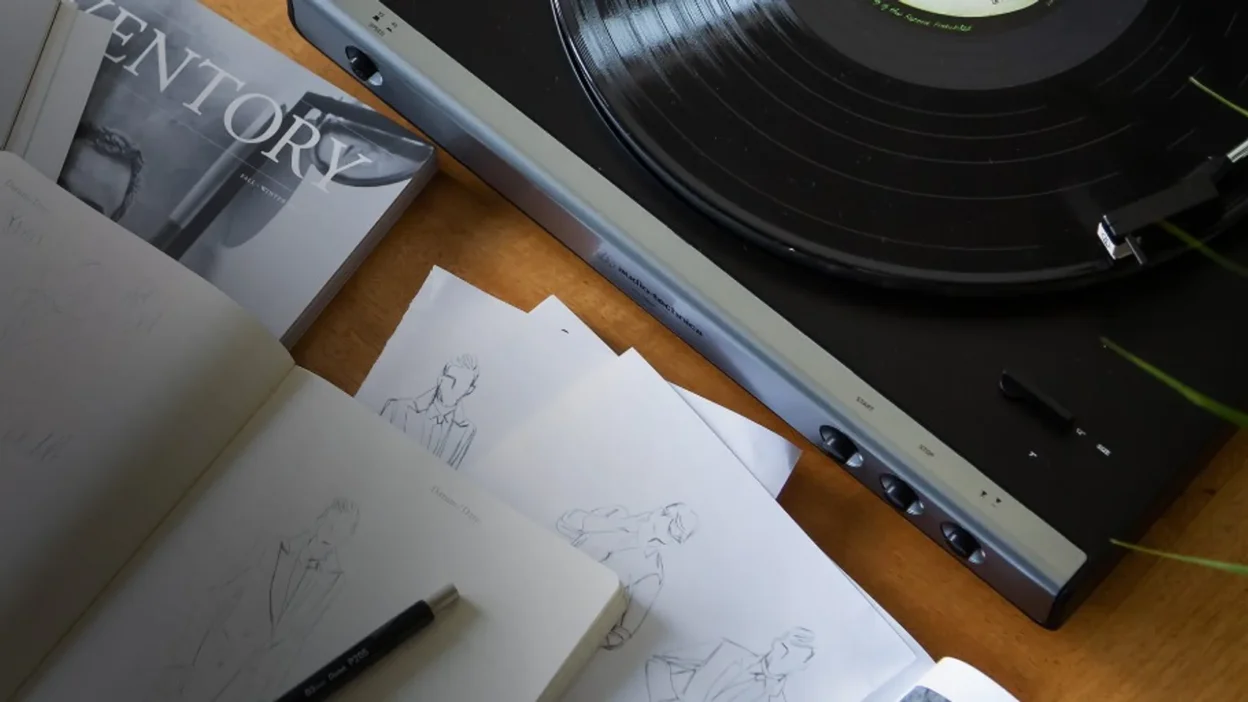
When a friend texts “I want vinyl but I don’t want a project,” I point them at the Audio-Technica AT-LP60X. Not because it’s the best turntable I’ve ever heard — it isn’t — but because it does the boring parts right: fully automatic cue and return, a switchable built-in phono stage, and a Dual Magnet cartridge with a replaceable stylus. You don’t balance a tonearm on day one. You don’t hunt for a separate preamp just to hear a record through powered speakers. That trade-off costs you upgrade headroom later. For a lot of people, that’s a fair swap.
Disclosure: The Amazon link below may earn Raw Gear Lab a commission. Verify model (AT-LP60X vs AT-LP60XBT) and price at checkout.
Specifications
I keep a spec table for decks like this because numbers anchor the story: they tell you what kind of machine you’re buying before the adjectives show up.
| Specification | AT-LP60X |
|---|---|
| Type | Belt-drive, fully automatic |
| Motor | DC servo-controlled |
| Speeds | 33-1/3 and 45 RPM |
| Platter | Aluminum |
| Wow and flutter | < 0.25 % (WTD) at 3 kHz |
| Signal-to-noise ratio | > 50 dB (DIN-B) |
| Cartridge | VM type, Dual Magnet™ with integrated headshell |
| Output (PHONO) | 2.5 mV nominal at 1 kHz, 5 cm/s |
| Output (LINE) | 150 mV nominal at 1 kHz, 5 cm/s |
| Built-in phono preamp | 36 dB nominal gain, RIAA equalized; switchable PHONO / LINE |
| Power | 100–240 V, 50/60 Hz, 0.6 A max; consumption 1.0 W; adapter 12 V, 2 A |
| Dimensions (W × H × D) | 359.5 × 97.5 × 373.3 mm (14.15 × 3.84 × 14.70 in) |
| Weight | 2.6 kg (5.73 lb) |
The LP60X generation tightened the tonearm base and headshell compared with the old AT-LP60 — better tracking, less of that hollow resonance you sometimes get on budget automatics. The power brick lives outside the chassis, which I like: keeps mains conversion out of the same box as the delicate bits.
Who it’s actually for
This deck wins when your priorities are low friction and predictable results. That’s not everyone. It’s usually:
- Your first turntable — you want music tonight, not a semester on cueing.
- Anyone running into powered bookshelf speakers or a small amp that only has line in (flip to LINE on the back).
- People with a classic receiver and a real phono input (use PHONO, ground if the hum tells you to).
It’s a bad fit for scratching, heavy platter mods, or building toward swap-any-cartridge flexibility. The cartridge is married to the headshell on purpose. Simple beats modular here.
Design & features
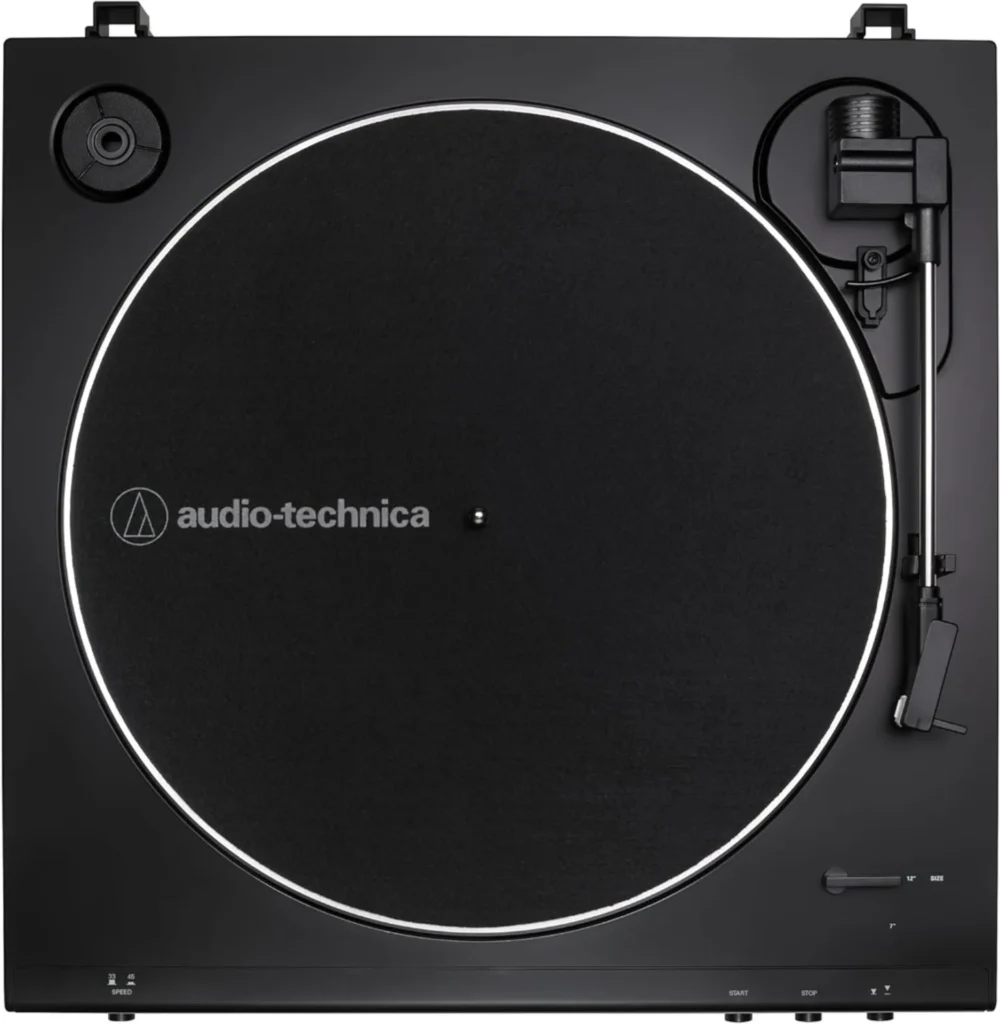
Full auto is the whole point: Start, Stop, and a tonearm lift on the front. You pick 12″ or 7″, hit 33 or 45, and the arm does the rest. The 45 RPM adapter for big-hole singles is in the box.
The switchable phono stage is why this thing survives in 2026. PHONO goes to a phono input only — period. LINE goes to anything expecting a line-level signal. Get it backwards and you’ll either wonder why it’s whisper-quiet or why the mids sound like they’re clipping through a wall.
In the box you get what you need: dust cover, felt mat, platter and belt, RCA lead (roughly 1.2 m on my notes), wall adapter (~1.5 m cable). The U.S. bundle I’ve seen ships with a detachable 3.5 mm to dual RCA — handy for some powered speakers; you might still need an adapter depending on your gear.
Sound & limitations
In practice the AT-LP60X is stable stereo with a noise floor low enough that you stop thinking about the deck and start arguing about pressings again. Those wow/flutter and S/N numbers describe pitch stability and hiss, not whether your jazz collection will sound “analog enough.” Character comes from the factory VM / Dual Magnet cart and whatever you plug it into — especially whether you’re on LINE into a bright speaker or PHONO into a warm receiver.
What you don’t get: isolation theater, a counterweight you dial by feel, or a glide path to moving-coil exotica. That’s the deal. The upside is consistency — the same reason this model keeps showing up on gift lists and in dorm rooms.
I swap the stylus after about 400 hours of real listening; a worn tip eats grooves. If you want a touch more detail without changing decks, look at stylus upgrades in the ATN3600 family (e.g. elliptical options in that line).
AT-LP60X vs AT-LP60XBT
The AT-LP60XBT is the same idea with Bluetooth layered on. It pairs with phones, speakers, headphones — and where both ends support it, aptX beats the mush of baseline SBC. You still have RCA; it’s not a wireless-only toy.
Finishes vary by region — black, white/black, red/black show up depending on where you shop. Expect to pay more than the wired X; by how much depends on your market and whatever sale is running.
I’d take the X if I’m always wired into an amp or powered pair. I’d take the XBT if my listening already lives on Bluetooth speakers or cans and I don’t want a cable run across the living room — knowing wireless will always be codec- and pairing-dependent.
Setup & care
Assembly is short: drop the platter, route the belt onto the brass pulley (use the red ribbon trick, then pull it out), felt mat, set PHONO/LINE before you plug anything in, then power. On first spin I give the platter ten slow hand rotations — seats the auto mechanism and the belt.
Don’t open the dust cover during playback. Don’t park it inches from a loud woofer and act surprised at feedback. The belt is a wear item; if speed drifts or rotation gets lazy, replace it — I treat that as roughly a yearly check-in if the deck gets daily use.
What else to consider
When people outgrow the LP60X, they’re usually chasing a half-inch mount, adjustable tracking force, and often a separate phono stage they can tune. That’s a different budget and a different learning curve. If you need USB ripping, buy a SKU that says USB in the name — don’t assume this one does it.
Want the geometry story in depth? Tonearm geometry & vinyl sound →
Verdict
The AT-LP60X still earns best entry-level automatic in my book: it removes the rituals that scare beginners off, the built-in stage is actually useful, and the numbers on paper match what you’d expect from a serious brand at this price. It will never satisfy someone who lives for cartridge swaps or scratch routines — and it shouldn’t have to. If you want vinyl without turning it into a second job, start here. Add Bluetooth only if your life is already wireless-first.
FAQ
Is the AT-LP60X the same as the AT-LP60XBT?
No. The XBT adds Bluetooth (with aptX when your receiving device plays along). Same automatic layout; the non-BT model is for wired setups.
Should I set the switch to PHONO or LINE?
PHONO only into a receiver’s phono input (ground if you need it). LINE into AUX, line inputs, or powered speakers that expect line level. Wrong setting means weak or ugly sound.
Can I upgrade the cartridge?
The cartridge is fixed to the headshell for simplicity. You can replace or step up the stylus in the ATN3600 line; you’re not dropping in random MM bodies like on a modular deck.
Is it good for scratching or DJ gigs?
No. It’s built for home listening, not back-cueing or stage abuse. Treat it that way.