
I’ve had a soft spot for LEAK’s industrial design for years- the aluminium trim, the retro grille, the way the brand wears British hi-fi history without looking like a museum diorama. So when the Sandwich 100 showed up as the newest, smallest box in the modern Sandwich family, I paid attention. It’s a compact two-way standmount that inherits the same sandwich-cone philosophy as the bigger 150 and 250, scaled for smaller rooms and modern shelves. This isn’t a listening review- I haven’t lived with a pair yet- it’s an introduction to what LEAK says the speaker is, and why the package matters in 2026.
Where it sits in the line
The Sandwich 100 joins the Sandwich 150 and Sandwich 250 as the most compact option. LEAK’s pitch is unchanged at the headline level: speed, articulation, transparency- the qualities that made the Sandwich name matter in the first place, now in a box that fits contemporary flats and shallow credenzas better than a floorstander ever will.
If you’re building a first serious system or downsizing from big towers, this is the SKU the lineup was missing: same family identity, smaller footprint.
The Sandwich idea- 1961, then now
The original LEAK Sandwich debuted in 1961 with a simple-sounding trick that was radical at the time: a cone built like a sandwich — light foam core, aluminium skins — so the diaphragm stayed stiff and light. Stiff and light means the driver can start and stop quickly. Quick cones mean clean transients instead of smeared attacks.
The current series keeps that philosophy but uses modern materials and tooling. The Sandwich 100 is explicitly aimed at today’s rooms and playback habits, not at cosplaying the sixties.
Drivers, crossover, cabinet
Mid/bass: The latest sandwich cone uses a Rohacell structural foam core between aluminium faces, bonded with aerospace-grade adhesive- LEAK’s language, but the point is mechanical: push break-up modes higher, keep the cone behaving as one surface for more of its range. A long-throw motor, high-gauss magnet, and low-loss suspension are there to keep motion linear when you turn the volume up.
Tweeter: A 30 mm coated textile dome — larger than typical for the class — which helps with power handling and allows a lower crossover so handoff to the mid/bass stays smooth.
Crossover: 2.2 kHz, built with polypropylene caps, air-core inductors, and low-loss resistors. LEAK stresses phase alignment and imaging stability off-axis, which matters in real rooms where nobody sits in a laser-aligned sweet spot all night.
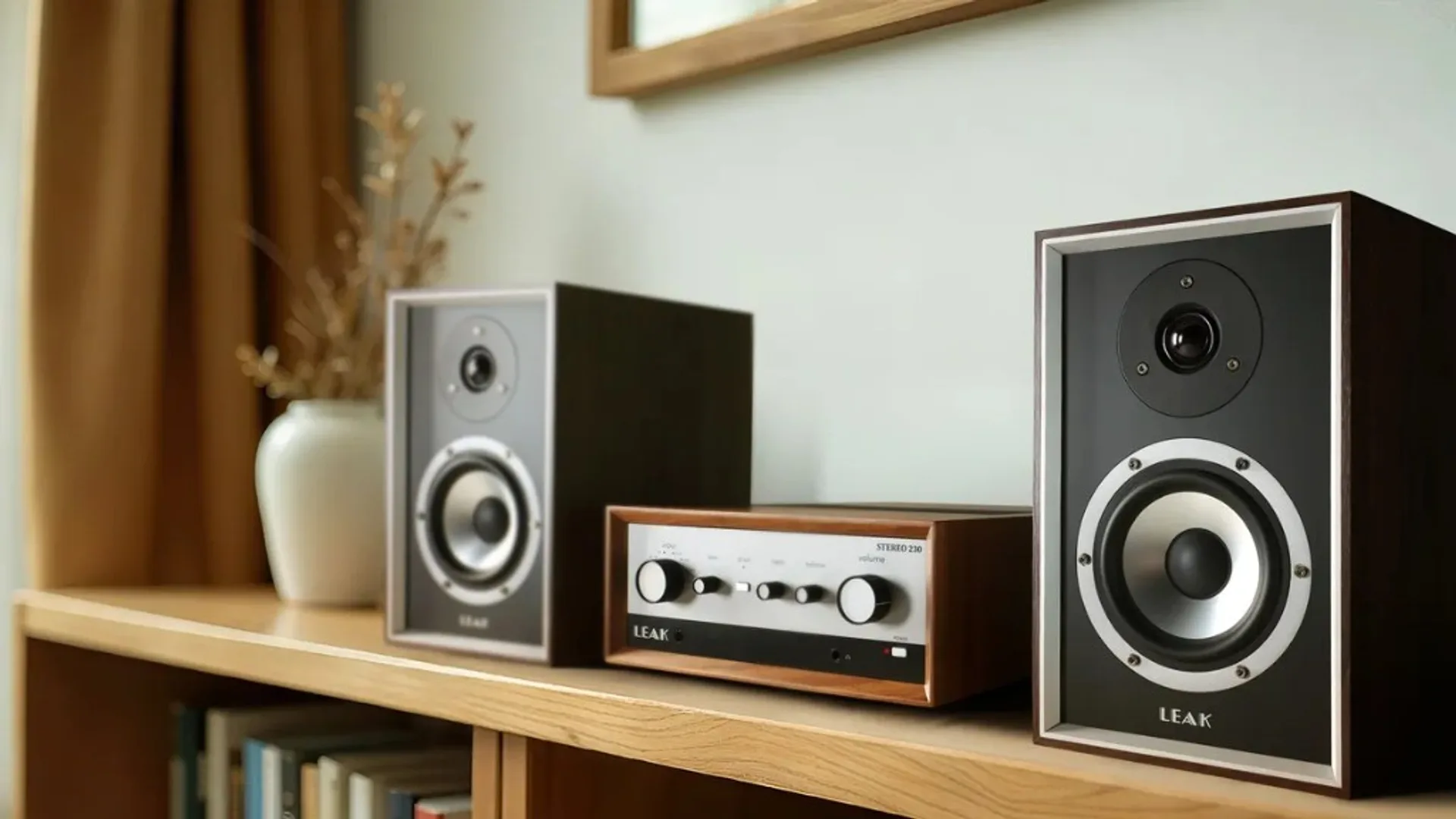
Cabinet: Internal bracing, damping to tame internal reflections, rear port for bass extension. The cloth grille is described as part of the voicing, not an afterthought — I’m curious how much character comes off with the grille removed; LEAK says it’s removable for a cleaner face.

Why the look still works
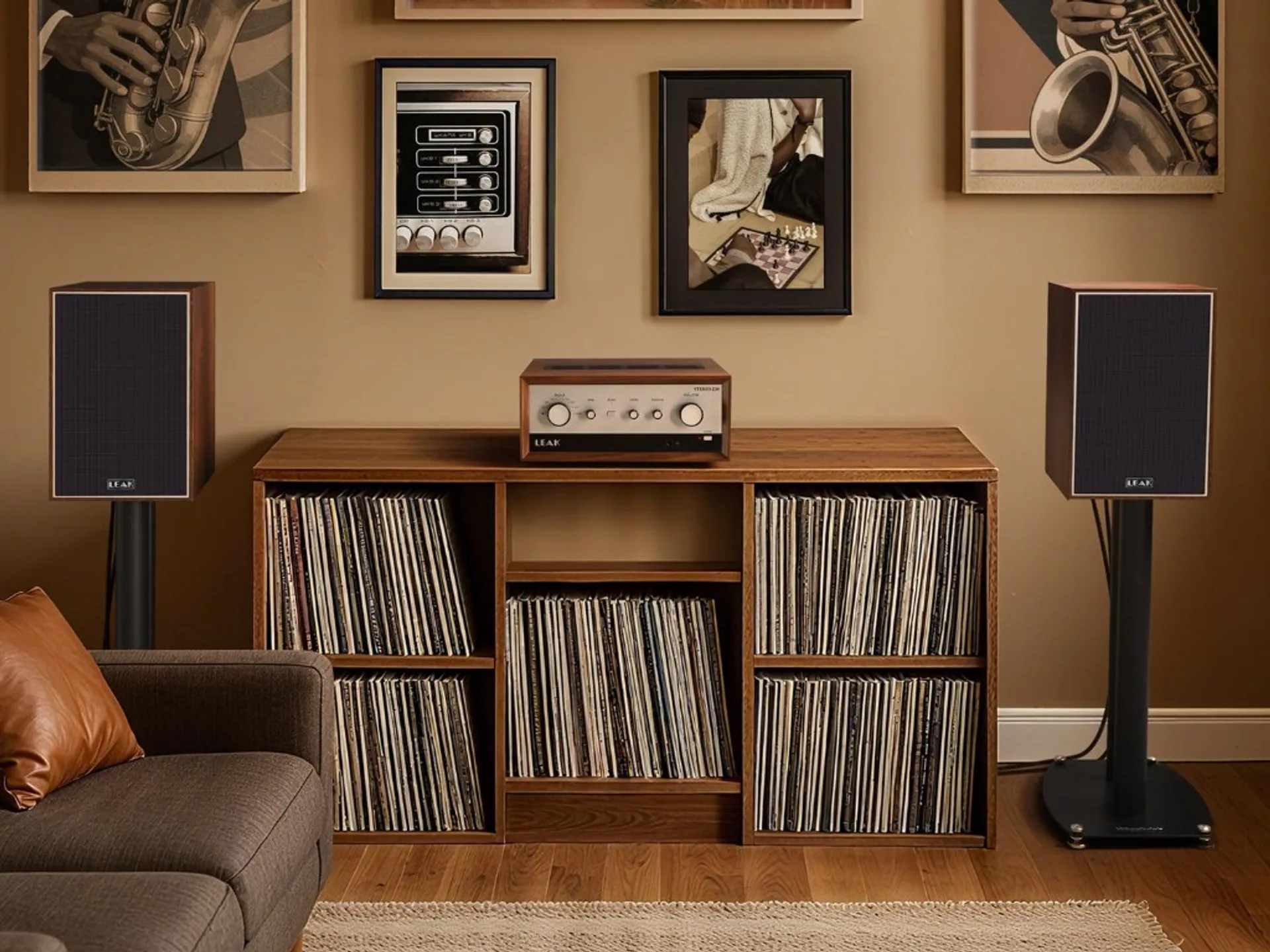
Here’s where I stop pretending I’m neutral. LEAK gets the object right. The walnut-effect wrap, the black baffle, the aluminium trim that nods to vintage panels without pastiche — it reads as furniture that happens to make sound. Too many “heritage” brands either go full cosplay or strip all personality for Scandinavian blankness. LEAK usually lands in the narrow band where I’d actually want the thing visible in a living room.
The Sandwich 100 is the same design language in a smaller silhouette. That matters if you care about how gear sits in a room as much as how it measures.
Pairing & placement
LEAK positions the Sandwich 100 as a natural partner for its own electronics Stereo 130, Stereo 230, or the TruStream streamer — as a compact but serious stack. That’s marketing symmetry, but it’s also practical: the brand has already tuned the voicing family in-house.
On paper, 86 dB sensitivity and a 4.8 Ω minimum impedance mean you’ll want an amp that’s comfortable with current, not the wispiest chip amp on the desk — nothing exotic, just honest power within the quoted 25–100 W recommendation. Stands or solid shelving, some breathing room around the rear port, and the usual toe-in experiment.
Spinning vinyl? The deck matters less than phono stage gain and noise matching your cartridge — if you’re new to the chain, our tonearm geometry primer is a sane next read.
Specifications
Figures below are as listed on the official Sandwich 100 product page at time of writing.
| Specification | Sandwich 100 |
|---|---|
| Type | 2-way vented-box / standmount, bass reflex |
| Bass / mid driver | 5.75″ (150 mm) aluminium–foamcore sandwich cone |
| Treble driver | 1.2″ (30 mm) coated textile dome |
| Sensitivity (2.83 V @ 1 m) | 86 dB |
| Recommended amplifier power | 25–100 W |
| Peak SPL | 102 dB |
| Nominal impedance | 6 Ω (8 Ω compatible) |
| Minimum impedance | 4.8 Ω |
| Frequency response (±3 dB) | 49 Hz – 20 kHz |
| Bass extension (−6 dB) | 44 Hz |
| Crossover frequency | 2.2 kHz |
| Internal volume | 10.6 L |
| Dimensions (H × W × D) | 340 × 210 × (250+20) mm (depth inc. terminals) |
| Net weight | 7.86 kg each |
| Finish | Walnut (as listed) |
| Included | Rubber feet |
Bottom line
The Sandwich 100 is LEAK’s bet that you can shrink the Sandwich formula without giving up the identity that makes the line interesting materials engineering in the cone, careful crossover work, and industrial design that still feels special. I’m here for that last part as much as the spec table.
When I get ears on a pair, I’ll report back on whether the bass stays honest in a real room and how the treble behaves at imperfect seating angles. Until then: if you’re shopping compact British standmounts in 2026, this one belongs on the short list and on the shortlist of things you won’t hide behind a plant.
Learn more: LEAK — Sandwich 100 Loudspeaker
Note: Acoustic design led by Peter Comeau (Heybrook HB1/HB2; work across Wharfedale, Mission, and LEAK under IAG, with research in Huntingdon, UK and Shenzhen). Product availability and finishes vary by region — confirm on LEAK’s site or dealers.