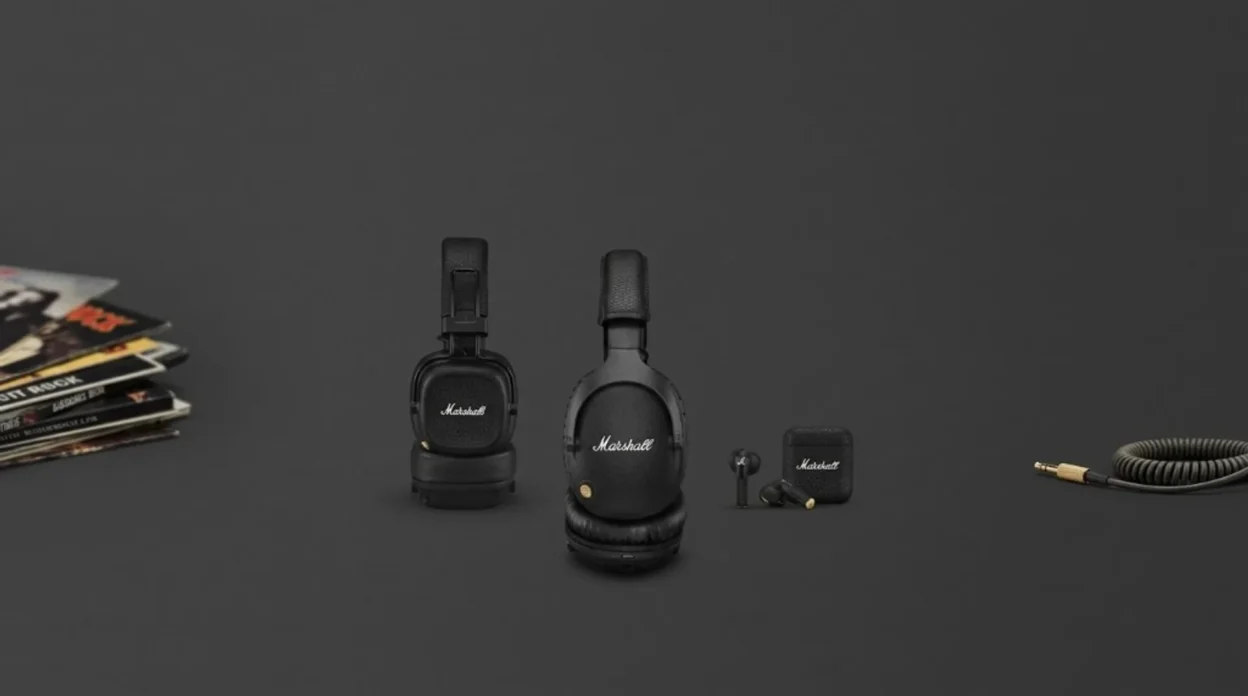
Marshall sells headphones the same way it sells amps: loud branding, rock-and-roll cosmetics, and a warm, punchy house tuning that stands apart from neutral studio gear. In 2026, the current wireless catalog that most buyers should compare breaks down into four SKUs: Minor IV (compact true wireless), Major V (foldable on-ear), Motif II A.N.C. (noise-cancelling earbuds), and Monitor III A.N.C. (flagship over-ear ANC).
Quick comparison: the four current Marshall wireless models
The table below mirrors Marshall’s own “PRODUCT DETAILS” summaries and headline feature copy. It is not a substitute for reading the full pages if you care about accessories, box contents, or regional SKUs.| Model | Form factor | ANC / transparency | Playtime (Marshall) | Multipoint | Wireless charging | LE Audio–ready |
|---|---|---|---|---|---|---|
| Minor IV | True wireless in-ear | No ANC listed | 7 h buds; 30+ h total with case | Yes | Yes (case) | Yes |
| Major V | On-ear wireless | No ANC | 100+ h wireless | Yes | Yes (headphones) | Yes |
| Motif II A.N.C. | True wireless in-ear | ANC & transparency (app) | 6 h buds with ANC (9 h without); 30 h total with case & ANC (43 h without) | Yes | Yes (case) | Yes |
| Monitor III A.N.C. | Over-ear wireless | ANC & transparency | 70 h with ANC; 100 h without ANC; 15 min quick charge → 12 h | Yes | Not listed on product details* | Yes |
* Marshall’s Monitor III A.N.C. page highlights quick charge and USB–C operation in FAQs and body copy; it does not list wireless charging in the same “PRODUCT DETAILS” strip we used for the other models. If that feature matters, confirm the latest spec sheet before you buy.
Speaker lineup (same ecosystem, different use case): Best Marshall Bluetooth Speakers →
Marshall’s headphone sound signature
Across these four products, Marshall’s marketing consistently promises “Marshall signature sound” — language that usually maps to elevated bass, forward mids, and present treble rather than a flat reference curve. That voicing is a feature if you like energetic pop, rock, and hip-hop, and a limitation if you want mastering-grade neutrality. Where the models diverge is DSP and ANC. Monitor III A.N.C. adds Dynamic Loudness, Adaptive Loudness (Marshall describes this as tuning that reacts to playback level and background noise), and Soundstage spatial processing to widen stereo image perception. Motif II A.N.C. focuses on ANC and transparency for mobile use. Major V and Minor IV rely more on driver tuning plus in-app EQ via the Marshall Bluetooth app. Practical takeaway: expect fun, branded tone out of the box, with EQ sliders to tame highs or bass if your library or streaming service runs bright.Marshall Minor IV: compact true wireless
Minor IV is Marshall’s entry-oriented true wireless stem-style earbud. Marshall positions it around comfort (redesigned angle for fit), mirrored touch controls on either bud, and auto pause/play when you remove or insert an earbud (“ear detect”). The case supports wireless charging, and Marshall advertises multipoint so you can stay connected to two devices.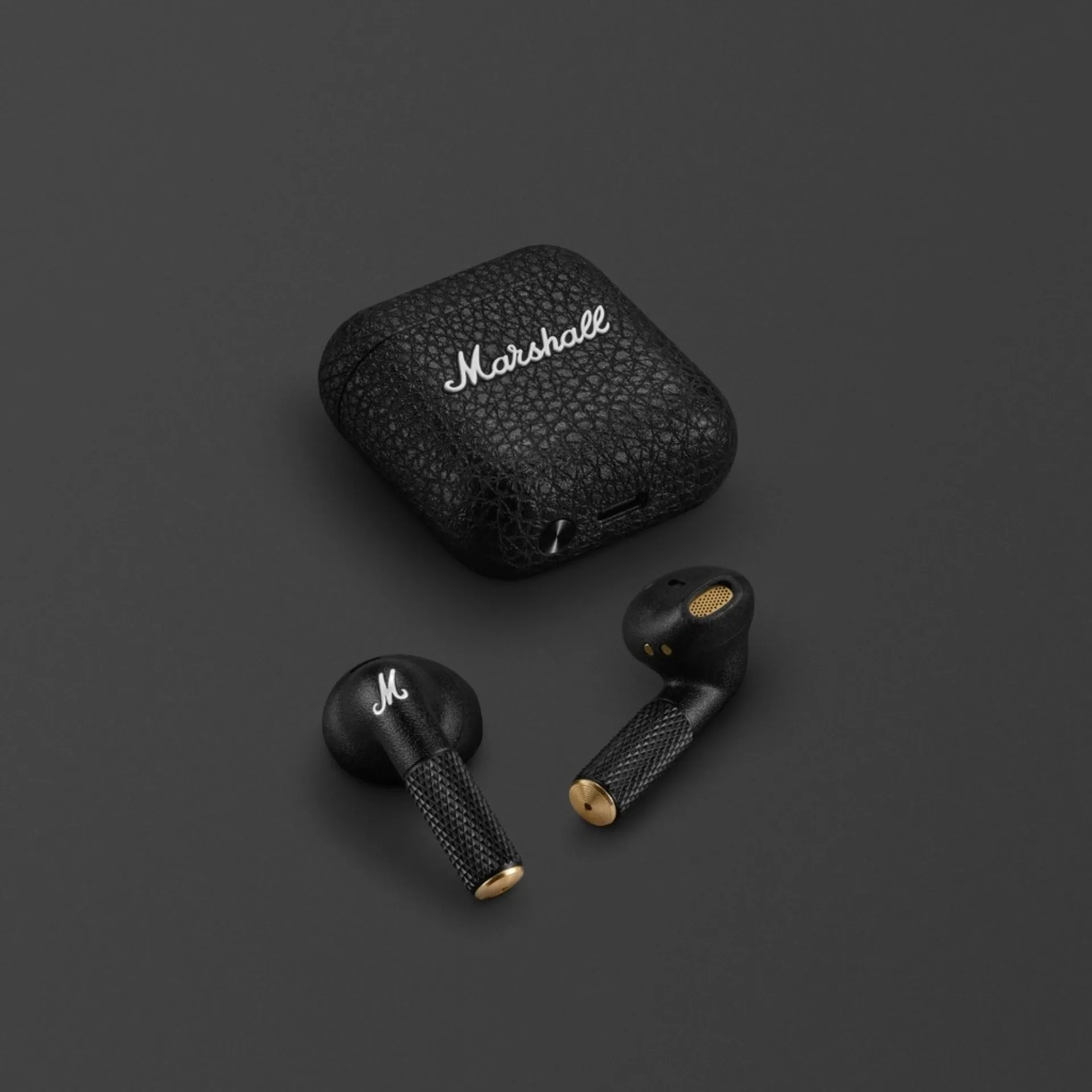 Battery figures from Marshall: up to 7 hours in the earbuds and 30+ hours total including the charging case. The product page also calls out water resistance for rain-splash scenarios (always treat manufacturer language conservatively — no substitute for checking the official IP statement for your region).
Best for: listeners who want the smallest carry, long case endurance, and Marshall styling without paying for ANC. Skip if: you need strong isolation on planes or ANC for open offices — that is Motif II A.N.C. or Monitor III A.N.C. territory.
Battery figures from Marshall: up to 7 hours in the earbuds and 30+ hours total including the charging case. The product page also calls out water resistance for rain-splash scenarios (always treat manufacturer language conservatively — no substitute for checking the official IP statement for your region).
Best for: listeners who want the smallest carry, long case endurance, and Marshall styling without paying for ANC. Skip if: you need strong isolation on planes or ANC for open offices — that is Motif II A.N.C. or Monitor III A.N.C. territory.
Marshall Major V: on-ear flagship with extreme battery life
Major V is the foldable on-ear in the lineup. Marshall quotes 100+ hours of wireless playtime — an unusually high number that matters most if you forget to charge gear or travel off-grid. Charging options include USB–C (cable in box) and wireless charging. A customisable M-button ties into the app for shortcuts such as Spotify Tap, EQ, or voice assistant. Bluetooth 5.3 is cited in Marshall’s FAQ, with LE Audio readiness called out for future use cases including Auracast.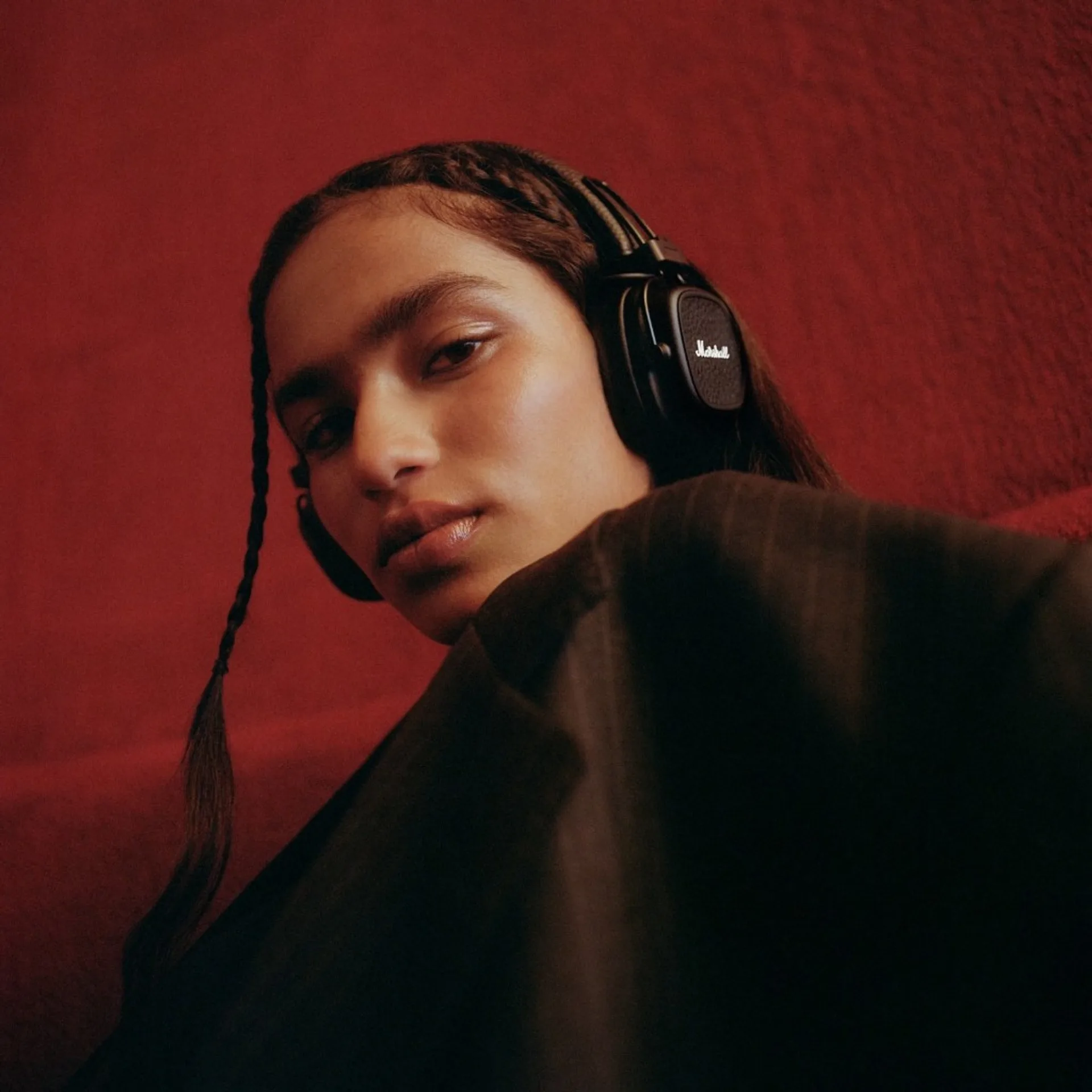 Marshall includes a 3.5 mm cable for wired listening. The FAQ is explicit that Major V is not IP rated — fine for commutes and cafes, not for poolside confidence. The brand also notes battery preservation options in the app (charge caps and temperature-aware charging) and authorised repair paths in many markets, signalling intent to extend product life.
Best for: anyone who wants on-ear comfort, physical controls (multifunction knob), and weeks between charges in typical mixed use. Skip if: you need class-leading ANC or over-ear cushion isolation — compare Monitor III A.N.C.
Marshall includes a 3.5 mm cable for wired listening. The FAQ is explicit that Major V is not IP rated — fine for commutes and cafes, not for poolside confidence. The brand also notes battery preservation options in the app (charge caps and temperature-aware charging) and authorised repair paths in many markets, signalling intent to extend product life.
Best for: anyone who wants on-ear comfort, physical controls (multifunction knob), and weeks between charges in typical mixed use. Skip if: you need class-leading ANC or over-ear cushion isolation — compare Monitor III A.N.C.
Marshall Monitor III A.N.C.: flagship over-ear noise cancellation
Monitor III A.N.C. replaces Monitor II A.N.C. as Marshall’s top over-ear wireless play. Marshall states 70 hours of playtime with ANC on and 100 hours with ANC off — figures that still outlast most competitors on paper. Quick charge is aggressive on the spec page: 15 minutes for 12 hours of playback (always verify with your charger and firmware). Feature-wise, this is where Marshall piles on DSP: Adaptive Loudness to keep tonal balance consistent across volume and environment, plus Soundstage spatial audio processing intended to move sound outside the head. ANC continuously measures ambient noise; Transparency mode brings outside sound back when you need situational awareness. Controls centre on a multidirectional knob (playback, volume, calls, power, pairing) and another customisable M-button for Spotify Tap, Soundstage toggle, dual EQ presets, or assistant.
Marshall’s FAQ directly compares Monitor III to Monitor II: revisited acoustic design, new custom-tuned drivers, and improved DSP for clearer, better staged sound. Materials messaging highlights recycled plastic content, DMFa-free alternatives to older vegan leather on headband and case, and PVC-free construction. The headphones fold into a premium hard case for travel.
Best for: frequent flyers, open-plan workers, and anyone who wants over-ear isolation with Marshall aesthetics and long ANC-on runtime. Color and finish options evolve — for example, see Marshall’s Monitor III A.N.C. in Cream on Raw Gear Lab.
Skip if: you want the smallest travel footprint — earbuds win on pack size even though they trade away cushion comfort.
Feature-wise, this is where Marshall piles on DSP: Adaptive Loudness to keep tonal balance consistent across volume and environment, plus Soundstage spatial audio processing intended to move sound outside the head. ANC continuously measures ambient noise; Transparency mode brings outside sound back when you need situational awareness. Controls centre on a multidirectional knob (playback, volume, calls, power, pairing) and another customisable M-button for Spotify Tap, Soundstage toggle, dual EQ presets, or assistant.
Marshall’s FAQ directly compares Monitor III to Monitor II: revisited acoustic design, new custom-tuned drivers, and improved DSP for clearer, better staged sound. Materials messaging highlights recycled plastic content, DMFa-free alternatives to older vegan leather on headband and case, and PVC-free construction. The headphones fold into a premium hard case for travel.
Best for: frequent flyers, open-plan workers, and anyone who wants over-ear isolation with Marshall aesthetics and long ANC-on runtime. Color and finish options evolve — for example, see Marshall’s Monitor III A.N.C. in Cream on Raw Gear Lab.
Skip if: you want the smallest travel footprint — earbuds win on pack size even though they trade away cushion comfort.
Marshall Motif II A.N.C.: true wireless with active noise cancellation
Motif II A.N.C. sits above Minor IV when you need ANC and transparency in a true wireless form. Marshall describes improved ANC versus the prior generation and app control over both ANC strength and transparency. Playtime is quoted as 6 hours in the buds with ANC on (9 hours with ANC off) and 30 hours total with the case when using ANC (43 hours total with ANC off) — a useful reminder that ANC drains every TWS product; the case is doing real work here.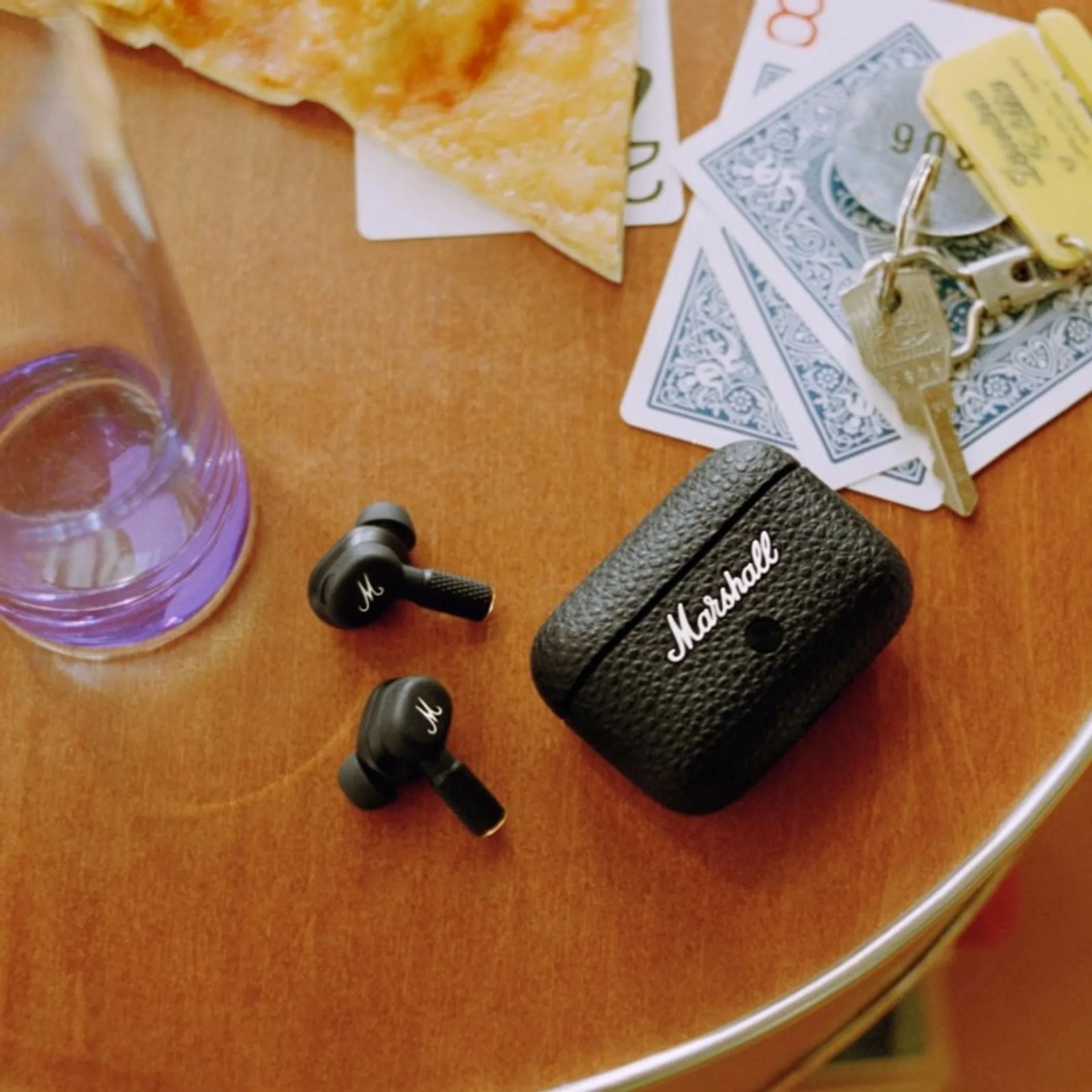 The charging case supports wireless charging; Marshall advertises a quick charge that yields about 1 hour extra playtime in 15 minutes. Ear detect pauses and resumes playback when you remove buds. Multipoint is supported, and touch long-presses can be mapped (via app) to jump between EQ presets, similar in spirit to how Marshall handles controls on higher-end models.
Best for: daily carry with ANC for transit and gyms, while keeping Marshall’s visual identity. Skip if: you only need basic TWS and want to save money — Minor IV is the simpler tool. Skip toward Monitor III if you cannot tolerate in-ear tips on long flights.
The charging case supports wireless charging; Marshall advertises a quick charge that yields about 1 hour extra playtime in 15 minutes. Ear detect pauses and resumes playback when you remove buds. Multipoint is supported, and touch long-presses can be mapped (via app) to jump between EQ presets, similar in spirit to how Marshall handles controls on higher-end models.
Best for: daily carry with ANC for transit and gyms, while keeping Marshall’s visual identity. Skip if: you only need basic TWS and want to save money — Minor IV is the simpler tool. Skip toward Monitor III if you cannot tolerate in-ear tips on long flights.
How Marshall headphones compare to Sony and Bose
Buyers cross-shop Sony 1000X–series and Bose QuietComfort / Ultra headphones because those lines own the “travel ANC” mental category. Honest positioning:- Noise cancellation depth: Sony and Bose have spent years optimising hybrid ANC for jets, trains, and HVAC rumble. Marshall’s ANC on Motif II and Monitor III is credible for everyday use, but lab-style “who blocks more dB” shootouts usually still favour the incumbents — especially in earbud form factors where seal variance dominates.
- Sound character: Marshall sells identity and mid-bass energy. Sony and Bose default closer to consumer-neutral with app EQ. Neither approach is wrong; it is a taste question.
- Features: Marshall leans into Spotify Tap, LE Audio readiness, and (on Monitor III) Soundstage spatial DSP. Sony/Bose apps often push 360 audio, multipoint polish, and platform-specific perks (LDAC on Sony for Android, etc.). Check codec support on each Marshall page if you are chasing hi-res wireless — marketing focus here is Bluetooth 5.3 and future LE Audio, not a laundry list of proprietary codecs.
- Battery: Marshall’s quoted Major V and Monitor III runtimes are marketing advantages on paper. Real-world results still depend on volume, ANC use, and temperature.
Who Marshall headphones are for
Marshall makes sense when design and voicing matter as much as the spec sheet. Strong fits:- Style-conscious listeners who want hardware that reads as music gear, not office IT.
- Rock, alternative, and hip-hop fans who like punchy low-end without buying a separate bass-boost mode.
- Travellers who value Monitor III’s quoted 70-hour ANC endurance or Major V’s 100+ hours for overland trips.
- People already in Marshall’s ecosystem (speakers, amps) who want one app and consistent branding.
Portable audio from the same brand: Marshall Emberton II vs Emberton III — speaker comparison for bag carry.