The Marshall Bromley 750 is the brand’s first dedicated party speaker — not a scaled-up bookshelf box, but a wheeled, stage-amp-styled system built for loud rooms and outdoor hangs. Marshall positions it around True Stereophonic 360° sound, 40+ hours of quoted portable playtime from a removable LiFePO4 battery, IP54 splash and dust resistance, and a control surface that could pass for a piece of backline gear. This guide walks through what the Bromley 750 is, how the hardware is laid out, and where it fits among large-format Bluetooth speakers, using Marshall’s published specifications and feature copy as the source of record.
What the Marshall Bromley 750 is (and isn’t)
Marshall built its reputation on guitar amplifiers, then leaned into headphones and smaller Bluetooth speakers. The Bromley 750 is a deliberate step into the large-format portable party category: high SPL, wheeled transport, and inputs aimed at hosts, performers, and outdoor gatherings rather than desktop listening.
What you are buying is volume and presence, 360° coverage from a single cabinet, and live-input flexibility (dual XLR / 6.35 mm combo jacks) more than hi-res streaming bragging rights. Marshall lists SBC, AAC-MPEG 2, and LC3 over Bluetooth — no LDAC or similar on the sheet we are working from.
Related hub: Best Marshall Bluetooth Speakers →
Design, portability & IP54
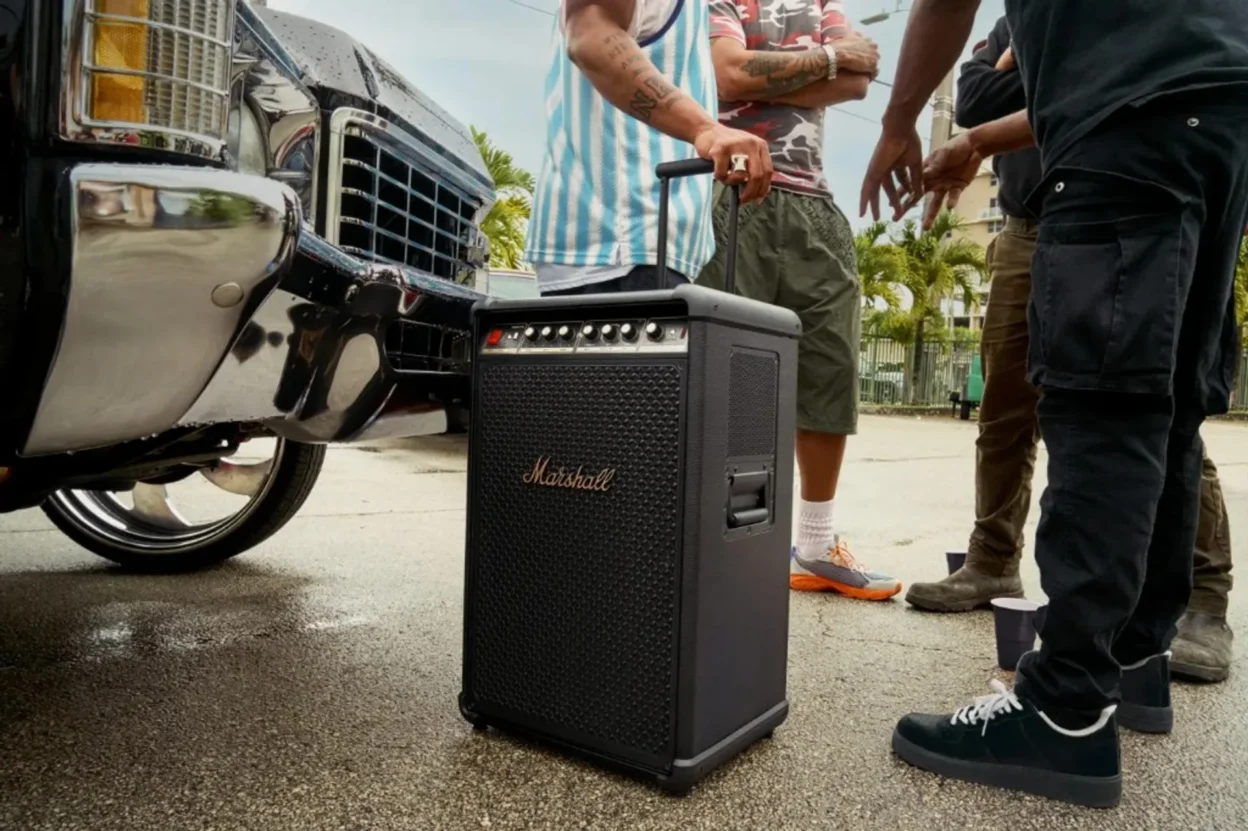
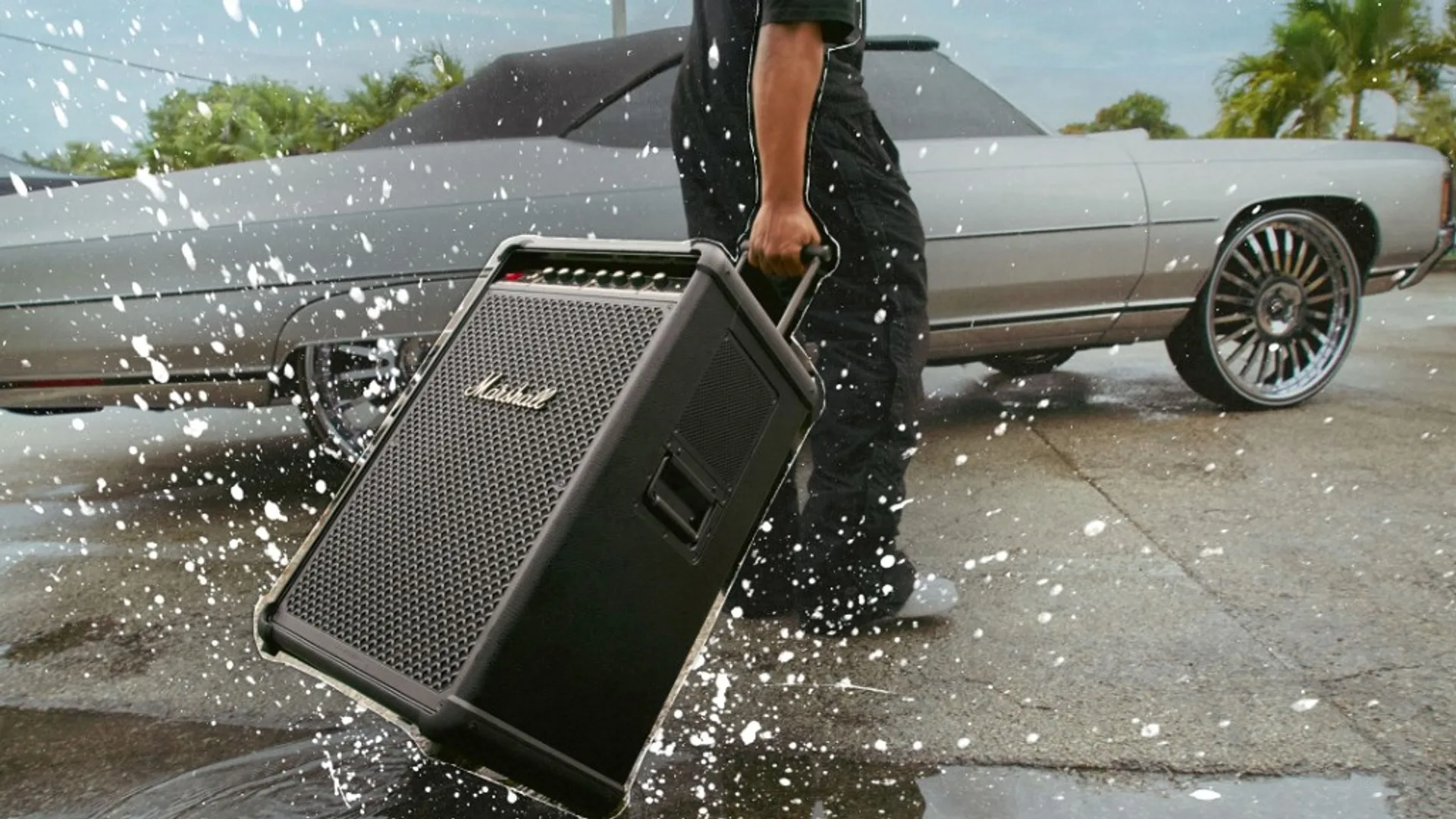
The industrial story is stage amplifier: black and brass, textured cabinet, metal grille, and a top panel dense with knobs and switches. Marshall rates the enclosure IP54 for dust and splashes — sensible for patios, campsites, and “someone knocked over a drink” scenarios, but not pool-submersion territory.
Physically, Marshall quotes 652 × 413 × 355 mm (HWD), 23.9 kg / 52.7 lb for the speaker, and 33.5 kg / 73.9 lb including packaging. This is a two-person lift for many buyers; Marshall mitigates with integrated wheels, a retractable handle, and side grips. Retail listings often flag heavy shipment — plan for that if you are importing or carrying upstairs alone.
Origin line from Marshall: designed and engineered in Sweden, made in China — standard for the category, but worth stating for readers who care about labeling.
Sound, SPL & True Stereophonic
On paper the Bromley 750 is a closed-box stereo system with a serious driver complement:
- 2 × 10″ woofers (150 W each, dynamic type per Marshall)
- 2 × 5.25″ midranges (50 W each)
- 2 × 1″ tweeters (7 W each) and 2 × 0.8″ tweeters (14 W each)
Amplification is Class D: two 100 W amps for woofers, two 50 W for mids, and four 50 W for tweeters. Marshall claims 127 dB SPL @ 1 m maximum and a 20 Hz–20 kHz frequency range — always interpret manufacturer ranges as marketing bandwidth unless tied to a defined measurement standard.
True Stereophonic is Marshall’s label for omnidirectional stereo imaging from one cabinet: marketing copy emphasizes 360° coverage so listeners hear a coherent image around the unit, including outdoor use — useful when guests are not sitting in one “sweet spot.” Real-world balance of bass, mids, and highs still depends on placement, content, and how hard you drive the 127 dB headroom Marshall claims.
Controls, lights & inputs
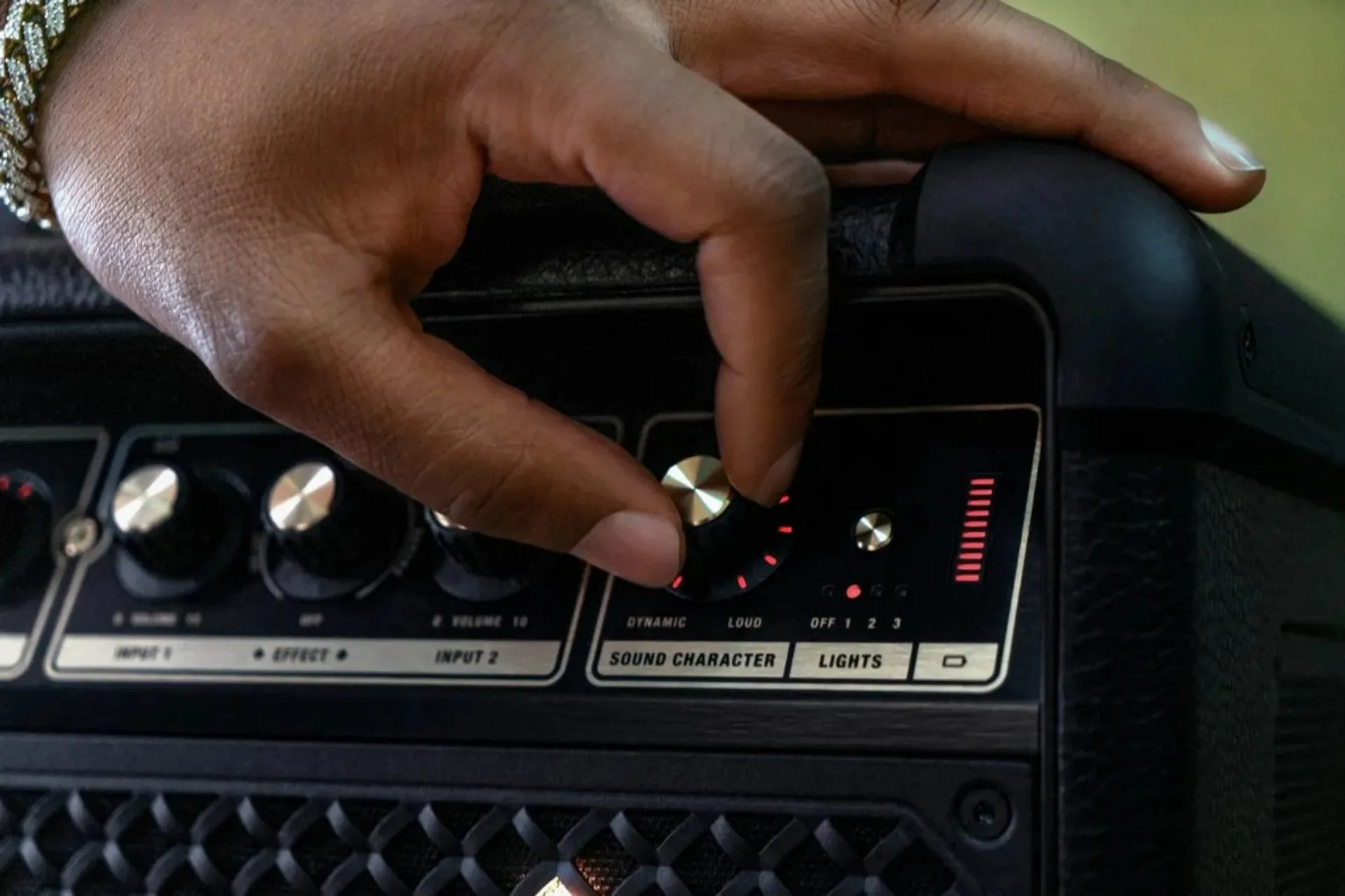
The top panel is the product’s personality. Marshall documents:
- Volume, bass, treble and Sound Character — Marshall describes this as adjusting tone to the pace of the party (shaping how the system presents dynamics at different listening levels).
- Power, source selector, media transport (play/pause, skip), customizable M button (default tied to lighting behavior).
- Per-channel level for two inputs plus shared effect control for those channels (Marshall positions this for performances alongside playback).
- Light mode cycling and battery indicator.
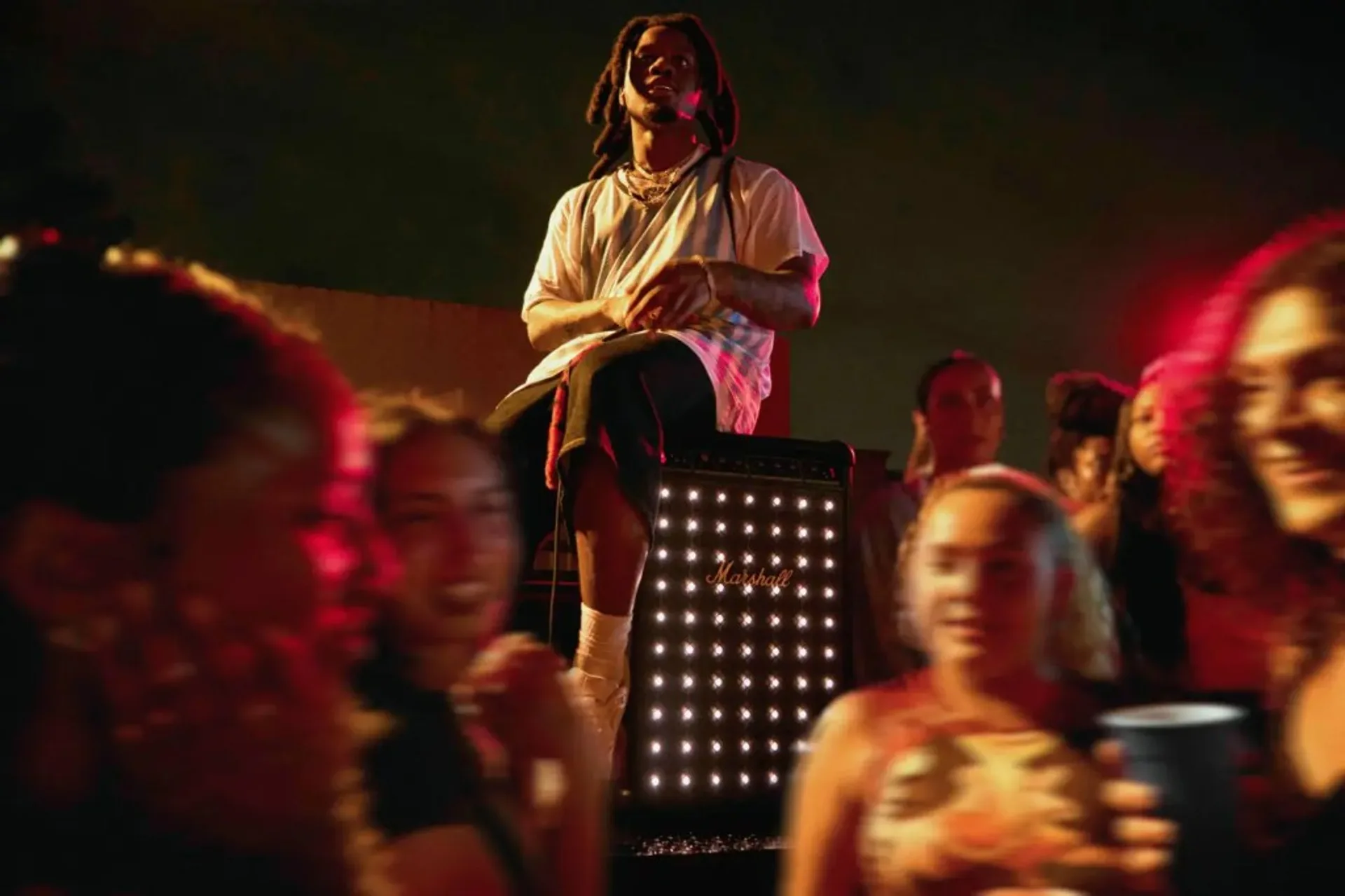
Lighting is stage-inspired warm white (three presets, audio-reactive option) rather than full RGB disco — Marshall is leaning concert rig, not night-club laser.
Wired connectivity includes 3.5 mm aux in and out (daisy-chain), RCA, USB-C (charge in/out), and two XLR / 6.35 mm combo jacks for mics or instruments — karaoke, speeches, or a quick guitar pass-through without pretending the cabinet is a tube amp.
Battery & charging
Marshall’s headline is 40+ hours of playtime from a rechargeable, user-replaceable LFP (LiFePO4) pack. Quick-charge claims: about 20 minutes on cable for roughly 5 hours of playback; full recharge about 3.5 hours. The battery module includes USB-C for charge in and power out (5 V, 3.0 A cited), so you can top up a phone or charge the pack away from the main speaker without moving the whole cabinet.
Mains operation supports 100–240 V / 50–60 Hz. In the box: speaker, Bromley battery (installed), mains lead, quick start and safety docs.
Bluetooth, Auracast & wired I/O
Wireless is Bluetooth 5.3 with Auracast and multipoint listed on Marshall’s spec sheet. Quoted range is >70 m in open space — real indoor performance will be shorter. Codec support: SBC, AAC-MPEG 2, and LC3.
If you need the cleanest signal for critical listening, use wired inputs; for a party, AAC from an iPhone is typically “good enough” unless you are chasing audiophile margins at 127 dB — at which point room acoustics and neighbor tolerance matter more than bitrate.
App & firmware
Marshall ties the speaker to the Marshall Bluetooth app for firmware updates, status, and configuration that does not require reaching the top panel. Marshall’s materials emphasize hands-on hardware control for tone, levels, effects, and lighting; treat the app as a companion for upkeep and light remote adjustments rather than a full mixing desk. Confirm the latest feature list on Marshall’s site and in-store displays before purchase.
Campaign: Denzel Curry
Marshall’s marketing for Bromley leans on high-energy live performance; Denzel Curry appears as a campaign face, pairing the speaker’s bold visual identity with an artist known for aggressive, detail-rich hip-hop. That alignment is brand storytelling, not a spec — but it signals who Marshall thinks should picture themselves wheeling this thing into a backyard or block party.
Marshall Bromley 750 vs other Marshall Bluetooth speakers
The Marshall Bromley 750 sits at the large-party / event end of the lineup: wheels, 127 dB-class marketing, XLR inputs, and stage lighting are the differentiators. Smaller models such as Marshall Emberton II (and the current Emberton generation) target pocket-to-backpack portability and IP67-class outdoor use, not filling a yard with SPL. Middleweight portables like Middleton or Tufton still prioritize carry-friendly shapes and simpler I/O; none of those replace a Bromley if you need dual mic/instrument channels and concert-style top-panel mixing at scale.
If your use case is desktop or shelf listening in a room, Acton / Stanmore / Woburn mains-powered home speakers remain the logical branch of the catalog. Choose Bromley 750 when the brief is one cabinet, many people, indoors or out, and you are willing to trade size and weight for output and inputs. For a full model-by-model breakdown, start at Best Marshall Bluetooth Speakers and cross-check current SKUs on Marshall’s site.
Specification summary
Condensed from Marshall’s published specifications.
| Category | Details |
|---|---|
| Drivers / amps | 2×10″ woofers, 2×5.25″ mids, 2×1″ + 2×0.8″ tweeters; Class D amplification as listed in guide body |
| SPL / response | 127 dB @ 1 m (max); 20 Hz–20 kHz stated range |
| Battery | 40+ h; removable LiFePO4; ~20 min quick charge → ~5 h; ~3.5 h full; USB-C in/out 5 V 3.0 A |
| Size / weight | 652×413×355 mm; 23.9 kg unit / 33.5 kg boxed |
| Durability | IP54; repairability listed yes (Marshall sheet) |
| Wireless | Bluetooth 5.3; Auracast; multipoint; codecs SBC, AAC-MPEG 2, LC3 |
| Wired | 3.5 mm in/out, RCA, USB-C; 2× XLR/6.35 mm combo (mic/instrument) |
| Finish | Black and brass |
Who should buy the Marshall Bromley 750?
Consider the Marshall Bromley 750 if you want a statement party speaker with Marshall heritage styling, serious output, mic/instrument flexibility, and battery logistics that are smarter than “carry the whole cabinet to the outlet.”
Think twice if budget is primary (the segment has cheaper big-box options), if you need maximum RGB light shows, or if you expected hi-res Bluetooth codecs on the published spec sheet. Also respect the weight and shipping class — this is not a one-hand grab like an Emberton.
FAQ
Is the Marshall Bromley 750 waterproof?
It is IP54 (dust and splash resistant per Marshall). That is not submersion-rated; treat it as outdoor-tolerant, not pool-float.
Can I replace the battery myself?
Marshall specifies an exchangeable / replaceable battery pack. Always follow official instructions and use genuine parts where available.
Does it support stereo pairing like smaller Marshalls?
Marketing emphasizes True Stereophonic from one unit and wired daisy-chain via aux. For Bluetooth stereo pairs, confirm current firmware and app notes on Marshall’s page- features evolve.
What codecs does Bromley 750 use over Bluetooth?
Per Marshall: SBC, AAC-MPEG 2, and LC3. There is no manufacturer claim of LDAC or aptX Adaptive on the spec sheet we used.
How loud is the Marshall Bromley 750?
Marshall lists maximum 127 dB sound pressure level at 1 m on its published specifications. Real listening level depends on content, EQ and Sound Character settings, and placement; always follow safe listening guidelines.
Does the Marshall Bromley 750 support Auracast?
Yes per Marshall’s spec sheet: Bluetooth 5.3 with Auracast listed alongside multipoint. Confirm device and firmware compatibility on Marshall’s product page before buying for a specific broadcast use case.
What is in the box with the Marshall Bromley 750?
Marshall lists: the speaker, Bromley battery (pre-installed), mains lead, quick start guide, and legal & safety documentation. Regional SKUs can vary slightly; verify the “in the box” list for your country before checkout.
Sources
- Raw Gear Lab, Best Marshall Bluetooth Speakers Compared
- Raw Gear Lab, Marshall Emberton II Review (2026)